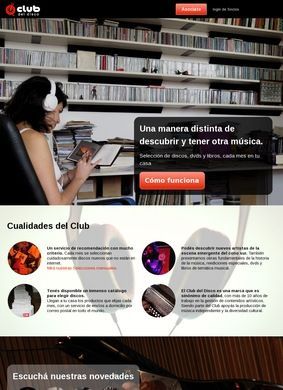
Where does a small label go when its music is tango, jazz, and the newer Latin American sounds that never fit a big-box catalog? Club Del Disco has answered that by building its own shop. It presses and sells vinyl and CDs, runs a new releases section, and gives its artists their own profiles, so the label and the storefront are the same place. Names like Alfonso Barbieri, Sebastian Tozzola, and Emilio Solla sit on the roster, each with a dedicated page instead of a single undifferentiated list.
The pricing is honest and easy to read: roughly three to twenty-eight euros, which tracks with what a physical record costs from an independent operation. There is a newsletter that hands over a twenty percent discount to new subscribers, and a gift music option for buying a record for someone else.
That is a modest set of ideas, executed plainly, and the whole of what Club Del Disco puts in front of a first-time visitor rests on those few moving parts. Nothing here strains to look bigger than it is. The newsletter discount is a common hook, and this one delivers, and pairing it with the gift option points to a label that expects some of its buyers to be giving these records away as much as keeping them.
How the shop and the roster fit together
Two storefronts run in parallel. One serves European customers with international shipping, and a separate one handles domestic Argentine purchases. That split is a practical answer to a real problem, since shipping vinyl across an ocean is expensive and slow, and keeping a local Argentine channel open means the artists' own country can buy the pressings without the penalty. It is the sort of arrangement that shows the people behind Club Del Disco thinking about buyers on two continents rather than only the ones nearest the warehouse.
The label sits in Spain, in Vilassar de Mar just outside Barcelona, while the music it carries leans hard toward Argentina and the wider region. That geography is the whole shape of the operation: a Catalan base pointing its catalog south. The Facebook description calls Club Del Disco an "Innovative Music Club & Record Label," and the club framing shows up in the subscription idea, where a buyer signs on for vinyl or CD shipments over time instead of hunting title by title.
A club that ships records to members on a schedule is a different promise from a shop a buyer visits when the mood strikes, and Club Del Disco clearly wants to be the former.
How well that promise holds depends on cadence, on records arriving often enough to justify a standing commitment. The site does not spell out how frequently a subscriber hears from Club Del Disco, and that is the one place where the club language outruns what a visitor can verify from the pages alone. A curious buyer would want to ask before subscribing.
New releases and the artist pages
The new releases section is where the label shows its pulse. It is the part of the site that changes, and for a catalog this size that section does a lot of the work, because a visitor lands there to see whether anything has moved recently. Alongside it, the individual artist profiles turn a purchase into something with a face attached. A record from Emilio Solla is presented as Solla's, not as a stock number, which fits a label whose whole pitch rests on the specific musicians it champions.
Depth is the honest question here. Three artists named in the brief is a starting roster, not a deep back catalog, and a browser who arrives at Club Del Disco expecting hundreds of titles will find a tighter selection than that. For the styles involved, tango and contemporary Latin jazz being niche to begin with, a curated shelf is closer to the point than a warehouse would be. What Club Del Disco sells is judgement about a narrow field, and the small roster is the visible cost and benefit of that.
Buying, subscribing, and reaching a person
The commerce mechanics are all present and unremarkable in the good sense. At Club Del Disco a buyer can pick up a single record, buy one as a gift, take the newsletter discount, or commit to a subscription. None of it is clever for its own sake. It reads like a shop run by people who wanted their own music sold their own way and built exactly the tools that took, which is a fair description of what Club Del Disco is.
Finding a human is genuinely easy. There are two email addresses on the site, a Spanish phone number, a full street address in Vilassar de Mar, and a contact page sitting right in the navigation. That is more openness than a lot of small labels bother with, and the physical address in particular does something for trust, since a real building in Barcelona is harder to walk away from than a lone web form.
The Facebook page for Club Del Disco also lists an Argentine phone number, which lines up with the two-country setup and does not contradict anything on the main site. Between the Spanish and Argentine numbers, both halves of the operation are reachable.
What the search turns up, and does not
A search for independent voices mostly drags up unrelated disco nightclubs and dance venues in places like Chicago and San Diego, plus a separate Madrid group with a similar name, none of which are this label. The two hits that do belong to Club Del Disco are a Discogs page and the Facebook presence, and both are the label's own footprint rather than an independent chorus of buyers.
Neither carries a verdict from customers. The Discogs page lists the discography but shows no rating, and the Facebook page reads "Not yet rated" with zero reviews. So there is no crowd to point to, positive or negative, and a shopper who leans on star counts before spending will not find any attached to Club Del Disco here. That absence is worth naming straight. The label documents itself well, yet it has not gathered the third-party feedback that would let a stranger cross-check the experience against someone else's.
Discogs is the more useful of the two for a serious buyer. A documented discography on that platform is how collectors verify pressings, catalog numbers, and what a label has actually put out over time, so the Club Del Disco entry there does real work even without a review score beside it. For music this specialized, that record says more than a handful of star ratings would. It also means the discography of Club Del Disco can be checked against a neutral database, which is a form of accountability of its own.
Club Del Disco is a focused operation. The catalog is narrow by design, the styles are specific, the contact trail is complete, and the two-storefront structure answers a real shipping problem for a label whose artists sit an ocean from its Spanish base. What it lacks is any accumulated public feedback, so the pressings on Discogs and the roster pages are the evidence a buyer has to go on. A newsletter sits on the front page offering twenty percent off the first order.