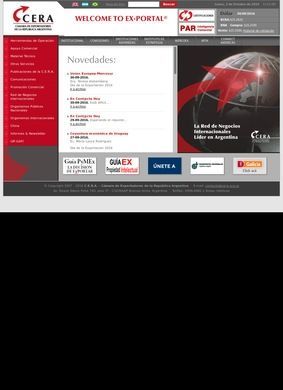
Issue 213 of "Cont@cto CHINA", the bulletin tracking the Argentina-China trade relationship, is a useful lens for understanding what CERA does day to day. CERA is the Camara de Exportadores de la Republica Argentina, the national chamber that represents companies sending Argentine goods abroad, and its site is built around the mechanics of exporting, not grand mission statements. The membership base runs past 3,000 companies, a large enough constituency to explain why so much of the material reads like working reference rather than promotion.
Origin certification and daily communications
An exporter visiting for the first time will notice how operational the spread of services is. CERA offers origin certification (certificacion de origen) to members and non-members alike, which is a practical detail worth noting: a firm does not need to join to get a document it needs for a shipment. Alongside that sit the daily sector communications, the Comunicaciones Diarias, plus a weekly newsletter, so the regular drip of customs, regulatory and market news runs on two schedules at once. For a company whose paperwork and timing can decide whether a container clears, that cadence is the substance of the service, not decoration around it.
Membership structure with tiered benefits
CERA structures its membership across tiers, with benefits that scale, and the internal organisation is more elaborate than a single contact form. There are periodic commissions (Comisiones Periodicas) that work through operational and strategic questions, and separate strategic committees (Comites Estrategicos) that take a longer view. That split between the routine and the forward-looking is sensible. Exporters live with both the immediate friction of a single shipment and the slower questions of where a market is heading, and CERA has built distinct bodies for each, not folded everything into one catch-all group.
Education programs and university partnerships
The education programs (Capacitacion) are not an afterthought. CERA runs courses and maintains university agreements (Convenios Universidades), treating export competence as something to be taught formally, not simply absorbed on the job. For a smaller firm trying to build internal capacity, that link to academic partners is a genuine resource, the sort that is hard to assemble independently.
Economic research and trade framework tools
The analytical weight comes from the Instituto de Estrategia Internacional, CERA's economic research institute, which publishes studies through the site. One of its more concrete tools is the Mercosur-EU translator (Traductor Mercosur-UE), aimed at the practical confusion that comes with two large trade frameworks using different terms for similar concepts. A tool like that is narrow and useful at once, which is usually the mark of something built by people who hit the problem themselves. The China bulletin belongs to this same research output, and reaching a 213th issue says CERA sustains its publishing; it does not start series and abandon them.
Advocacy work with government and media
Press presence rounds out the picture. The chamber turns up in outlets such as Revista Megatrade and Ambito Financiero, and it carries advocacy work before government on issues that hit exporters directly, tax rebate policy among them. That advocacy role is the part a single company cannot replicate. An individual exporter rarely gets a hearing on rebate rules; a chamber representing thousands of them can press the point with some force behind it.
Trade infrastructure for export managers
The certification desk, the daily communications, the translator, the bulletins: these are things an export manager would open during a working week, not glossy pages meant to be admired and forgotten. CERA is positioned as infrastructure for a trade community, and the menu of services reflects a chamber that knows its members want documents, data and decisions rather than atmosphere. A listing in a business directory barely hints at what is behind it.
What lies behind the member login portal?
There are limits to what the public surface reveals. Much of the deeper material sits behind a member login portal, so a non-member browsing from outside sees the shape of the offering more than its full contents. The newsletter subscription and the certification access for non-members are the open doors into CERA's regular work, but the richer layers, the commission output, the committee work, the fuller research archive, are reserved for those who have joined. That is a defensible model for a membership body, though it means an outsider has to take some of the value on trust.
How CERA appears in public search results
A search for CERA turns up media appearances and policy citations, which fits an organisation whose audience is other businesses, not the general public. No aggregate platform score was found, and that absence says nothing negative about CERA itself.
Unglamorous work that sustains trade
Taken together, CERA does the unglamorous middle work of trade: certifying origins, publishing market intelligence on a fixed schedule, training the next cohort of export staff, and arguing the sector's case with policymakers. The China bulletin at issue 213, the standing university agreements, and the Mercosur-EU translator are the details that make the breadth feel earned. The site is functional and dense, which fits an organization whose audience comes looking for specific answers.