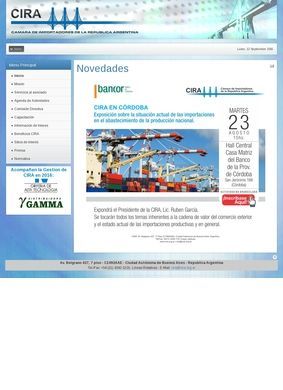
CIRA is the chamber that represents importers in Argentina, a private non-profit that has been running for roughly 114 years. That longevity is the first thing worth registering: an organization does not survive more than a century of Argentine economic turbulence, with all the currency swings and shifting import regimes that implies, unless it is doing something its members keep paying for. The membership it speaks for spans several economic sectors and, taken together, accounts for around a billion dollars in annual imports. So this is not a hobbyist trade group. It sits close to the practical machinery of how goods enter the country.
How CIRA organizes its work
The site organizes its work around a handful of named programs, and they are easy enough to tell apart. CIRACapacita handles training, delivered as distance-learning courses in foreign trade and customs. CIRAEventos covers the seminars and trade events. CIRABeneficios is the member benefits side, the discounts and perks that come with belonging. CIRAInternacional packages international trade advisory and related services. Naming each strand instead of lumping everything under a vague "what we do" page is a small organizational discipline, and it makes the offering legible to someone trying to work out whether membership would pay off for their particular line of business.
Training courses in foreign trade
The distance-learning courses are the part I find most concretely useful for an outsider, because customs and foreign-trade procedure is exactly the kind of subject where formal instruction beats trial and error. Getting a classification wrong or misreading a regulatory change has real cost, and a course run by the chamber that lobbies on those same rules is closer to the source than a generic online tutorial. The brief does not detail course length, pricing, or accreditation, so anyone weighing the training would need to check those specifics directly. What the page does establish is that the instruction exists as a standing program, not an occasional one-off.
News and regulatory reporting
Alongside the courses, the organization publishes a steady stream of news, regulatory updates, and reports. The coverage runs across trade facilitation, customs procedures, international trade negotiations, logistics and port costs, and anti-dumping measures. For an importer, that mix reads like a genuine working agenda rather than padding. Port costs in particular are a perennial sore point in Argentine trade, and an entity that tracks and reports on them is providing something members can act on. The editorial output also doubles as evidence that the chamber is engaged with current policy. A body whose credibility partly rests on being able to influence and interpret the rules needs to be seen doing exactly that.
Strategic axes for member advocacy
CIRA frames its activity around a set of strategic work axes: economics, customs, international negotiations, logistics and ports, and anti-dumping defense. These are not abstract themes. Each maps to a place where an importer can lose money or run into a wall, and the fact that anti-dumping defense gets its own axis tells you the chamber expects to advocate for members facing trade-remedy actions. That advocacy dimension is harder to evaluate from the outside than a course catalogue, but its presence on the strategic agenda suggests the chamber sees itself as a representative voice rather than a pure service provider.
Governance and membership audience
The audience is reasonably well defined. CIRA serves businesses that import into Argentina, across sectors, and the published leadership and institutional governance information lets a prospective member see who is steering the organization. Transparency about governance is a fair thing to expect from a body that claims to speak for an industry, and CIRA puts it on the table. There is also a sponsorship track for companies that want visibility with the importer community, which is a sensible way for a membership organization to fund itself without leaning entirely on dues, though it does mean some of the visibility on offer is paid placement.
What remains behind membership walls
Where I would temper expectations is on the depth a casual visitor can actually verify. The structure is clear and the programs are named, but much of the real value sits behind membership or requires direct contact to assess properly: what a CIRABeneficios membership saves you, how rigorous CIRACapacita is, how effective the advocacy has been on a given regulatory fight. The public face tells you the chamber is organized, active, and long-standing. It does not, on its own, prove the outcomes. For an importer operating in a market as regulation-heavy as Argentina, the natural next step is to engage CIRA directly and find out how it has performed on the issues that cost its members the most.
From century-old track record to outcomes
The verdict is favorable but bounded. For anyone doing real import business in Argentina, CIRA looks like a logical place to start, with training, ongoing regulatory reporting, and a representative voice on customs and port matters all under one roof, backed by a span of operation that few peers can match. For an outside observer who is merely curious, the public material is informative on what exists but light on hard outcomes, so the strongest reason to take CIRA seriously remains its century-plus track record and its evident closeness to the policy machinery that importers have to navigate. Useful, credible, and clearly purpose-built for its constituency, with the caveat that the payoff is best judged from the inside.