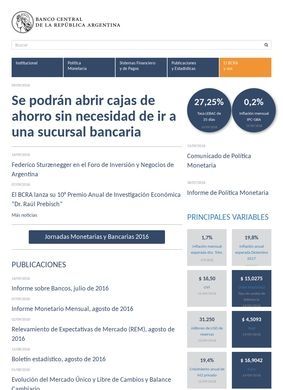
Arriving at the Banco Central De La Republica Argentina website without a specific task in mind is a slightly disorienting experience, because the site is built for people who need something precise: an official exchange rate from a particular date, a regulatory circular, a monetary report, or programmatic access to statistical series. Once you accept that framing, the layout makes sense.
Banco Central De La Republica Argentina is upfront about a point that trips up casual visitors. It states plainly that it does not provide banking or financial services to the general public. There are no accounts to open here, no loans, no cards. Its job is monetary stability and the regulation of the banking system, and the content follows that job closely. The bank supervises every financial entity operating in the country, sets reserve requirements, publishes interest rate benchmarks, and lays down the foreign exchange rules that the rest of the system has to live by.
Exchange rates and monetary policy documents
For anyone tracking the peso, the foreign exchange material is the obvious draw. Banco Central De La Republica Argentina carries foreign exchange market analyses alongside historical exchange rate quotations searchable by date, so a researcher can reconstruct what the official rate was on a specific day rather than guessing from secondary sources. Around that sit the monetary policy communications: monthly reports on how the money supply is evolving, plus the market expectations surveys that economists watch to gauge where inflation forecasts are heading. These are the documents that get cited in news coverage, and going to the source directly is the whole point.
Programmatic access to financial data
The API and data catalog is the feature that sets the Banco Central De La Republica Argentina site apart from similar institutions. It hands out programmatic access to official statistical series covering monetary, financial, and external sector data, which means an economist or developer can pull historical numbers straight into their own tools without scraping a single web page. That capability reframes how you read the rest of the site: this is a working instrument for people who handle Argentine financial data regularly, not a brochure about what a central bank does.
Checking rejected checks and bank fees
Some tools have a more practical, day-to-day flavour. There is a reported checks database, the cheques rechazados registry, searchable by institution, and a banking commission comparison tool that lets someone see what different banks charge. The communications search engine indexes the regulatory circulars and directives Banco Central De La Republica Argentina issues, which matters to compliance staff who need to locate a specific instruction quickly. None of this is flashy, and that suits the audience. People who come here usually know exactly what they are looking for.
Consumer protections for individuals
A notable portion of the Banco Central De La Republica Argentina site is aimed at ordinary citizens alongside the institutions it regulates. The Central de Deudores, the debtor registry, lets individuals request that their data be corrected or deleted, which is a genuine consumer right rather than a formality buried three levels deep. There is a mechanism for submitting complaints about fraud, scams, and disputes over financial products. Financial education resources and consumer protection tools round that out. A retail person who has been mistreated by a bank has a real route here, given how often a regulator's public face is opaque.
Governance structure and operating procedures
The institutional section is exactly what you would expect from a body of this standing: information on governance, the composition of the board, and the legal framework Banco Central De La Republica Argentina operates under. There is also a procedures portal aimed at regulated entities, plus retail payments system reports and a banking holiday calendar. The holiday calendar sounds trivial until you remember that in a country where settlement timing affects real money, knowing when the system is closed carries weight.
Finding the current website address
One detail to flag for visitors arriving from older links or saved bookmarks: the official address has shifted to bcra.gob.ar from the earlier bcra.gov.ar. The reviewed address still points the way, but it is the kind of change that can leave outdated references hanging, so updating any stored shortcuts takes only a moment. For an organisation that publishes data series people depend on, address continuity is part of the service.
Read as a whole, the Banco Central De La Republica Argentina presence is organised by function, and that is its strength. The API and data catalog serve the technical crowd, the exchange rate and monetary reports serve analysts and journalists, the complaint and registry tools serve individuals, and the procedures portal serves the regulated banks. Each audience gets a defined set of resources without the others getting in the way. The site makes no attempt to be friendly in a marketing sense, and given the subject matter, that dryness is closer to a feature than a flaw.
The honest measure of Banco Central De La Republica Argentina is whether the specific thing you need is here and current. If you want the official exchange rate on a given date, the rules a bank must follow, or a way to dispute a financial product, there is a defined path for each. The depth available makes it a useful reference for anyone who deals with Argentine money seriously, and there is enough here to confirm that the published material is primary, not filtered through someone else's interpretation.