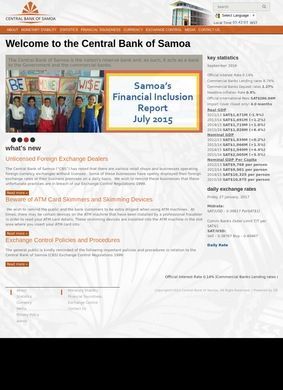
As Samoa's reserve bank, the Central Bank of Samoa issues the country's currency and acts as banker to both the government and the commercial banks. Its website is the public face of that role. The homepage sorts the work into three operational areas, monetary stability, financial stability, and currency services, and most of what a visitor needs branches from those three headings.
For a small-nation central bank the site is more complete than the size of the economy might suggest. Alongside the policy material there is a data dashboard with live economic indicators, a full library of publications, and a regulatory sandbox framework aimed at fintech firms that want to test an innovation under supervision. The Central Bank of Samoa has built the site to serve several audiences at once, and the structure mostly holds that ambition together.
One line in the self-description does a lot of work: the bank is banker to both the government and the commercial banks. That dual role is why a single institution ends up publishing fiscal data, running securities auctions, and supervising the very banks it also serves, and the three-way split on the homepage is the tidy public version of a genuinely tangled job. For a newcomer, reading those three sections in order is the fastest way to grasp what a reserve bank in a small open economy actually does.
Three mandates under one roof
The core of the Central Bank of Samoa sits in three functions, and the site keeps them clearly separated. Each has its own remit, its own publications, and its own audience, and reading them together gives a fair sketch of what a reserve bank in this position spends its days doing.
None of it is written like a business directory entry with a phone number to ring. It reads like the operating record of an institution that other people are required to consult, not court, and the site is built for that role. Each of the three mandates below carries its own publications and its own audience, and together they cover more operational ground than a reserve bank's site usually bothers to expose.
Monetary stability
Monetary stability is the classic central-bank brief: keeping inflation in check and the currency steady. Under it the Central Bank of Samoa handles interest rates, foreign exchange operations, and the securities tenders through which government paper is sold, and it publishes monetary policy statements that set out its thinking. For a researcher or a bank treasurer, those statements are the primary source on where policy is heading, and having them posted openly instead of circulated privately is a point in the site's favour.
The securities tenders are worth flagging on their own. They are how the government raises short-term money and how the bank drains or adds liquidity in the system, and posting the schedule and results in the open is exactly the kind of transparency that lets a market price government paper fairly. It is technical work. For the people who need it, it is the difference between guessing and knowing.
Financial stability
Financial stability covers the health of the banking system itself. Here the Central Bank of Samoa supervises the commercial banks, enforces anti-money-laundering compliance, and oversees the integrity of the wider financial system. This is the regulatory muscle of the institution, the part that decides whether a bank is run soundly and whether the rails money travels on can be trusted. The material in this section matters most to the institutions being supervised, though the anti-money-laundering rules reach any business that has to comply with them.
The public-facing value of this work is easy to underrate. When the Central Bank of Samoa signs off on the soundness of the banks and the integrity of the anti-money-laundering regime, it is underwriting the confidence that lets ordinary depositors and foreign correspondents deal with the system at all. The rules posted here are the visible half of that job, and a compliance officer at a regional bank will read them as obligations, not background reading.
Currency services
Currency services is the most tangible function, and the one an ordinary member of the public is most likely to want. The Central Bank of Samoa issues and manages the national currency, produces collectible coins and banknotes, and runs the anti-counterfeiting measures that keep the money credible. For a collector, the commemorative coins and notes are the draw; for everyone else, this is the quiet machinery that makes the cash in a wallet worth what it says.
Anti-counterfeiting rarely gets a heading on a website at all, and its presence here says the Central Bank of Samoa treats the credibility of physical cash as an active job rather than a settled one. In an economy where notes and coins still do a lot of the daily work, that emphasis is sensible.
Publications, data, and public tools
Past the three mandates, the Central Bank of Samoa puts real effort into publishing what it knows. The volume and range of documents are the strongest reason for an outsider to visit, and they go well beyond a token annual report.
That effort spans reports, live data, and tools built for people who are not economists by training. A dashboard sits next to the bulletins, a sandbox sits next to the compliance rules, and an FAQ sits next to all of it, so none of the material is reserved only for specialists who already know where to look.
Reports, bulletins, and the data dashboard
The Central Bank of Samoa keeps a deep publication list. Annual reports give the yearly overview; quarterly bulletins break the economy down by money and banking, trade, government finance, and prices; and specialised reports tackle financial inclusion, monetary developments, and sector assessments one subject at a time. Economic statistics are provided directly, including inflation rates, GDP figures, and exchange rates, so a user can pull a single number without reading a whole report to find it.
What stands out across all of it is the discipline of keeping the material current and sorted by subject. A reader after trade figures does not have to dig through a banking bulletin to reach them, because the quarterly series splits those apart. That editorial care is easy to overlook and genuinely useful.
Depth over time is the quiet advantage of a site like this. A quarterly series that has run for years becomes a record a researcher can track a trend across, and the Central Bank of Samoa keeping the back issues available is what makes that possible. A single snapshot tells you where things stand; the archive tells you how they got there.
The dashboard is the modern touch. Real-time economic indicators sit in one place, which turns the Central Bank of Samoa site from an archive into something closer to a live reference. Two other features round out the public-facing side: a regulatory sandbox that lets fintech companies test new products within a controlled framework, and an FAQ section written to explain the bank's work to people with no finance background. That last one signals a real attempt at public education from the Central Bank of Samoa, a step past the disclosure aimed only at specialists.
Who should consult it, and where to start
The audiences the site serves are easy to list because the content is built around them. Policymakers and government officials come for the policy statements and the fiscal data. Commercial banks and financial institutions come for the supervisory rules and compliance guidance. Academic researchers and students come for the statistics and the historical bulletins. The general public comes for currency services and the plain-language FAQ, and international stakeholders tracking the country's finances come for the reports that let them monitor Samoa from a distance.
Serving that many readers from one site is a real demand, and the Central Bank of Samoa meets most of it without forcing any single group to wade through material meant for another.
Whether it is worth consulting depends on which of those readers you are, and for most the answer is yes. A student writing on the Samoan economy will find the primary numbers here that secondary sources only summarise. A treasurer or a compliance officer at a regional bank will find the rules and the rate decisions that govern their work. The obvious first move for either is to open the data dashboard for the current indicators, then pull the latest quarterly bulletin for the detail behind them.
For anyone who needs authoritative figures on Samoa's economy or its currency, the Central Bank of Samoa is the source the others are quoting, and going straight to it saves a step.