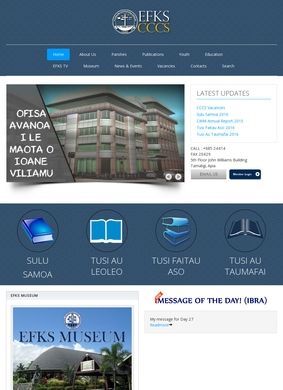
What does a national church put online when it is trying to serve members on three continents simultaneously? EFKS CCCS, the web home of the Congregational Christian Church in Samoa (Ekalesia Fa'apotopotoga Kerisiano o Samoa), treats its site as a working hub for one of the largest Protestant denominations in the country. This is the umbrella body overseeing member congregations across Savaii and Upolu, and the page is built to speak to those congregations as well as to diaspora communities in New Zealand, Australia, and the United States.
Standing committees define church governance
The governance material is where the site does its most useful work. EFKS CCCS lays out the church's structure through its standing committees, covering elders, education, missions, and finance, so a member can see who holds responsibility for what. That administrative transparency is the practical backbone of an organisation this size, and it tends to be the thing congregants and clergy come looking for, well ahead of devotional reading. The body coordinates parishes nationally and internationally, and the site reads as the place where that coordination gets recorded. For a member trying to follow a decision back to the committee that made it, naming the committees by remit gives them somewhere concrete to start.
Training pastors and scheduling church calendars
Ministerial formation runs through Malua Theological College, which EFKS CCCS presents as the training ground for its pastors. Alongside it sits a Christian education system with school calendar resources, tying the denomination's teaching work to a published schedule instead of leaving it as an afterthought. A family tracking the academic year of a church school has a concrete starting point here, and so does anyone weighing a call to ministry.
Publishing magazines and devotional guides
Publishing is a genuine strength. There is Sulu Samoa, the church magazine, and Tusi Au Leoleo as a newsletter, both aimed at keeping the wider membership current. The devotional shelf goes further: Tusi Faitau Aso offers daily readings, Tusi Au Taumafai gathers motivational texts, and Tusi Lotu Talosaga works as a prayer guide. Holding that many titles in active circulation says something about how seriously the church takes the written word as part of worship, and it gives a reader several distinct ways in depending on whether they want news, daily structure, or guided prayer.
Broadcasting services beyond the congregation
Beyond print, EFKS CCCS reaches outward through a TV channel that extends services and programming to members who cannot be physically present, a real consideration when a large share of the congregation lives overseas. A church museum sits in the mix too, pointing to an institution conscious of preserving its own record, and the news and events listings keep the calendar moving. Youth programs round out the pastoral side, giving the next generation a named place in the structure.
Posting job vacancies for staff
There is even a practical, secular corner: job vacancies are posted, which is the sort of detail that makes a denominational site useful to its own staff and to people hoping to work within the church. It shows EFKS CCCS doing the unglamorous administrative jobs a national body needs done.
What holds this site together?
The breadth is the headline. EFKS CCCS is trying to be the single online point of reference for governance, training, education, publishing, broadcasting, heritage, and employment under one roof, and it organises those strands well enough that a visitor can find the one they came for. Information is grouped under clear menu sections, including an About Us area that gathers the institutional material, so navigation does not demand much guesswork. For a church serving congregations spread across the Pacific and three continents, that consolidation is the whole point.
If there is a limitation worth naming, it is one of emphasis: the site is built to inform and coordinate, so a first-time visitor with no prior connection to the denomination will get more from the structural and publishing sections than from anything resembling an introduction to the faith itself. That is a fair trade for an institution whose primary audience already belongs to it, and EFKS CCCS clearly knows who it is talking to.
A search for independent ratings or reviews of EFKS CCCS turns up nothing on the usual platforms, which is not surprising for a denominational body whose relationship with its members runs through direct congregation involvement rather than public review sites. The site itself is the evidence, and on that basis EFKS CCCS makes a reasonable case for being the reliable coordination point it sets out to be. Members of a Samoan congregation, whether at home or in the diaspora, have enough here to track committee work, read Sulu Samoa, or follow a service on the church channel without needing to look elsewhere.