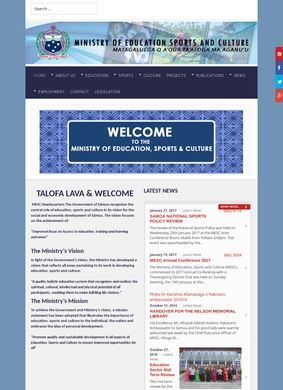
Past papers for four separate national examinations sit on this site as direct downloads: the Samoa School Leaving Certificate, the Samoa Secondary Certificate, the Samoa National Junior Secondary Certificate, and the Samoa National Assessment for Primary Education. That alone tells you what MESC is really for. As the Ministry of Education, Sports and Culture, the body that runs formal schooling across Samoa from the early years through to the end of secondary, MESC maintains a platform that has to serve teachers and students every term, not a glossy front built to impress visitors.
Curriculum, textbooks and teacher forms
The remit covered here is wide. The ministry administers Early Childhood Education, primary, and secondary schooling, and the site groups its material around the practical needs of each. Curriculum design and the supply of instructional materials sit alongside the examinations function, and the two clearly feed each other. A student preparing for the SSLC can pull the relevant past papers; a teacher can reach textbooks, school calendars, and timetables in the same place. The administrative forms aimed at teachers are also published openly, which means MESC treats its own staff as a primary audience, not an afterthought.
Audience across the school system
The answer that comes through when you look at who this is built for is everyone inside the Samoan school system at once, which is a hard balance to strike. Parents want term dates and a sense of how assessment works. Students want the exam papers and the textbooks. Teachers need registration details, professional development resources, and the forms that keep a school running. School administrators want the operational and facilities side. MESC tries to hold all of these on one platform, and the breadth is the point: a single official source beats a scatter of unofficial copies passed around between schools.
College portal and IT helpdesk
There is a College Portal built for student and institutional use, which moves the platform past being a simple download library into something closer to a service platform. An IT HelpDesk runs through Spiceworks, a sensible choice for a ministry that has to field technical questions from schools across the country without building its own ticketing tool from scratch. These two pieces matter because they show the ministry thinking about the day after a form is submitted or a portal login fails, which is exactly where a lot of government sites quietly give up.
Registering teachers, building professional skills
Teacher registration and professional development are core functions, and putting the paperwork for them online removes a layer of friction that, in a country spread across islands, is far from trivial. Inclusive education programs are part of the brief too, and ICT in education initiatives appear as a stated priority, which fits a ministry plainly trying to push more of its operation onto digital rails.
Examination archives across four certificates
If one function defines the public face of MESC, it is examinations. Four certificates, each with its own past papers available to download, is a serious commitment to transparency in how Samoan students are assessed. A junior secondary candidate, a school-leaver, and a primary pupil all have something concrete to work from. For a self-directed student, free access to genuine past papers is worth more than any amount of advice about study habits, and MESC hosts them as a matter of course rather than gating them behind a registration wall.
Calendars, timetables, textbooks online
The same openness extends to the everyday scaffolding of a school year. Calendars and timetables are published, so families and staff are working from the same dates. Textbooks are reachable without a request process. None of this is flashy, and it is not meant to be. It is the infrastructure a national education system needs to function, set down in one place so that a school on a smaller island has the same reach as one in Apia. MESC made a deliberate choice to publish rather than protect this material, and that choice has real practical weight.
Beyond schooling, MESC also carries the Sports and Culture portfolios at national level. The site does not give those areas the same depth as education, so it is fair to read the teaching and examination content as the dominant part of what is on offer here, with sports and culture sitting alongside as part of the wider mandate. The ministry also works with international development partners on education reform and capacity-building, which places its work in a longer arc of system change and not year-to-year administration alone.
Few education ministries make all four of their national examination archives downloadable, add textbooks and forms, and then layer a student portal and a helpdesk on top. MESC does all of this without requiring an account to access most of the content, which is a genuine advantage for students and teachers in lower-connectivity environments who cannot afford a failed login to block their work. The depth of what is published here is where this platform earns its credibility as a public resource.
Where I would temper expectations is on polish and discoverability. A platform that tries to be exam archive, textbook library, calendar, forms repository, portal, and helpdesk all at once can become hard to navigate, and the breadth that is its great strength is also the thing most likely to bury a useful page two clicks too deep. The published record gives no detail on how cleanly the navigation pulls these threads together, so a first-time visitor may need patience to find the precise paper or form they came for.
The sports and culture side is the other open question. As the national authority for those portfolios, MESC presumably carries material on them, but the weight of the site sits firmly on education, and anyone arriving for cultural programming or sports administration may find less to work with than a student would. That is not a flaw so much as a reflection of where the ministry's daily work concentrates.
Taken whole, this is a useful and genuinely functional government resource. Its value is highest for the school-system audience it most directly addresses, and lighter for the broader portfolios it nominally covers. Still, the openness of the examination archives, the textbook access, and the operational clarity MESC provides make it a worthwhile reference even for those with only a passing connection to Samoan education. The published content is substantial enough to draw a fair conclusion: MESC delivers on the core promise of a public education ministry's website.