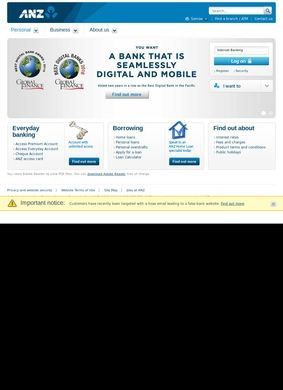
ANZ is the Australia and New Zealand Banking Group, one of the largest banks in the region, and this part of its site covers personal banking for customers in Samoa. It reads as a regional slice of a much bigger global operation, which shapes both what the page does well and where the template shows its limits. Everything a retail customer in the Pacific would look for sits here in some form, from an everyday account to a home loan, laid out under the same corporate template ANZ uses across its markets.
The Samoa section is aimed squarely at ordinary customers first, with a business tier running alongside it. That split is sensible, and it is the natural way to walk through what the site offers, whether a visitor lands here from search or from a business directory entry pointing at ANZ's Samoa page.
Everyday accounts and the cards behind them
The foundation is the standard transaction account, the day-to-day account most people open first. It comes paired with the ANZ Visa Debit Card, which is the piece that actually matters for a customer buying groceries or paying online, since a Visa debit card works far beyond Samoa's shores.
Backing that up are ATMs and EFTPOS services, the physical rails that let cash come out and card payments go through at the shop counter. In a country where cash still moves a large share of daily trade, that ATM and EFTPOS network is the part of ANZ most customers touch every week, and the account only works as well as those machines are maintained.
For a market the size of Samoa, having a Visa-branded debit card tied to a local account is a genuine convenience, because it plugs a small Pacific economy into a global payment network without the customer needing a separate travel card. Savings and investment products sit next to the transaction accounts, framed around helping customers reach specific financial goals. The site keeps that description fairly general, so a saver would need to read the actual rates before judging whether the return is worth parking money there.
This is a recurring pattern across the ANZ pages: the products are named clearly, the specifics wait behind a link.
Internet banking and the Pacific app
Two digital channels carry most of the ongoing relationship. ANZ Internet Banking handles the browser side, and the ANZ Pacific App covers phones, with both built around account management, bill payments, and balance checks. That is the core of what most people do with a bank between visits, and having a dedicated Pacific app instead of a generic global one suggests ANZ has at least tailored the mobile experience to this set of markets.
How well that app actually performs is the part a static product page cannot answer. A banking app lives or dies on reliability and on how it copes with the patchy connectivity common across the islands, and none of that shows up in a feature list. The promise is reasonable; the proof would be in daily use. Bill payments and quick balance checks are the features people lean on hardest, and those are precisely the ones a poor connection punishes first.
Borrowing, from home loans to personal credit
Lending is where a bank of this size tends to pull ahead of smaller local competitors, and ANZ puts a full spread on the table. Home loans come with guidance through the buying process, which is a useful gesture for a first-time buyer who has never dealt with a mortgage before. Personal loans cover the smaller, shorter borrowing most households need at some point. Business lending and overdrafts round out the credit side for customers who run something of their own.
The home-buying guidance is the part I would single out as the most customer-friendly touch here, since a first mortgage is exactly the moment when a bank's willingness to explain, step by step, earns real trust. Whether that guidance is substantive or just a basic walkthrough is another thing the page alone will not settle.
Home loans and the buying process
Framing the home loan around the buying journey, with the interest rate as only one piece of the picture, is a smart choice for this audience, and it is a good example of how ANZ pitches its lending to first-timers. A prospective buyer in Samoa is often navigating land, family, and financing questions all at once, and a bank that positions itself as a guide through that has picked the right emphasis.
The caution is that the page describes the support in broad strokes. There are no worked examples, no calculators visible in the description, and the real terms live in the separate fee schedules and interest-rate pages. A borrower will still need to do the arithmetic themselves before taking out a loan, and the guidance is a starting point rather than a substitute for that homework.
The business tier and the fine print
Beyond personal banking, ANZ carries a proper business offering on the same site. Business transaction products and merchant EFTPOS services handle the everyday cash flow of a shop or company. More telling for a bank operating across borders, it offers international and trade financing along with treasury and foreign-exchange services, which are the tools an importer, exporter, or larger firm in Samoa genuinely needs and rarely finds at a purely domestic lender.
That trade and treasury capability is the clearest sign of what a multinational brings to a small market. A local business dealing in Australian dollars, New Zealand dollars, or US dollars can handle the currency side through ANZ, the same institution that already holds its accounts, and that is a real advantage over a smaller lender without those connections.
Trade finance and treasury for business clients
The foreign-exchange and trade-finance lines deserve their own mention because they are the part of the offering least likely to be matched locally. An exporter shipping to Auckland or Sydney, or an importer paying suppliers abroad, needs settlement, hedging, and financing that reach outside Samoa, and a bank with an Australian and New Zealand backbone is well placed to provide it. This is where the scale of ANZ translates into something concrete for a business customer.
ANZ also serves graduates through a Pacific Graduate Program, a recruitment and training track aimed at bringing local talent into the organisation. It sits a little apart from the product range, but it signals a longer-term commitment to staffing the operation with people from the region, and that kind of commitment tends to show up in service quality over time.
The supporting material is the quiet strength of the site. Product terms and conditions, fee schedules, interest rates, and security and fraud-protection guidance are all published, and that transparency is exactly what a careful customer should look for before opening an account or taking out a loan. Banking documentation is dry, and putting it out in the open is the responsible thing to do, even if almost nobody reads it until something goes wrong. A listing that points a customer toward those documents is doing more good than one that only advertises the products.
What the page cannot resolve is how much of this global polish survives contact with the ground in Samoa. The products are comprehensive and the documentation is honest, yet a regional section of a corporate site tells you what is on offer, not how the account behaves when a payment fails, how long a query takes to answer, or whether the rates buried in those schedules are competitive with the alternatives a Samoan customer actually has. That gap between a complete product list and a lived banking experience is the doubt a reader is left holding.