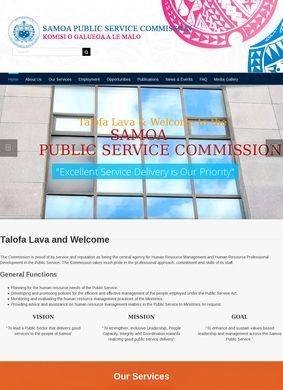
Where does a Samoan public servant go to find a confirmed appointment notice, the latest official circular, or an open scholarship to study in New Zealand? For almost all of it, the answer is the website of the Public Service Commission of Samoa, the agency that runs human resource management and professional development for the country's entire public service. The site pulls those threads together in one place, without making you guess where to click.
Eight divisions managing public service functions
The work of the Public Service Commission of Samoa is split across eight divisions, and the names alone tell you how the commission thinks about its job. Senior Executive Services handles the appointment of senior government roles. Human Resource Management Services covers planning, policy, and monitoring of HR practice across ministries. Human Resource Development Services runs training and professional development. Then come Public Service Policy, Performance and Ethics; Sector Governance, Partnerships and Communications; Legal and Investigation Services; Corporate Services; and the Human Resources Management Information Services group that keeps the HRMIS systems running. It is a full HR function for a national government, laid out so a visitor can see which unit owns which problem.
Employment Portal for vacancies and appointments
The single most practical thing on the site is the Employment Portal. It lists contract, permanent, and project vacancies, and it also publishes provisional and confirmed appointments, internal vacancies, and special advertisements. For someone already inside the service watching for a move, or someone outside trying to break in, that range of listing is genuinely useful. The appointment notices in particular turn the portal into a record of decisions, not a list of openings that may or may not have been filled.
Official circulars and policy guidance
For most routine questions about pay grades, postings, ethics rules, and training, the Public Service Commission of Samoa is the right first stop. It publishes the Public Service Official Circular, the PSOC, on a regular schedule, with Issue 23 for the current year already posted. A circular series like that is the formal channel through which a government tells its workforce what has changed, so having every issue reachable from the front of the site is a practical benefit for anyone whose job depends on staying current.
Scholarships for overseas study
Alongside the circulars sits a Scholarship Opportunities section, and this is where the Public Service Commission of Samoa reaches past its own staff toward the wider public. It covers schemes such as the Samoa Scholarship Scheme, the SSS, with study destinations including New Zealand, Fiji, and others. For a student or a parent, that section answers a concrete question about how to fund overseas study, and it sits on the official source that administers the scheme, so the dates and eligibility rules stay current.
There is also a Publications area and a News and Events portal, which is roughly what you would expect, but the inclusion of an FAQ shows some thought about the person arriving with a half-formed question. The FAQ does the quiet work of catching queries before they escalate, and on a government site that is a genuine courtesy.
One detail worth noting is the Service Charter, offered as a download in both English and Samoan. Publishing the charter bilingually is the right call for an institution that answers to the whole population, and it shows the commission expects ordinary citizens, as well as officials, to read what standard of service they are owed. The fact that it is downloadable means a person can keep a copy and hold the commission to it.
Service Charter with complaint mechanisms
The commission backs the charter with channels that let the public push back. The Public Service Commission of Samoa provides a Customer Complaint Form, reachable both through a QR code and a direct link, and a separate Customer Service Survey. Those two tools turn the charter from a statement into something measurable, because a complaint and a survey are the mechanisms by which a stated standard gets tested against what people experience. Placing the feedback loop directly beside the charter ties the promise to a way of measuring it.
The customer-service posture has a name on this site: the "Talofa with a Smile" initiative, which frames a standard of warmth and courtesy across the commission's dealings with the public. The phrase carries more than goodwill because it sits beside the charter, the complaint form, and the survey, which is to say it comes with the apparatus to back it up. The wording is local and unforced, and it fits an institution that clearly wants to be approachable.
The stated vision is "Public Service Excellence" and the mission is "To Provide Quality Public Services." Those are broad lines, the kind every commission writes, and on their own they would not tell a reader much. What gives them some grounding is everything underneath them on the site: the divisions, the portal, the circulars, the charter, the feedback tools. Read together, the structure is more informative than the mission statement, which is usually how it goes with government bodies.
Serving both government staff and the public
The Public Service Commission of Samoa serves two audiences at once and manages to do right by both. Government ministries and the people who staff them get the HR machinery: policy, appointments, circulars, performance and ethics guidance, and the information systems that hold it together. Members of the public get the parts that touch their lives directly, the scholarships, the bilingual charter, the complaint route, and the survey. A site that tried to serve only the first group would feel closed off. This one keeps a door open to the second.
The clearest strength of the Public Service Commission of Samoa online is that it behaves like a working tool. The Employment Portal is the kind of resource a person returns to, the PSOC archive rewards repeat visits, and the scholarship pages have a clear use for students well outside the public service. Even the FAQ and the survey suggest an agency paying attention to the experience of the person on the other side of the screen.
If there is a limit, it is the natural one for any institutional site: the headline statements stay general, and the depth lives in the documents you have to open. That is the shape of the thing rather than a fault. A vision line will always read like a vision line. The substance is in the circulars and the charter, and the Public Service Commission of Samoa makes both easy to reach.
Weighing the whole, the Public Service Commission of Samoa runs an information resource that does the jobs it sets out to do. It tells public servants where they stand, it tells job-seekers what is open, it tells students how to apply for funded study, and it gives every visitor a way to register a complaint or rate the service. The eight divisions give the organization a clear spine, and the public-facing tools give it a human face. What the Public Service Commission of Samoa has built is a site that answers the practical questions its users bring to it, and that is harder to do well than it looks.