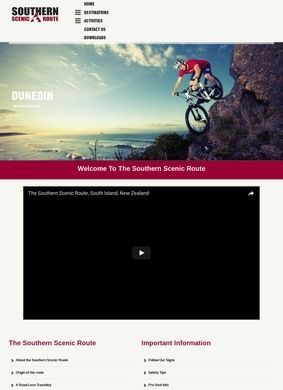
Five separate Regional Tourism Organisations run one website together, which is rare enough to be worth saying upfront. Queenstown, Fiordland, Southland, Clutha, and Dunedin each have their own patch and their own promotional priorities, yet they jointly maintain the Southern Scenic Route as a single planning resource for a 600 km self-drive trip down the southern edge of New Zealand's South Island. That cooperation shows in the coverage. Instead of one region pushing its own attractions and going quiet at the boundary, the site carries the whole road from Dunedin through to Queenstown as a continuous journey. The Southern Scenic Route is, in other words, a route first and an administrative collaboration second, and the website manages to keep the traveller's view on top, not the funder's.
Trip planning for independent drivers
The road itself is the product, and the site treats it that way. It does not sell anything. There is no booking engine, no cart, no checkout for tours or beds. What you get is a trip-planning tool aimed at independent travellers who intend to drive the thing themselves, set their own pace, and stop where they like. The route is pitched at roughly three to five days by road, which is honest framing for a distance that some people will try to rush and probably should not.
Seven regions from Dunedin to Queenstown
Geographically it splits the journey into seven regions: Dunedin, Clutha, The Catlins, Invercargill, Western Southland, Fiordland, and Queenstown. Each gets its own destination guide, so a traveller can read ahead about the stretch they are about to enter instead of discovering it from a fuel-stop pamphlet. Alongside the regional guides sit curated itineraries and activity listings, which is the part that turns a list of place names into an actual plan. Someone with four days and a hire car can read what fits and what does not. The breakdown also makes the scale legible: laid out as seven legs, the Southern Scenic Route stops feeling like an abstract number of kilometres and starts looking like a sequence of days with different characters.
Wildlife sightings with timing and location
The natural draws are specific, and the site names them rather than gesturing at scenery in general. Glacial lakes, sandstone hills, limestone formations, and native forest of beech, rimu, and rata all appear in the descriptions. The wildlife angle is the most genuinely useful part for planning, because it is the kind of thing you organise a day around: yellow-eyed penguins and sea lions are both flagged, and those are sightings with timing and location attached, not guaranteed roadside views. A visitor who knows in advance that these are on the menu can plan stops in The Catlins or near the coast instead of finding out afterward. This is where the Southern Scenic Route does its quiet best work, putting a concrete detail in front of you early enough to act on.
Local history and Maori heritage content
Because the focus stays on the landscape and the driving, the content reads like orientation written for people who have not been before. The seven-region structure means the information is portioned the way a trip is lived, one leg at a time. That is a sensible call for a route this long, where the difference between Dunedin's coast and Fiordland's fjords is the entire point of going. Sections on local history and Maori heritage appear alongside the activity listings, which adds some texture beyond the standard what-to-do rundown. The Catlins section in particular benefits from this: the area has its own pace and character, and the guide reflects that instead of treating it as a throughway between bigger names.
Booking accommodation on separate platforms
The trade-off of being purely informational is that anyone wanting to book accommodation, a Milford cruise, or a guided activity has to leave and do it elsewhere. The Southern Scenic Route hands you the plan and the context, then sends you off to transact on other platforms. For a self-drive audience that is arguably the correct division of labour, since these travellers tend to assemble their own bookings anyway, but it is worth knowing the site stops at inspiration and information. There are also some links to regional operators in the activity sections, so it is not entirely agnostic; it is more that accommodation and transport booking is not centralised here.
Visitor information centres and contact options
Contact is handled in a way that suits what this resource is. The Contact page does not offer a single switchboard so much as a directory of real help on the ground: phone numbers and addresses for i-SITE Visitor Information Centres and Department of Conservation centres at Queenstown, Fiordland, Balclutha, and Dunedin, plus a web form for general enquiries. For a road trip the more valuable contacts are the staffed centres you can ring or walk into along the way, and the page reflects that priority.
From Tripadvisor reviews to traveller feedback
Tripadvisor lists the Southern Scenic Route as an attraction with individual traveller reviews indexed, and the sentiment visible in those snippets leans positive. No overall star figure surfaced, and no other review platform returned anything substantial. That is a modest footprint for a route of this scale, though it fits the nature of the thing: people tend to review the penguins, the cruise, or the town they stayed in, not the road that linked them. The absence of a large rating pile is not a credibility problem here so much as a reflection of how travellers categorise what they enjoyed.
Authority from five regional tourism bodies
The backing is what gives this site its weight. Because the Southern Scenic Route is maintained jointly by the five regional tourism bodies that govern these areas, the information carries the authority of the organisations responsible for the destinations themselves, and the practical contacts point to official i-SITE and conservation staff rather than to resellers. For trip planning, that means the guidance comes from the source, not from an aggregator with an angle. It also explains why the seven regional sections feel evenly weighted instead of tilting toward whichever operator paid the most, which is a common failing on tourism portals and one the Southern Scenic Route avoids.
If there is a limit here, it is the one built into the purpose. The site will inspire you and structure your days, and then you are on your own for the logistics of money and beds. That is a fair division for the audience it courts, and it keeps things from drowning in commercial clutter. Wildlife timing, current road conditions, and local availability change seasonally, so phoning the i-SITE centre in whichever town is your base is a more reliable last step than relying on any website alone, including this one. Read the regional guides, book accommodation independently, and then confirm the specifics by phone. That sequence works, and the Southern Scenic Route is well set up for the first two parts of it.