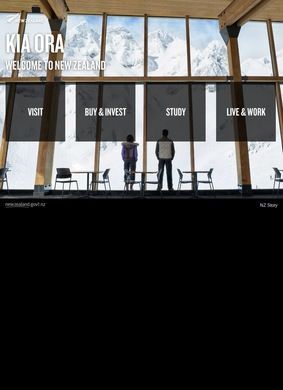
Where does a first-time traveller to New Zealand go to figure out whether the geysers are worth the detour, which island holds the glaciers, and how many days a road trip really needs? Hundred Percent Pure New Zealand answers that with the depth you would expect from the country's own tourism authority. The site is the consumer portal of Tourism New Zealand, the Crown entity that markets the country internationally, running under the long-established "100% Pure New Zealand" campaign that gives the listing its name.
Planning by region and traveller type
The planning material is organised the way a visitor actually thinks. Hundred Percent Pure New Zealand splits the country into the North Island and the South Island, then drills down into regions within each. Rotorua gets its own treatment for the geothermal pools and the steaming earth that defines it. Coastal stretches and alpine country are handled separately, so a traveller weighing beach time against mountain time can see what each part of the map holds without guessing. There is a good amount of regional content that pushes past the obvious stops, off-the-main-road material that tends to get buried on lesser travel sites.
Beyond geography, Hundred Percent Pure New Zealand sorts its content by who is travelling and what they came for. Adventure, culture, nature, luxury, and family each have their own track. Someone chasing bungee jumps and someone planning a quiet family fortnight are looking for different things, and Hundred Percent Pure New Zealand lets each follow their own thread instead of wading through everything. Maori cultural experiences get real coverage here, presented as a central part of the country and not a footnote, and that reflects how Tourism New Zealand has positioned the destination for years.
Interactive maps and ready-made itineraries
The practical tools are a real asset. There are search functions and listings for accommodation, tours, activities, and attractions, so the planning does not stop at inspiration. Interactive maps tie the regions together, and curated itineraries do the heavy lifting for travellers who would rather follow a tested route than build one from scratch. I find the itinerary approach genuinely useful on a country this shape, where distances between highlights are easy to underestimate and a loose plan can quietly eat half a holiday. The combination of browsing by region, by traveller type, and by ready-made route means most people will find a way in that suits how they like to plan.
Market-specific content for different audiences
One detail worth noting is how Hundred Percent Pure New Zealand adapts to where the visitor is coming from. The site is localised for several markets, including the US, the UK, and Australia, so the content, distances, and framing shift to match the audience reading it. A traveller from London and a traveller from Sydney are planning trips of very different scale and cost, and the localisation is not cosmetic; it changes what gets surfaced and how entire sections are framed. For a long-haul destination with audiences spread across multiple continents, that kind of market-specific layering is hard to build and easy to overlook when it works well.
Hundred Percent Pure New Zealand also carries a thread that sits slightly apart from holiday planning: sections covering business and investment information related to New Zealand. It is a smaller part of the whole, pointing to the country as a place to do something more lasting than visit. For most users this will be background noise, but it does broaden the picture beyond pure tourism, and it fits the remit of a national agency with more than visitor numbers to think about.
It is worth being clear about what Hundred Percent Pure New Zealand is and what it is not, because Tourism New Zealand runs more than one web property. The site at newzealand.com is the consumer-facing destination, built for the person dreaming up a trip. Industry, media, and trade resources live on a separate corporate site. Keeping those audiences apart is the right call, and it means the traveller-facing pages are not cluttered with material aimed at tour operators or journalists. The version a holidaymaker lands on stays focused on the holiday.
Reliable information from the official tourism agency
Content quality is high. The destination guides are genuinely informative, the photography supports the text without drowning it, and the structure holds whether someone arrives knowing exactly where they want to go or with nothing more than a vague pull toward fjords and sheep country. Because the source is the official agency, the information about regions, seasons, and what each area offers is as reliable as any single travel site is going to get for this country. A search for independent third-party reviews of Hundred Percent Pure New Zealand as a site turns up very little, which is unsurprising for a national tourism portal people use to plan a trip instead of a service they rate publicly.
Starting point for trip research and bookings
There are limits to what a national portal can be, and Hundred Percent Pure New Zealand sits at the inspiration-and-planning end of the journey. It will point you toward operators and accommodation and hand you a route, but the actual booking and fine logistics still happen elsewhere, through the providers it lists or third-party platforms. That is the normal division of labour for a tourism board. Treated as a starting point, Hundred Percent Pure New Zealand does the heavy front-end work of turning a country-sized question into a shortlist of regions and a draft itinerary.
The strongest reasons to start at Hundred Percent Pure New Zealand are the breadth of regional coverage, the way it slices content by interest, and the itineraries that account for New Zealand's real geography. The off-the-beaten-track regional material gives it an edge over the generic round-ups that recycle the same five attractions. The Maori cultural content is substantive rather than decorative, and the market localisation means Hundred Percent Pure New Zealand meets travellers at their own planning horizon rather than assuming everyone is flying from the same city. A visitor weighing North against South, geothermal against alpine, or a fast loop against a slow wander will find the site has already mapped those trade-offs in detail.
Almost everything on Hundred Percent Pure New Zealand pulls toward one outcome: getting a visitor from a vague idea to a workable plan for a country that rewards careful preparation. The regions are mapped, the traveller tracks are drawn, the itineraries are ready, and the maps stitch it together. As a starting point for New Zealand trip research, the site has few peers among free planning resources.