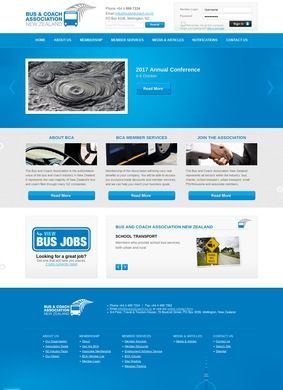
New Zealand's bus and coach operators need someone to speak for them when a new regulation lands or a fuel contract needs negotiating. Since 1931 that role has fallen to the Bus and Coach Association (BCA), the national body that represents operators, vehicle manufacturers, and the suppliers who keep the sector running. The site is built around that single job, and it reads like the working hub of an organisation that has been at this for the better part of a century.
What membership includes
The membership section does most of the heavy lifting, and it is refreshingly specific about what belonging buys you. Discounts on fuel and legal advice are named outright, alongside networking, access to industry events, advocacy on the sector's behalf, and technical guidance. Those are the practical hooks a small charter firm or a regional operator will study when deciding whether the annual cost pays for itself. Rather than gesture vaguely at "the benefits of membership," the Bus and Coach Association puts the concrete items on the table, which lets a prospective member do the arithmetic before they join.
Resources for policy and operations
Beyond joining, the Resources area is where the policy work of the Bus and Coach Association becomes visible. Advocacy and policy material sits here, along with communications and a page dedicated to coach parking information, which sounds mundane until you have driven a fifty-seat vehicle into a city centre and needed somewhere legal to leave it. That kind of narrow, operator-facing detail tells you the content is written by people who understand the daily friction of running these vehicles, down to the awkward practicalities most outsiders never think about.
Industry conferences and networking
There is. Events form a clear strand of their own, covering conferences and networking gatherings where operators, manufacturers, and suppliers meet in one room. For an industry this concentrated, those events are often where the practical business and the harder problem-solving get done, and the site treats them as a standing part of what the Bus and Coach Association does rather than an occasional add-on. An event calendar is one of the more honest signals that a trade body is active, because dormant associations quietly stop scheduling them.
Public shop and newsletter access
A public shop opens the organisation up slightly past its own membership. It lets people purchase items without necessarily being members, a sensible enough touch for an industry body, since not everyone who needs a resource or a piece of merchandise is a card-carrying operator. Paired with the "In the Loop" newsletter subscription, it gives the wider public and the peripherally interested a way to stay connected without committing to full membership. The newsletter option is a low-barrier entry point, the sort of thing that keeps an organisation in front of people who are not yet ready to join.
Behind the member login portal
The member login portal and the About section round out the structure. The login gates whatever the association reserves for paid members, which is standard and expected. The About material carries the organisational background, and this is where the 1931 founding date and the framing as the authoritative voice of New Zealand's bus and coach industry live. A LinkedIn presence extends the whole thing onto a platform where operators, recruiters, and suppliers already spend their professional time, which is a more fitting choice for a trade body than chasing a broad consumer audience.
What I appreciate about the layout is that the sections map cleanly onto what the sector needs. Membership handles the commercial relationship, Resources handles knowledge, Events handle connection, the shop handles transactions, and the newsletter handles ongoing contact. Nothing feels bolted on to pad the site out. Each piece answers a distinct question an operator or supplier might arrive with, and the Bus and Coach Association keeps them separated cleanly enough that you will not end up in one area searching for something that logically belongs in another.
Advocacy as the core mission
The advocacy angle deserves its own mention, because it is the part that justifies a national body like the Bus and Coach Association existing at all. Individual operators rarely have the time or the standing to argue policy with regulators on their own. Pooling that voice is the historical reason associations like this were formed, and the site gives advocacy and policy their own named resource instead of tucking the mention into an about-us paragraph. When the Bus and Coach Association describes itself as the industry's authoritative voice, the policy and technical guidance material on the site is what backs the claim up instead of leaving it as a bare assertion.
There is a clear split between what serves existing members and what serves newcomers or the curious. Members get the login, the fuller resource depth, and the discount arrangements. Newcomers get the shop, the newsletter, the events listings, and enough About detail to understand who they would be joining. That two-audience design is deliberate, and the Bus and Coach Association handles the split without making either group feel like an afterthought. A visitor who has never run a bus in their life can still learn what the organisation is and does within a couple of minutes on the About page.
If there is a limit to what the site does, it is that much of the real value sits behind membership, which is the nature of a trade body and not a flaw. The public-facing pages are a shop window onto a members-only operation, and they are honest about that. Anyone browsing this listing who runs a coach line, builds the vehicles, or supplies the sector will find the Bus and Coach Association is built squarely for them, and the technical and advocacy resources are the reason to look closer.
The site does not try to be a general transport portal or a consumer travel guide, and that restraint works in its favour. It knows its audience is a defined professional community, and every section is pitched at that community. Ninety-plus years in, the Bus and Coach Association presents itself as a working association with membership machinery, live events, policy resources, and a shop, all pointed at the specific people who keep New Zealand's buses and coaches on the road. The coach parking page alone tells you the content comes from people who have actually done the job.