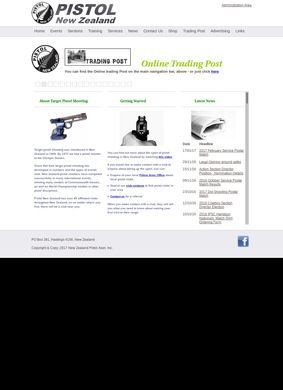
One national body oversees everything from Olympic-grade ISSF target shooting to Cowboy Action Shooting, the western-themed discipline where competitors work through scripted scenarios in period costume. Pistol New Zealand is that body, and the sheer spread of what falls under it is the first thing to register.
Pistol New Zealand is the official national sports association for pistol shooting in New Zealand, sitting over 86 affiliated clubs spread the length of the country. That network is the real substance behind the website. The disciplines, the event calendars and the routes in for new members all run back through those clubs, so the association works less as a destination in itself and more as the hub that ties scattered clubs into one recognized sport.
One association, nine disciplines
Nine is a lot of disciplines for a single governing body to carry, and the nine Pistol New Zealand groups here have little in common beyond the handgun. Holding them together under one membership is the organizing idea of the whole operation, and it is what makes the association a harder one to sum up in a sentence than a typical single-sport body.
They pull in genuinely different directions, from split-second reactive shooting to the kind of slow precision measured in fractions of a ring. Walking the list is the clearest way to see what the sport Pistol New Zealand governs contains, because most outsiders underestimate how wide that range actually runs.
There is a real argument that a single umbrella is what keeps a fragmented, safety-critical sport coherent. Nine disciplines run by nine separate bodies would splinter the rules, the licensing advice and the fixture lists into something no newcomer could navigate. One association keeps all of it under a common standard, and for a sport where the paperwork and safety expectations are heavy, that consolidation is worth more than it first looks.
The nine disciplines
The fast, dynamic end is where a lot of the energy sits. IPSC blends speed, accuracy and power inside a single stage, so a run is judged on how quickly and cleanly a shooter moves through it. Multigun goes further and folds pistol, rifle and shotgun into one combined event. Action Pistol and the Speed and Steel Challenge stay on that same reactive side, built around moving fast and hitting steel.
The other pole is precision, and it is every bit as serious. ISSF is the Olympic and Commonwealth discipline, all control and repeatable technique, and Service Pistol with WA1500 lives in the same exacting territory. Handgun Metallic Silhouette puts knock-down targets out at distance, which rewards a steady hold over any hurry.
Muzzle Loading keeps historic black powder firearms in live competition, a niche inside a niche. Then there is Cowboy Action Shooting, the outlier of the set, more theatre than the rest and none the worse for it. All nine are full competition codes in their own right, and Pistol New Zealand governs each one separately.
For a beginner deciding where to start, that spread is both the appeal and the puzzle. The same licence and the same clubs can open onto wildly different sports, and choosing between them turns out to be less about equipment than about temperament: whether the pull is a stopwatch or a tight group on paper. A single association covering all of it means someone can drift between codes without leaving the sport, trying steel one season and precision the next.
Getting affiliated and getting licensed
Beyond running the sport at the top, Pistol New Zealand handles the practical way in. Club affiliation and membership pathways are set out for people joining or moving between clubs, safety training and firearms-licensing guidance are there for those still working through the paperwork, and beginner introductory sessions give someone with no background a supervised first attempt under club conditions. Competition events and match calendars complete the services, which counts for a great deal in a sport organized entirely around scheduled matches at clubs scattered across the country.
For a newcomer the licensing guidance is probably the single most useful thing on offer. The firearms licence is the wall most people hit long before they reach a range, and having Pistol New Zealand lay out that process, alongside a first supervised session, lowers the barrier that stops most casual interest from going anywhere.
The match calendars are worth singling out too. A shooting season is a long string of fixtures at clubs up and down both islands, and a central calendar is what turns 86 separate schedules into something a competitor can plan a year around. For an active member that coordinating job is close to the entire reason for belonging to a national body, and it is the service most likely to be checked week after week.
Shooters of every age and level
The stated audience is deliberately wide: New Zealand pistol shooters of all ages and experience levels, from a curious first-timer booking an intro session to a seasoned competitor working toward ISSF selection. Pistol New Zealand pitches itself as the common ground for that whole span, and the nine-discipline reach is what lets it make the claim without overreaching.
A teenager drawn to steel challenge and a veteran shooting muzzle-loaders are, on paper, served by the same body. Whether that promise holds in practice depends less on the national office than on the nearest of the 86 clubs, which is where every one of those members actually shoots.
The open question is upkeep. Nine disciplines, 86 clubs and a live match calendar are a heavy load to keep current, and a page that names them all reveals nothing about how fresh those dates are or how fast a beginner's first enquiry actually turns into a booked session at a real club. Pistol New Zealand has the structure mapped out cleanly; whether the day-to-day maintenance keeps pace with that ambition is the one thing the page itself cannot answer, and for anyone weighing up the first step, that gap is exactly what to raise with a club directly.