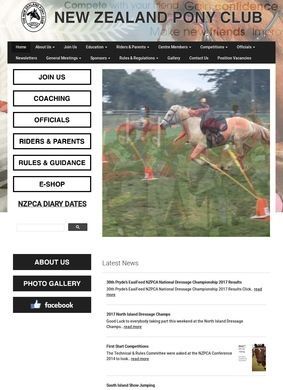
The first pony club in New Zealand opened in 1944, started by a woman named Dorothy Campbell, and two years later the scattered clubs banded together under one national body. That body is the New Zealand Pony Clubs Association, and it has run the country's pony and horse riding clubs ever since. Its early ties were to the British Horse Society and the Pony Club, which is why the whole structure, the certificates, the rallies, the badge ladder, still carries a distinctly British shape.
This is a youth organisation first. The New Zealand Pony Clubs Association is a not-for-profit run largely on volunteer effort, aimed at young people who are keen on ponies and horses and want to learn to ride properly. The stated values are plain: sportsmanship, citizenship and loyalty. Read that as an old-fashioned character brief bolted onto a riding curriculum, which is more or less what the site delivers, and it is a fair description of what pony club has meant to generations of rural New Zealand families.
Learning to ride, and to manage the horse
What separates the New Zealand Pony Clubs Association from a commercial riding school is the emphasis on horse management, beyond time in the saddle. A member is expected to understand the animal, its care and its health, alongside the mechanics of riding it. The teaching side of the site is built around that idea and structured so a child can measure progress in clear stages instead of guessing whether they are improving.
The clearest part of the whole thing, at least after working through most of the site's teaching pages, is the way each level builds on the one before, so the path from nervous beginner to competent horseperson is laid out in plain sight.
That structure is also what lets a volunteer-run club maintain a consistent standard. Instructors change, clubs vary in size, and children come and go, but the syllabus holds the line.
The Certificate syllabus and achievement badges
The backbone is a formal qualification system. The Certificate syllabus sets out graded riding and stable-management standards that a member works through and is assessed against, and a parallel set of achievement badges rewards smaller, specific skills along the way.
It functions like a martial-arts belt ladder for equestrians. A rider always knows the next rung, and an instructor has a shared yardstick to sign off against, which keeps standards consistent from one club to the next across the country. For a parent, that graded system is probably the most reassuring thing the New Zealand Pony Clubs Association puts on the table, since it turns a vague hobby into something with visible milestones.
HorseMasters and the equine skills courses
Beyond the core certificates, the New Zealand Pony Clubs Association runs equine skills courses and a programme called HorseMasters, plus coaching webinars for members who want to go deeper than a weekend rally allows. These fill the gap between raw beginner and competent horseperson, covering the ground knowledge that riding lessons alone tend to skip.
The webinar format is a sensible touch for a membership spread across a country where the nearest expert might be a long drive away, and it lets the Association reach a rider on a remote farm as easily as one near a city.
Competition, from rallies to tetrathlon
Riding to a standard is one half of the offer. Competing is the other, and the New Zealand Pony Clubs Association runs a full calendar of events that gives members somewhere to test what they have learned against their peers.
The competitive side is where the volunteer machinery really shows, since rallies and championships do not organise themselves. Clubs feed into regional and national events, and the range of disciplines is wide enough that a member who dislikes the show ring can still find a place to compete. That breadth keeps children involved who might otherwise drift away once the novelty of a first pony wears off.
Rallies, championships and mounted games
Rallies are the regular local gatherings where instruction and practice happen, and championships sit at the top of the pyramid as the season's proving ground.
Mounted games add a fast, team-based, slightly chaotic option that suits younger riders and keeps the whole thing from feeling like an exam. Between them, these events are the social heart of the New Zealand Pony Clubs Association, the reason a lot of children stay in the saddle past the first hard winter and the muddy early mornings that go with owning a pony.
Dressage, show jumping and eventing
For members chasing the recognised equestrian disciplines, the Association covers dressage, show jumping and eventing, along with tetrathlon, the multi-sport format that pairs riding with running, swimming and shooting. That last one is a proper commitment and marks the New Zealand Pony Clubs Association as more than a casual riding club.
A youngster who works through these disciplines here is on the same pathway that feeds the sport's senior ranks, which is exactly the pipeline a national governing body is supposed to build.
The hubs, the guidance, and a place on the record
Day-to-day, the New Zealand Pony Clubs Association runs on a set of member portals: a Members Hub, a Coaches Hub, an Administrators Hub and a Communications Hub, each pitched at a different role in the organisation. Sitting behind them are resource areas on coaching, on health and safety guidelines, and on horse welfare, which is the part the outside world tends to care about most and the part a governing body cannot afford to get wrong.
There is also an official mobile app, NZPCA by Nominate, for members who would rather run their involvement from a phone than a desktop, which is a practical concession to how a teenager or a busy parent actually keeps track of rallies and results these days.
As an organisation the New Zealand Pony Clubs Association is well documented, down to its own Wikipedia entry, and its long history gives it a settled, institutional feel that a typical business directory entry for a local riding school would not carry. The digital face matches that. It is orderly, role-segmented and clearly built for people who are already inside the tent.
Which is also the honest catch. Most of what makes the New Zealand Pony Clubs Association valuable, the certificate materials, the coaching resources, the hubs, sits behind member logins, so a parent or a curious newcomer landing on the public pages sees the shell of the organisation more than its substance. The structure is sound and the mission is clear.
Whether the site is genuinely useful to you, though, depends almost entirely on whether you or your child has already joined a club, because from the outside it reads more like a members' noticeboard than an open door. The real test of a prospective membership happens at the local rally, on a cold Saturday morning with a pony to catch and an instructor to impress, and a hands-on organisation like this one was probably always going to be judged there rather than on its homepage.