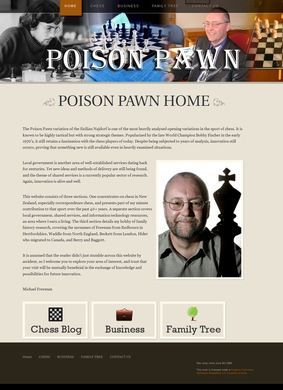
Worth clearing up right away: this is not the official home of the New Zealand Chess Federation. Despite what the listing name implies, poisonpawn.co.nz is a personal site run by Michael Freeman, and the New Zealand Chess Federation itself operates at a separate address. What lands here is a one-man archive that carries a genuine slice of NZ chess history alongside two other subjects that have nothing to do with chess. That mix defines the site, and it sets the tone for everything below.
Freeman has built the place around three interests of his own: chess, his professional field of local government shared services and IT, and his family genealogy. A visitor arriving with the New Zealand Chess Federation in mind needs to know this going in, because the chess material is one third of a personal project rather than a department of an organisation. The good news is that the chess third is the most developed of the three and the most useful, and it is where almost any reason to visit will be found.
Chess history and correspondence play
The chess section leans heavily on New Zealand chess history and on correspondence chess, a discipline Freeman has played for more than forty years. Someone who has stayed inside a niche that long tends to keep records nobody else bothered to keep, and that is roughly what the site offers: game collections, articles on the history of the game in New Zealand, and write-ups of how local players fared at overseas events.
Archived bulletins from the federation
Inside this is a run of archived bulletins and newsletters tied to the New Zealand Chess Federation. The site hosts material such as a Project Grandmaster wrap-up and editorial notes about the New Zealand Chess Federation magazine. For a researcher, an older player, or anyone trying to trace what the New Zealand Chess Federation was publishing in years past, this is the part that justifies the visit. It reads like a personal collection that grew because one person cared enough to hold onto it, and that is a different thing from an official records office, with different strengths and different gaps.
What this site is not
The limitation follows naturally from the same fact. Because the bulletins are curated by an individual, coverage will reflect what Freeman had to hand and chose to keep, not a complete or current run. A reader who needs the latest New Zealand Chess Federation news, membership details, tournament calendars, or anything administrative is in the wrong place and should head to newzealandchess.co.nz, where the New Zealand Chess Federation actually operates. Treat poisonpawn.co.nz as a historical supplement and it delivers; treat it as the federation's front door and it will frustrate.
Family surnames and genealogy research
The second strand is family history. Freeman documents research across a set of surnames, including Freeman traced to Redbourn in Hertfordshire, plus Waddle, Beckett, Hider, Berry, and Baggott. This is the sort of content that means everything to a handful of people and nothing to everyone else. If one of those names sits on your own family tree, the pages could be a genuine find. If not, there is no reason to linger, and the site does not pretend otherwise.
Local government and IT resources
The third strand covers Freeman's professional ground in local government shared services and IT resources. It is the least developed of the three for a general visitor, and it sits on the page mostly because the site doubles as its owner's personal hub. None of these sections sells anything. There are no products, no services for hire, no checkout. That keeps the place honest in one sense, since nobody is being pitched, but it also means the site lives or dies on whether its specific archives match a specific need.
Three distinct topics in one archive
The three-topic structure is the real character of poisonpawn.co.nz, and it is unusual enough to be worth stating plainly. Most sites pick a lane. This one is a digital filing cabinet for one person's distinct interests, and a visitor self-selects into whichever section applies to them. The chess section is deep, the genealogy section is narrow but potentially precious, and the work section is there for completeness.
Evaluating credibility without reviews
On the question of trust, there is not much external signal to lean on. A search turns up no notable third-party reviews, ratings, or write-ups, which is unsurprising for a personal archive that was never trying to attract an audience or sell to one. The absence of reviews is not a mark against the content; it simply means the material has to be judged by reading it rather than by what a crowd has said about it.
Contact is the weaker spot. A "Contact" link appears in the footer, so there is a route in, but the landing page carries no phone number and nothing prominent to tell a visitor who runs the site or how to reach them quickly. For a personal project this is normal, but a more visible contact path would help, especially for a genealogy researcher hoping to compare notes or a chess historian wanting to ask about a source. A first-time visitor may also not realise the New Zealand Chess Federation bulletins here are an individual's archive until they have read a fair way in.
Set against that, the depth of the chess holdings earns confidence on its own. A correspondence player of forty-plus years writing about New Zealand chess history and preserving New Zealand Chess Federation bulletins that might otherwise vanish is offering something concrete. The expertise shows in the subject matter, not in any badge or testimonial, and for this kind of resource that is the right way for it to show.
As a stand-in for the New Zealand Chess Federation, this site fails, because it is not that and never claimed to be once you read past the listing name. As a personal archive of New Zealand chess history, correspondence play, and salvaged New Zealand Chess Federation material, it is a quiet, genuine resource that rewards the narrow group it was built for. The work and genealogy strands are bonuses for the even narrower groups they touch. The chess archive is where the real value sits, and it is substantial enough to be worth the trip for anyone with a genuine interest in the history of the game in New Zealand.