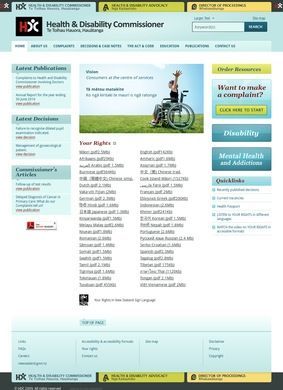
What does a patient in New Zealand do when they feel a hospital, a clinic, or a disability service has wronged them and nobody is listening? The Health and Disability Commissioner is the office set up to take that complaint, look into it, and decide whether a provider breached the rights that every consumer of health and disability services is owed. It is a statutory body, created by the Health and Disability Commissioner Act 1994, and its work is built around one document most people never read until something goes wrong: the Code of Health and Disability Services Consumers' Rights.
Filing a complaint about care
The site is structured around that purpose, and the Health and Disability Commissioner does not pretend to be anything other than a public agency at work. The clearest entry point is the section that lays out a person's rights under the Code, written for someone who has no legal background and is probably upset. From there the path to making a complaint is direct. A consumer can describe what happened and ask the office to step in, and the Health and Disability Commissioner can route the matter toward a quick resolution, formal mediation, or a full investigation depending on how serious it is. That graduated approach is sensible, because not every grievance needs the weight of a formal inquiry, and some plainly do.
Independent advocates support consumers
One feature I found more useful than expected is the advocacy service. The Health and Disability Commissioner appoints independent Health and Disability Advocates, people who sit outside the provider entirely and help a consumer understand their options and push their case forward. For an older person or someone with a disability who finds the whole process daunting, having a free and independent advocate is the difference between a complaint that goes somewhere and one that quietly dies. The site explains who these advocates are and how to reach them, and treats that help as a core service.
Searching the decisions database
A good deal of what the Health and Disability Commissioner publishes is aimed at stopping the same harm from happening twice. The decisions database is the heart of this. It holds anonymised investigation reports and the office's findings, all searchable, so a clinician, a manager, or a curious member of the public can read how a real case was assessed and what the Code required in that situation. Reading a few of these tells you more about how the Code works in practice than any summary could, because the reasoning is laid out case by case.
That archive feeds directly into the education side. The Health and Disability Commissioner runs online learning modules and case studies pitched at the people who deliver care: doctors, nurses, aged-care staff, and the organisations that employ them. The point is to teach providers what compliance with the Code actually looks like before a complaint ever lands. There is also a research and data section that publishes reports on how people experience health services, and the Health and Disability Commissioner issues guidance to providers on meeting their obligations. Taken together, the complaint function and the educational function are two halves of the same machine: one corrects, the other prevents.
Reaching users in 25 languages
The breadth of who the site is written for stood out as I clicked through. It addresses patients and their families, disabled people, older adults, and the Deaf community, alongside the health professionals and organisations on the other side of the relationship. Material is offered in 25 languages, which is a genuine practical commitment in a country where a person needing to complain about their care may not be a confident English reader. That wider reach determines who can actually use the office.
What can this office actually do?
It is worth being honest about the limits of a place like this, because they shape whether it is the right destination. The Health and Disability Commissioner deals with the rights of consumers under the Code; it is not a regulator that hands out medical licences, and it is not a court awarding damages. Someone arriving expecting compensation or a malpractice ruling will need to understand what this office can and cannot do, and the site is reasonably clear that its remedies run through findings, recommendations, and provider accountability. Setting that expectation early saves frustration later.
The news section keeps a record of the office's announcements, published reports, and developments in its work, the kind of ongoing output you would expect from an active agency. It is not the reason most people will arrive, but the database and the guidance are being added to continuously. For a provider trying to stay current with how the Code is being interpreted, that running update has real value.
Putting the consumer's question first
If there is a single thing the site does well, it is keeping the consumer's question at the centre. The Health and Disability Commissioner could easily have built a portal that speaks mainly to lawyers and administrators, and instead the most prominent paths are the ones an ordinary person needs: understand my rights, make a complaint, get an advocate. The provider-facing material is there in depth, but it sits a layer back, where the people who need it will look for it. That ordering reflects what the office is for.
Waiting through a formal investigation
Consumers should know that the process can be slow, which is the nature of investigation. A formal inquiry takes time because it gathers records, hears from the provider, and weighs the evidence against the Code. The site is candid that resolution can happen at different levels, and the advocacy route exists partly to support people through the wait. Anyone weighing whether to lodge a complaint should read the rights section first, because understanding which right may have been breached makes the whole submission stronger and faster to assess.
Training tools for health professionals
For health professionals and the organisations that employ them, the most rewarding part of the Health and Disability Commissioner site is probably the combination of the decisions database and the learning modules. A manager building staff training can pull real anonymised cases, pair them with the office's guidance, and show a team exactly where care has fallen short before and why. That is concrete material drawn from actual outcomes, freely available to anyone who wants to use it.
A search for third-party reviews of the Health and Disability Commissioner turns up no rated profiles on consumer platforms, which is expected for a statutory government body. The Health and Disability Commissioner's public record lies in the complaints it has resolved and the decisions it has published, and those are openly searchable on its own site.
The Health and Disability Commissioner serves a clearly defined country and a clearly defined relationship: the one between people who use health and disability services in New Zealand and the people who provide them. Everything on the site bends toward that relationship, whether it is teaching a consumer their rights, giving them an independent advocate, investigating when something goes wrong, or teaching providers how to avoid the next failure. The Decisions Database alone, with its searchable record of how the Code has been applied to real complaints, is a resource a researcher, a clinician, or a worried family member can open and read for themselves.