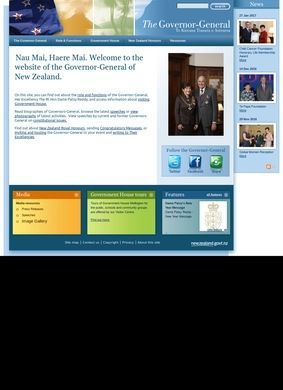
Say a community group wants to mark its centenary with a vice-regal guest, or a colleague has spent a lifetime in volunteer work and someone thinks that deserves formal recognition. Where does a request like that even go? The website of the Governor-General of New Zealand exists partly to answer those very practical questions, sitting beside its larger job of explaining what the office is and what it does.
It is the official home of the Governor-General of New Zealand, the representative of His Majesty King Charles III, who is New Zealand's Head of State, and the person in the role is appointed on the recommendation of the Prime Minister.
The current holder is Dame Cindy Kiro, the twenty-second person to serve as the Governor-General of New Zealand, appointed to a five-year term. Her biography anchors the site, alongside a deep bench of history on those who held the post before her.
The audience for all this is wider than it first appears. The site speaks to the general public trying to make sense of the constitution, to government bodies that deal with the office in formal terms, to event organizers chasing a vice-regal guest, and to anyone weighing a Royal honours nomination. Those are very different visitors with very different errands, and the Governor-General of New Zealand site has to answer every one of them from a single shared set of pages.
The constitutional role the site sets out
Most of the substance here is an explanation of a job that many citizens only half understand. The Governor-General of New Zealand carries real constitutional functions, and the site lays them out in plainer language than a law textbook would bother with. This is genuinely useful reference material for a student, a journalist, or anyone trying to follow how power actually transfers after an election.
The Governor-General of New Zealand is careful to frame these powers as exercised on advice and by convention, which is the whole character of the position. The balance between formal authority and deliberate restraint is the thread that makes the constitutional pages worth reading, and the site does not shy away from it or dress the role up as something grander than it is.
For a reader who assumes the position is either a rubber stamp or a hidden lever of power, the correction on offer is genuinely useful. The Governor-General of New Zealand can decline in the very rarest of circumstances, but the pages are candid that convention, not personal preference, drives almost every act. That candor is what makes the explanation educational instead of merely decorative, and it is the reason a curious citizen learns something real here.
Dissolving Parliament and appointing a government
Two of the functions are the most visible by far. The Governor-General of New Zealand dissolves Parliament before a general election and, once the votes are counted, appoints the government that commands the House.
The site explains these as formal acts that follow a democratic result rather than shape it, which is the distinction people most often get wrong. For anyone confused about who technically forms a government after an election, this is the clearest place to check.
Signing legislation on the King's behalf
The other headline function is assent. A bill passed by Parliament becomes law when the Governor-General of New Zealand signs it on the King's behalf, the final step that turns a vote into a statute. The pages treat this as procedure, not veto, and that framing is both accurate and worth stating clearly, since the signature can look far more discretionary from the outside than it ever is in practice.
What a visitor can arrange or request
Beyond the civics lesson, the site has a working, transactional side, and this is where the office of the Governor-General of New Zealand meets ordinary people carrying specific errands. The guidance pages are practical and laid out step by step, which is more than a lot of official sites manage.
Inviting the Governor-General to an event
One guidance page walks through how to invite the Governor-General of New Zealand to an event, a genuine milestone for charities, schools, and community organizations when a vice-regal guest actually shows up.
Setting the process out in the open saves organizers from guessing at protocol, and it makes an intimidating request feel approachable. The value here is procedural clarity, plain and simple, and it is the kind of thing a first-time organizer badly needs.
Nominating someone for a Royal honour
The counterpart page from the Governor-General of New Zealand covers nominating a person for a New Zealand Royal honour. This is a genuinely important civic function, since the honours system depends on ordinary people putting names forward, and the office provides the guidance on how to do it properly. A well-run explanation of that process arguably does more public good than any amount of ceremonial biography ever could.
History gets real room too. The site keeps biographical material on former holders of the post, tracing the line of the Governor-General of New Zealand back through its earlier occupants, which gives the current role its context. For a researcher or a curious citizen, that archive is a quiet strength, and it stops the site from reading as a snapshot of one term.
The Office of the Governor-General sits behind the individual, and the site is clear that the institution outlasts any single term. Legislation is signed, Parliament is dissolved, and governments are appointed regardless of who holds the post at the moment, which is the entire point of having a constitutional office in the first place. That continuity is the quiet argument the whole thing is making, whether or not a casual visitor ever clocks it.
What is harder to judge from the outside is depth of upkeep. A government reference site like the one run for the Governor-General of New Zealand lives or dies on whether its procedural pages stay current and its constitutional explanations stay accurate as conventions shift.
The material reads as authoritative, as it should coming from the office itself, but for a visitor working against a real deadline, an event date closing in or an honours round with a cutoff, the site cannot say for certain whether that timeline holds; the step that actually decides it still happens somewhere off the page.