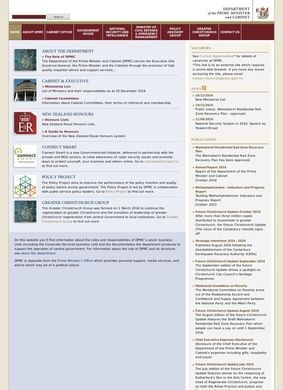
Most people picture a prime minister's office as a single room with a few advisers. In New Zealand the machinery behind that office is a whole department, and the Department of the Prime Minister and Cabinet runs it. This is the central agency that keeps the executive functioning day to day: it feeds policy advice up the chain, coordinates the work of separate ministries so they pull in roughly the same direction, and keeps the Cabinet system itself in working order. The website is where most of that work surfaces in public form, and it is more substantial than the dry name suggests.
Cabinet records and decision-making
The clearest way to understand the site is to look at what it actually publishes. The Cabinet Manual sits at the centre. For anyone trying to grasp how decisions move through the New Zealand government, that document is close to the rulebook, and the Department of the Prime Minister and Cabinet hosts it directly. Alongside it are Cabinet Circulars, the proactive release of Cabinet papers, and records connected to Cabinet committees and meetings. A reader who wants to see how a particular decision was framed, or what guidance ministers were operating under, can usually trace it through these pages without needing an intermediary.
How proactive release works
That openness is not incidental. The proactive release of Cabinet papers means documents that once stayed inside the building now appear on the site as a matter of routine, which gives researchers, journalists, and ordinary citizens a window into government reasoning that used to be far harder to reach. The Cabinet Office function, which the Department of the Prime Minister and Cabinet houses, is the engine room here: it manages the meetings, the committees, and the official records, then publishes a sizeable share of what comes out of them.
Two things are worth keeping in view when reading these pages. First, the records are primary sources, not summaries, so a Cabinet paper appears more or less as ministers saw it. Second, the Department of the Prime Minister and Cabinet sets the procedural rules and then operates inside them, which is why the Cabinet Manual and the circulars sit so close together on the site. The guidance and the decisions it shapes are documented in the same place.
National security coordination
Cabinet support is only one part of the remit. The Department of the Prime Minister and Cabinet also carries national security and intelligence coordination, a role that gets less attention but covers a lot of ground. The National Security Group sits inside the department and is tasked with coordinating the country's national security system, including how the government responds when a crisis hits. The Domestic and External Security Secretariat, usually shortened to DESS, works within that structure. The site publishes national security strategies, so the framing of how New Zealand thinks about threats and resilience is available to read in the department's own words.
Inside the security system
This is a useful thing to find in one place. Security coordination in many countries is scattered across agencies that rarely speak to the public, so having a central department that both runs the coordination and explains its strategy openly is worth knowing about. It also makes the breadth of the Department of the Prime Minister and Cabinet obvious. The same organisation that publishes a procedural circular on Cabinet conduct is the one coordinating crisis response across the whole system.
Honours administration
Then there is the honours system. The Department of the Prime Minister and Cabinet administers the New Zealand Royal Honours, which means it handles nominations and publishes the announcements when honours are conferred. For a member of the public wanting to nominate someone, or simply to check who received what, the relevant pages live here. It is a very different register of work from national security, and seeing both under one roof tells you how much of the constitutional plumbing this single department holds.
Policy advice to the Prime Minister
The Policy Advisory Group rounds out the picture. This is the unit that delivers independent policy advice straight to the Prime Minister, separate from the advice flowing up from individual ministries. Its presence inside the Department of the Prime Minister and Cabinet explains part of why the agency matters so much in practice: it coordinates other agencies' advice and generates its own counsel at the top of government. The Department of the Prime Minister and Cabinet also supports the Executive Council and works alongside the Governor-General, which puts it at the constitutional hinge between the elected government and the Crown.
Worth noting is who the department actually serves. The Prime Minister and Cabinet ministers are the obvious clients, but the brief makes clear the reach extends to the Governor-General and the broader machinery of government. That phrasing is accurate to what the site shows. The Department of the Prime Minister and Cabinet is less a service for the public than a service for the institutions of state, and the public-facing site is essentially a window onto that internal work plus the formal records it is obliged to make available.
Who uses this site
For different visitors the value lands in different ways. A law or politics student will find the Cabinet Manual and the released papers the richest part. A journalist tracking a decision will lean on the proactive releases and the circulars. Someone curious about honours will head to that section and ignore the rest. A person trying to understand how New Zealand organises its security thinking has the strategies set out plainly by the Department of the Prime Minister and Cabinet. The site does not try to flatten these audiences into one experience, and the site is the better for letting each thread sit on its own terms.
Primary sources, not summaries
If there is a limit, it is the one built into the subject. Much of what the Department of the Prime Minister and Cabinet does is internal coordination that never produces a public document, so the site can only ever show part of the work. What it does show is well organised and genuinely authoritative, because it comes from the body that owns these functions outright. There is no secondary commentary to wade through and no need to verify the source against anything else.
The honours announcements and the Cabinet paper releases are the parts most likely to bring a general reader back. Both are updated as government business moves, so the site functions as a live record rather than a static reference. A circular issued to guide ministers, a strategy document setting out security priorities, a list of new honours recipients: these are the concrete things the department puts out, and they are the reason the site remains worth returning to. The Department of the Prime Minister and Cabinet publishes primary material, not summaries of it, so anyone who needs the actual record rather than a paraphrase will keep ending up here.