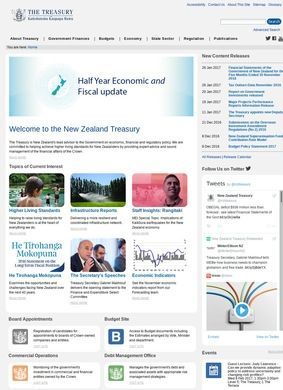
Say a researcher needs the actual numbers behind a New Zealand fiscal year: how much the Crown is forecast to collect, what it plans to borrow, where the spending lines sit, and how those projections shift between updates. That kind of question used to mean chasing scattered press releases. New Zealand Treasury answers it directly, because this is where the government's own economic and fiscal forecasts are produced and published in full. The Economic and Fiscal Update appears here in its half-year and budget-year forms, the HYEFU and BEFU, and in election years the Pre-election update arrives so voters and parties are arguing over the same set of figures, not competing summaries.
Economic and fiscal forecasts
Te Tai Ohanga, to give New Zealand Treasury its Maori name, sits at the centre of how the country manages money. It advises the Government and successive Ministers of Finance, and it publishes a great deal of what it produces for anyone to read. That openness is what makes the website useful well beyond Wellington policy circles. A journalist, a student, a council planner, an investor weighing sovereign risk: each can pull the primary documents instead of relying on someone else's interpretation. The site does not treat public interest as a privilege that needs to be earned through an OIA request.
Budget papers and long-term fiscal statements
The Budget section is the obvious centrepiece of the New Zealand Treasury site. Every annual Budget lands here with its supporting papers, and the archive stretches back through earlier years, so it is possible to trace how a given spending decision evolved or how forecasts in one Budget compared with what later materialised. Alongside the Budgets sit the long-term fiscal statements and generational reports, which look decades ahead at the pressures of an ageing population and the sustainability of public finances. Those documents are dry on the surface and genuinely consequential underneath, setting the terms for debates about superannuation, infrastructure and climate-related spending that New Zealand will be having for the next twenty years.
Living Standards Framework for policy analysis
One thing that distinguishes New Zealand Treasury from many finance ministries is the Living Standards Framework. It is a wellbeing-based tool the agency uses to weigh policy against more than the bottom line, taking in factors like natural capital, social cohesion, the state of the environment and the distribution of outcomes across the population. The framework shapes how advice is built, not how it is dressed up after the fact. It has its critics and its defenders, but the documentation is laid out plainly enough that a reader can judge the approach for themselves. New Zealand Treasury does not hide the methodology behind a paywall or a press summary.
Research outputs from Treasury economists
Quite a lot, and across several layers of depth. At the analytical end there are working papers and analytical notes written by New Zealand Treasury economists, the sort of material that feeds debates on macroeconomics, tax design, housing supply and infrastructure. These are technical and footnoted, aimed at people comfortable with economic modelling, yet they are public and freely downloadable. Sitting above them are the policy advice publications covering the same subjects in a form pitched closer to decision-makers, where the reasoning behind a position is set out in plain prose. If you ever want to understand why a particular tax or spending recommendation landed the way it did, the chain from working paper to published advice is often traceable here.
Government accounts, debt management, public finance guidance
On the accounts side, New Zealand Treasury publishes the financial statements of the Government and information on the Crown accounts, the audited record of what was spent and collected against what was planned. The Debt Management Office material covers how government debt is issued and managed, useful to bond market participants and to anyone trying to understand the country's borrowing programme. The New Zealand Treasury site also functions as the go-to reference for public sector financial managers: guidance on the Public Finance Act, on business case development, on capital asset management and on commercial and public sector investment all live here. In that sense it operates as a specialist business directory for the public finance profession, with each subject area pointing to a defined set of documents rather than a promotional summary.
Regulatory assessments and trade policy
The Regulatory Impact Statements and regulatory stewardship material document how new rules are assessed before they are made, which is relevant to lawyers, lobbyists and anyone tracking a pending regulation. International economic engagement and trade policy advice round out the offering. The breadth is genuine, and it is organised by purpose, not by department.
The site also holds the strategic intentions and annual reports of New Zealand Treasury itself, so the agency's own goals and self-assessment are on the record next to the advice it gives others. Most agencies publish their glossy strategy document and leave accountability to the Auditor-General; New Zealand Treasury puts both the intent and the measured result in the same place.
Transparency in methodology and assumptions
What stands out about the structure is that it respects the difference between an audience that wants the headline forecast and one that wants the spreadsheet behind it. The forecasts come with the underlying data and the assumptions stated. That is the standard you want from a central economic agency, and New Zealand Treasury meets it without forcing readers through layers of interpretation first. Careers and recruitment pages are present too, for economists and analysts considering the public service.
If there is a fair caveat, it is that the volume can overwhelm a casual visitor. Someone arriving with a simple question may find themselves in a thicket of forecast vintages, working papers and Act-specific guidance. The material is well sorted, but it is built for people who already know roughly what they are looking for. That is the nature of a primary source. It rewards a reader who comes with a defined question and is willing to read closely instead of scanning for a quick answer.
Publishing forecasts with underlying data
Where New Zealand Treasury earns real trust is in publishing the inputs alongside the conclusions. The Economic and Fiscal Update is no glossy summary; it ships with the numbers, the modelling notes and the risks the forecasters flagged. The same holds for the long-term fiscal work, where the assumptions about productivity, migration and demographics are stated so a reader can stress-test them. An agency confident in its analysis shows its working, and New Zealand Treasury does exactly that.
How different readers use the site
For an economics student or an early-career analyst, the working papers and the Living Standards Framework documentation are a quiet education in how a modern finance ministry reasons. For a journalist on deadline, the Budget archive and the Crown accounts are the fastest route to a defensible figure. For a public sector manager, the Public Finance Act guidance and the investment material are reference texts worth keeping open.
New Zealand Treasury serves each of these readers without diluting the substance for any of them. The concrete step for anyone who keeps citing second-hand summaries of New Zealand's fiscal position: go to New Zealand Treasury directly and pull the most recent Economic and Fiscal Update, then read the assumptions section before the headline numbers. Follow the forecasts and the accounts beside them, and the site repays the visit with primary evidence rather than someone else's reading of it.