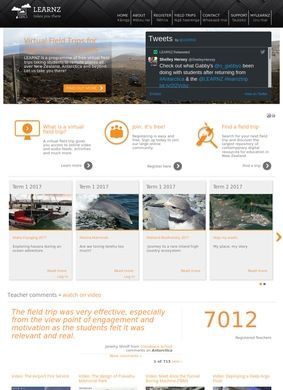
Learnnz is a New Zealand educational platform that runs free virtual field trips for schools, letting classes follow real expeditions to places most students would never reach in person. The premise is simple and a little ambitious: take a teacher and thirty children, point them at a remote pa site or a mountain sanctuary, and bring the place into the room through video, audio feeds and structured online material. The phrase the site uses for this, "access the inaccessible," is the honest heart of what it does.
Trips spanning hazards, heritage and conservation
The trips on offer are not generic. At the time of looking, the lineup covered natural hazards, cultural heritage and environmental conservation, with specific destinations such as Otumoetai Pa, Sanctuary Mountain Maungatautari, Te Wahi Pounamu and a strand called Origin Stories. That is a deliberate spread across the curriculum: some of it is science and the physical landscape, some of it is history and identity rooted in Aotearoa. A school doing a unit on the land and its risks gets a different trip than one studying conservation, and both are sitting in the same catalogue. The breadth here is narrow by design and deep where it counts, which is the right trade for a tool that wants teachers to trust it.
Filtering trips with the field trip chooser
Finding the right trip is handled by a tool Learnnz calls the Field Trip Chooser. You filter by inquiry topic, by location, and by year level, which matters because the same platform is meant to serve a five-year-old and a senior secondary student. A primary teacher chasing an inquiry on local heritage and a college teacher building a hazards module are not browsing the same shelf, and the chooser respects that. It is the kind of practical filtering that decides whether a teacher uses a resource twice or abandons it after one frustrating afternoon.
Managing classes through MyLEARNZ
Behind the Learnnz catalogue sits MyLEARNZ, a teacher portal for managing a class and handling enrolment. This is the part that turns a nice video library into something a teacher can run with a register and a plan. Subscription for educators is free, and that pairing is unusual enough to be worth saying plainly: a structured platform with class management and curriculum-aligned content, at no cost to the school, is rare.
Bringing real New Zealand contexts into lessons
What Learnnz is really offering, if offering is even the word for a free service, is supplementation. The trips are built to slot alongside classroom teaching, giving real New Zealand contexts to topics that can otherwise stay abstract on a whiteboard. A lesson about geothermal hazard means more when the class has watched a feed from the ground. Conservation reads differently when the students have been walked, virtually, through a fenced sanctuary and shown why the fence exists. That tie to a real place, with real audio and video from the expedition, is what separates a Learnnz trip from a worksheet on the same subject.
Grounding trips in local places and stories
The Learnnz library leans contemporary and digital, and it is anchored in places and stories that belong to this country rather than imported wholesale from overseas curricula. That local grounding is the quiet strength. Plenty of online learning material treats geography as interchangeable; Learnnz does the opposite, building each trip around a named site with its own ecology, history and reasons to matter to a New Zealand student. The inclusion of pa sites and pounamu country alongside conservation projects points to an intent to carry cultural heritage and environmental learning together, not in separate silos. A teacher who wants students to see their own landscape, not a stock image of someone else's, will find that approach refreshing.
Limits of a focused tool
It is worth being honest about the limits. This is a focused tool, not a sprawling one. The value is bounded by the trips currently available and by how well a given topic happens to line up with what a teacher needs that term. A class studying something with no matching trip will simply find nothing here, and the platform does not pretend otherwise. The strength is depth on a defined set of New Zealand subjects, not breadth across everything a school might teach.
Structure behind each virtual trip
The interactive layer, live and recorded feeds, audio, the online materials wrapped around each trip, is the difference between this and a folder of links. A teacher is handing students more than a video. There is a structure to follow, content pitched at chosen year levels, and a portal to keep a class organised through it. For a busy classroom that combination removes a lot of the friction that usually kills good intentions about using digital resources.
Keeping the trip catalogue current
One honest reservation about any specialised platform applies here too: the usefulness of Learnnz rises and falls with how active and current the trip catalogue stays. A platform like this lives or dies on fresh, well-produced expeditions arriving regularly. The contemporary feel of the material on display is a good sign that this is being tended, though a teacher planning ahead is right to check what is scheduled before assuming a trip will appear on demand. None of that undercuts the core idea, which is sound and well executed for the subjects it covers.
What the evidence suggests for teachers
The evidence on the page, a free subscription, named destinations, curriculum-tagged material pitched by year level, is enough to take the Learnnz offer seriously as a classroom resource. A teacher who registers and filters by topic will know within a few minutes whether a Learnnz trip fits the unit they are planning.