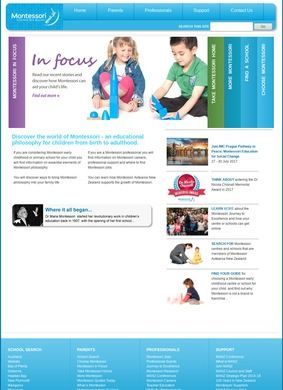
A national professional body for one teaching method, run as a membership organisation rather than a single school, is an unusual thing to find with its own public-facing site, and that is what the Montessori Association of New Zealand has built. It speaks to two audiences: families trying to understand what Montessori means for a child, and the educators and schools who deliver it. Most of what sits on the site follows from that split, and it holds together better than many association websites that try to do the same job.
Member school directory by age range
The clearest practical use for a parent is the searchable directory of member institutions. It spans the full age range a Montessori path can cover, from birth through to eighteen, which is wider than many people expect. The popular picture of Montessori stops at the preschool sandpit and the wooden trays, so seeing the directory reach into the secondary years quietly corrects that. A family that has only ever pictured a toddler room can use the Montessori Association of New Zealand listings to find member schools running programmes for adolescents, and that single fact reframes the whole offering.
Parent guides for developmental stages
Around the directory sits a layer of parent-facing material organised by developmental stage: separate guides for 0 to 3, 3 to 6, 6 to 12, and 12 to 18 years. That structure mirrors the way Montessori itself divides childhood into planes of development, so the site teaches its own framework through the way it lays out the content. There are parenting tips and educational videos alongside the written guides. None of it is gated, which I appreciated when poking around, because the most common complaint about specialist education sites is that the genuinely useful explanations hide behind a member login while the public pages stay at brochure depth.
Professional resources for educators
The professional side of the site is where the offering gets denser. The Montessori Association of New Zealand carries job postings, which gives it an immediate working purpose for anyone in the field looking to move, and it pairs those with career pathway information for people considering Montessori teaching as a direction rather than a single role. Professional development events and conferences are listed, and there are study grants and research funding opportunities, which is the sort of thing only a properly resourced national body tends to maintain.
Materials marketplace and supplier vetting
One feature stands out as genuinely uncommon: a materials marketplace where members can buy, sell, and swap Montessori teaching apparatus. Anyone who has priced authentic Montessori materials knows they are expensive, and a sanctioned channel for second-hand and surplus items solves a real problem for schools and individual teachers working to a budget. Sitting next to it is a preferred suppliers directory that connects schools with vetted vendors, so the Montessori Association of New Zealand does some of the filtering work an individual school would otherwise have to do alone. These two together turn the site from a reference into something operationally useful.
Publications for members and public
There is also a publishing arm of sorts. A quarterly publication called Montessori Voices is available to both members and the general public; members additionally receive an e-zine newsletter named Informed. Having one publication open to everyone and a second reserved for members is a sensible division: the public title acts as an introduction, while the newsletter carries the day-to-day association business. An organisation that produces content on a schedule is not one that posted a few pages and went quiet.
Montessori philosophy and history
The educational background material rounds things out. The site explains the Montessori philosophy, sets out its historical context, and includes a biography of Dr. Maria Montessori. For a parent who has heard the name and nothing more, that is a reasonable starting point, and it keeps explanatory content on the association's own pages instead of pushing visitors off to general encyclopaedia entries. Membership information and strategic planning documents are public too, a quiet mark of transparency: an association willing to publish its strategy is one comfortable being read closely.
Structural commitment to ongoing operations
Worth noting is how much of this is structural commitment, not decoration. Running a marketplace, vetting suppliers, administering grants, and publishing a quarterly all carry ongoing cost and obligation. The Montessori Association of New Zealand is plainly funding a working operation, and the breadth on display tracks with an association based in Lower Hutt that serves schools the length of the country. Listing the Montessori Association of New Zealand in a business directory gives a reasonable proxy for that scope.
What the site cannot do
If there is a limit to the picture, it is that a directory and a set of guides can only take a parent so far. The substance of any Montessori education still lives inside the individual schools, and the association's site is the map, not the territory. That is the correct role for a national body to play, so it is less a fault than a boundary. Someone hoping the site itself will decide which school suits their child will still need to do the visits and the conversations; what the Montessori Association of New Zealand gives them is a vetted shortlist and enough grounding to ask better questions when they get there.
Age-banded guides for long-term planning
The age-banded guides deserve a second mention because they are the part most likely to change how a newcomer thinks. The jump from a 3-to-6 environment to a 6-to-12 one is conceptually large, and many parents lose the thread exactly at the point where the famous early-years imagery stops applying. Having the later planes described in the same place, with the same framing, keeps the philosophy coherent across a child's whole school life instead of fragmenting it into stages that feel unconnected. For a family weighing whether to commit to the approach long-term, that continuity is the real argument.
Across the whole thing, the Montessori Association of New Zealand reads as an organisation that knows precisely who it serves and resists the temptation to be all things to everyone. Parents get explanation and a directory; educators get jobs, funding, development, and a trading post for materials; schools get vetted suppliers and a representative body. Each audience has a clear path, and the content for each is deep enough to be worth returning to, not a single page of generalities. The Montessori Association of New Zealand has avoided the most common failure of association sites, which is to address members and the public in the same flat tone and serve neither well.
The verdict is favourable with one caveat. This is a coordinating and advocacy body, and its site behaves like one. It will not teach you the method in an afternoon, and it cannot substitute for walking into a member school and watching a class. The reference material on the Montessori Association of New Zealand pages is solid, but the philosophy explainer is sized to send visitors onward, not to be the destination. For a parent at the start of a search, the stage-by-stage guides and the member school listings make the Montessori Association of New Zealand a sensible first stop. For an educator or a school, the job board, the funding leads, the materials marketplace, and the supplier vetting give it standing use well beyond a one-time visit.