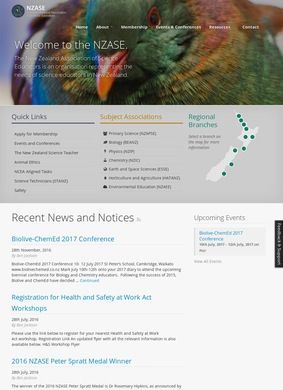
Scholarship exam preparation materials, built from past derived and scholarship papers, are one of the more concrete things the New Zealand Association of Science Educators, or NZASE, keeps within reach of a teacher, and they hint at the practical bent of the whole operation.
This is the national professional body for science educators across Aotearoa New Zealand, and its work points squarely at the people standing in front of a class, from a primary teacher improvising a first experiment to a secondary specialist prepping students for the hardest papers in the system. Membership, in effect, buys a teacher a share in a national conversation about how the subject gets taught.
The stated mission of the New Zealand Association of Science Educators is plain: connecting, supporting and advocating for Aotearoa science educators. What that looks like day to day is a mix of teaching resources, professional learning, and the quieter machinery of a teachers' network, the emails, branches and shared files that keep a scattered profession talking to itself. Advocacy sits in there too, the body speaking for science teachers when curriculum and assessment decisions get made above their heads, a role no single school can fill for itself.
What the association puts in a teacher's hands
The core of the New Zealand Association of Science Educators is professional development, PLD in the local shorthand, and the site frames itself as part of a wider Networks of Expertise. In plain terms that means practical training, curated resources, expert advice, and chances to connect with other teachers who run into the same walls.
Science is broad and equipment-dependent in a way few school subjects are, so pooling that know-how saves real effort; a good idea for teaching electricity or a safer way to run a reaction does not have to be reinvented in every staffroom. That is the quiet argument for a subject association: it spares teachers from solving the same problems in parallel.
Reach runs through regional branches and affiliated teacher associations, which is how the New Zealand Association of Science Educators stays useful across a country where a teacher in a small rural school faces very different constraints from one in a big-city department. Affiliated associations extend that reach further, tying regional and subject-specific groups into one professional web. The network is the point as much as any single download, and the branch structure is what turns a national body into something a local teacher can feel.
Professional learning and the Networks of Expertise
PLD is where the New Zealand Association of Science Educators spends most of its stated energy. Sitting inside a Networks of Expertise arrangement means the professional learning is meant to be hands-on and ongoing, the sort a teacher comes back to across a year, and the expert advice on tap is pitched as a live working resource rather than a static page.
How rich that support turns out to be will depend heavily on how active a given teacher's branch is, which is the honest ceiling on judging it from the outside. A teacher in an isolated branch may find the same masthead delivers far less than a colleague in a well-run regional group enjoys. The framework is sound. Whether it hums or idles is a local question.
Teaching materials, articles and scientist profiles
The resource library is the part a browsing teacher reaches for first. There are teaching materials and science articles, and a set of scientist profile or backgrounder resources that put a human face on the discipline, handy for a class looking at how science is really done and by whom. The articles skew toward the practical questions of teaching a topic, not toward research nobody has time to read.
A newsletter from NZASE, with accessible back issues, rounds this out, and that archive is more useful than it first appears: past issues stay readable, so a resource flagged some time ago does not drop off the edge of the internet. Back issues, taken together, become a slow-built library instead of a stream that scrolls away.
Health and safety, and animal ethics
Two areas set a science teachers' body apart from a general education one, and the New Zealand Association of Science Educators covers both. Health and safety guidance speaks to the plain reality that a science room holds chemicals, heat and sharp equipment, and getting that wrong carries consequences a spreadsheet lesson never will. Standardised safety notes also give a teacher something to point to when a nervous administrator asks whether an activity is allowed. Animal ethics resources address the other charged corner of school science, where dissection and live specimens raise questions a teacher cannot improvise answers to.
Shared, considered guidance on both is one of the more genuinely valuable offerings here, something a lone teacher could not easily build alone.
Science fairs and scholarship exam preparation
Science fair support and exam preparation cover the two ends of a student's year, the open-ended project and the high-stakes paper. The exam materials lean on derived and scholarship-level papers, aimed at senior students chasing the top marks, and the scholarship-level preparation in particular targets a small cohort that mainstream textbooks tend to underserve. The science fair help serves the younger, messier, more curious end of the subject.
I liked that the New Zealand Association of Science Educators bothers with both, since a fair is often where a kid first catches the bug and a scholarship paper is where a few of them decide science is their future. Covering the full span, from playful fair to final exam, says something about how the body reads its job.
Who benefits is narrow and specific: a science teacher working inside the New Zealand system, primary through secondary to scholarship level. For anyone outside that audience the site holds little, and even for those inside it the true depth of each resource is hard to gauge without logging in and putting it to use.
None of that is a criticism so much as a description; a body this specialised does its job precisely by being narrow. What the New Zealand Association of Science Educators plainly is, on the evidence of its own pages, is a practical hub assembled by people who know the particular headaches of teaching science in this country, and that tight focus is at once its strength and the reason its usefulness stops at the classroom door.