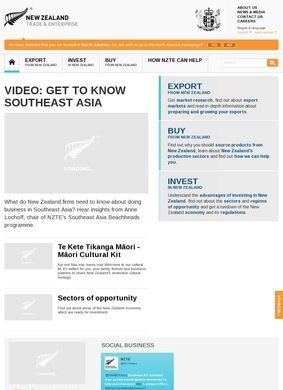
Where does a New Zealand business turn when it wants to sell abroad but has no map of the foreign market it is aiming at? New Zealand Trade and Enterprise answers that directly. It is the country's official agency for trade and investment promotion, and its remit is narrow and practical: get New Zealand companies selling into other markets, and get foreign buyers and investors looking at what New Zealand makes. The site says it works with more than 5,000 exporters every year, which gives a sense of the scale it operates at and the kind of company it is built for.
Export advice, market insights, growth funding
The substance on offer falls into a few clear buckets. There is independent export advice, the sort a company can take or leave without a sales pitch attached. There are in-market insights, meaning intelligence gathered by people who are physically in the markets a New Zealand exporter wants to crack. There are connections to global networks, and there is growth funding for businesses that have the ambition but not the capital to expand on their own. None of this is dressed up as more than it is, and that plainness works in its favour.
MyNZTE portal for registered exporters
The part of the site doing the heaviest lifting is myNZTE, a portal that gives a registered company personalised access to the agency's tools. Through it a business reaches workshops, events, market insights, and direct contact with staff stationed in offices around the world. The personalisation matters because export problems are specific: a dairy exporter eyeing Southeast Asia and a software firm chasing North American contracts need different answers, and a generic resource library would not serve either well. Routing each company to the relevant tools and the relevant people is a sensible way to structure a service this broad.
Timely trade intelligence on tariffs, disruptions
Alongside the portal, New Zealand Trade and Enterprise publishes current trade intelligence that reads as genuinely timely. Two examples on the site are a guide to navigating United States tariffs and material on dealing with Middle East trade disruptions. These are not evergreen filler. They address conditions exporters are facing right now, which is exactly where a national agency can add value that a private consultant or a stack of textbooks cannot match at the same speed.
For the other side of the trade equation, a "Trade with New Zealand" section is aimed at international buyers and investors looking for New Zealand products, services, and partnerships. That two-sided structure is logical for a body whose job is both pushing exports out and pulling investment in, and it keeps the two audiences from tripping over each other.
Global office network with trade commissioners
What gives New Zealand Trade and Enterprise more weight than a website alone could carry is its physical presence. The agency runs a network of offices spread across major markets in Asia, the Americas, Europe, and the Middle East, staffed by trade commissioners and regional advisors. That is the difference between reading a market report and having someone on the ground who already knows the buyers, the regulators, and the local quirks. For a small or mid-sized New Zealand exporter, that in-market expertise is hard to assemble independently and is probably the single most useful thing the agency provides.
Capital, capability programmes, sector networks
The funding and capability side rounds it out. Beyond advice and connections, New Zealand Trade and Enterprise links exporters to capital, to capability development programmes, and to sector-specific networks where companies in the same field can share what works. It sits under New Zealand's Ministry of Business, Innovation and Employment and is funded by the government, so the services come without the commercial conflict a privately owned advisory firm carries. A company is not the product being upsold here.
Who benefits most from this service
There are limits worth naming. The agency is built for businesses with real export intent and some capacity to act, so a very early-stage founder or a hobby operation may find much of the apparatus aimed past them. The reliance on the myNZTE portal also means the most useful material sits behind registration, so a casual visitor browsing the public pages sees a fraction of what a registered exporter does. Neither is a flaw exactly, but both shape who gets the most out of it.
The verdict is favourable with that qualification attached. For a New Zealand company that is serious about selling overseas, New Zealand Trade and Enterprise is close to an obvious first stop, given the office network, the government backing, and the timeliness of its trade intelligence. For anyone outside that core audience, the value drops off quickly, and the registration wall means a visitor has to sign up before seeing most of what is on offer. Judged on what it sets out to do, though, it does the job, and the absence of a sales motive makes its advice easier to trust than a privately funded advisory operation would be.