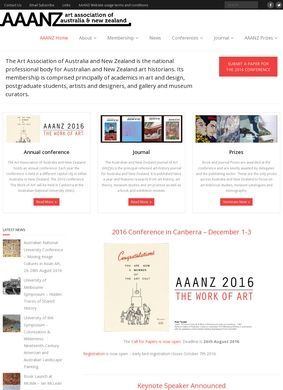
AAANZ is the Art Association of Australia and New Zealand, the peak professional body for art historians, art writers, curators, and practising artists across both countries, in operation since 1974. The site lays out a clear remit: it speaks for people whose working lives revolve around the study, writing, teaching, and making of art, and it gives them a shared institutional home that crosses the Tasman. That binational scope is worth noting because it is unusual. Most professional associations stop at a national border. This one deliberately ties together two art-historical cultures that overlap but are far from identical.
Publishing the ANZJA journal
The publishing arm is the part I kept coming back to. AAANZ puts out the Australian and New Zealand Journal of Art (ANZJA), a peer-reviewed title that appears twice a year through Taylor and Francis. Its scope runs across art history, art theory, museum studies, and art practice, which is a wider net than many academic journals cast. A peer-reviewed journal with a recognised commercial academic publisher behind it tells you something concrete about the association's standing in the scholarly world. It is the kind of output that gets cited, indexed, and read well beyond the membership, and it gives postgraduate researchers a regional venue that understands their context.
Annual national conference
Beyond the journal, the calendar centres on an annual national conference. The site notes attendance in the range of 300 to 500 delegates, with the host country alternating between Australia and Aotearoa New Zealand. For a specialist field, those delegate numbers mean something concrete, and the rotation keeps the event from defaulting to one country's institutions year after year. A conference of that size is where careers in this discipline get built: papers tested, networks formed, hiring conversations started in corridors. Listing the delegate range and the alternating pattern, instead of vague talk about a flagship gathering, makes the commitment legible.
Recognition through writing awards
The recognition side is well developed. AAANZ administers the Art Writing and Publishing Awards, the AWAPAs, which single out regional publishing achievements, and it runs PhD prizes alongside early-career publishing programs. Awards like these matter in a field where output is mostly text and where a national prize can lift a young writer's profile in a way that a strong CV alone cannot. The early-career emphasis recurs throughout, which reads as a body thinking about the pipeline as much as its established names.
Directory and mentoring support
Member services extend past prizes and the journal. There is a searchable professional directory of art experts and researchers, which doubles as a way for journalists, institutions, and curators to find the right specialist for a project. Mentoring programs pair newer professionals with experienced ones, and advocacy working groups take up issues affecting the discipline more broadly. That mix, recognition plus connection plus a collective voice, is roughly what you would hope a professional association does, and AAANZ has each strand present and operational.
Membership tiers by income
Membership is structured in annual tiers. There is a student rate, a concession rate for concession-card holders earning under AUD 50,000, and a standard tier for those holding an Australian or New Zealand postal address. The income-tested concession band is a thoughtful detail. It acknowledges that many of the people this field most wants to keep, early-career researchers and sessional academics, are also the ones earning least. The membership audience is stated plainly too: academics, postgraduate students, artists, designers, and museum professionals. That breadth, taking in designers and museum staff alongside historians, points to AAANZ reading its discipline expansively.
How active are these programs?
What is harder to judge from the public-facing material is depth versus breadth. AAANZ names a lot of programs, the journal, the conference, the awards, the directory, the mentoring, the working groups, and on a single browse it is not obvious how active each one is from year to year. Mentoring schemes and advocacy groups in particular can sit on a website long after the energy behind them has drained away, kept alive in a navigation menu more than in practice. Nothing here confirms that is the case, but nothing rules it out either. The journal and the conference are the two assets you can verify externally; everything else depends on what a current member would tell you.
Who this association suits
A researcher who wants to publish in ANZJA, present at the conference, or appear in the expert directory has obvious reasons to join AAANZ. An artist or designer further from the academic centre would need to look harder at how much of the offering bends their way, since the gravity of the whole operation, the peer-reviewed journal, the PhD prizes, the academic conference, clearly sits on the scholarly side of the field and not the studio side. That is not a criticism so much as a structural observation about where the association invests most of its energy.
Balancing two art communities
The binational structure, the thing that makes AAANZ distinctive, is also the thing most worth scrutinising. Running a genuinely shared institution across two countries is demanding. Conferences alternate, but the journal, the awards, and the working groups all have to keep both art communities equally served, and it would be easy for the larger Australian sector to quietly dominate the New Zealand one. The AAANZ site presents the cross-Tasman partnership as settled and balanced. Whether Aotearoa New Zealand members get the same weight in practice as their Australian counterparts is a question the published pages cannot fully resolve, and it is probably the most consequential uncertainty about the organisation for anyone considering membership from the New Zealand side.