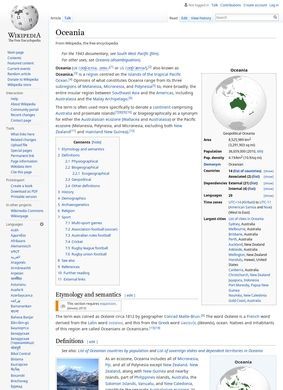
Oceania holds the odd distinction of being the second-least populated continent on Earth, behind only Antarctica, yet it sprawls across roughly 9,000,000 square kilometres and crosses both the Eastern and Western hemispheres. Around 46.3 million people live across the whole region, a figure that sits awkwardly against an area large enough to swallow most of Europe several times over. Wikipedia: Oceania makes that contrast plain from the opening paragraphs, threading the population number through geography, history, and economy so it starts to mean something rather than floating as an isolated statistic.
Defining the boundaries of Oceania
The article opens by wrestling with a question that turns out to be genuinely contested: where does Oceania begin and end? Wikipedia: Oceania devotes a Definition section to the boundary debates, including how the United Nations interprets the region against other readings. This is not a tidy landmass with obvious edges. It is a grouping of Australasia, Melanesia, Micronesia, and Polynesia, and the article is upfront that reasonable sources disagree on the lines between them. The page treats this as an open scholarly matter instead of flattening it into a single confident answer, which is what separates a reference entry from a tourism blurb. That restraint is earned: the alternative would be to paper over a real methodological disagreement for the sake of a cleaner introduction.
Settlement and European contact across millennia
History gets serious treatment. The settlement of the region begins more than 60,000 years ago, and the article carries that thread forward through European exploration starting in the 16th century and into the modern day. For anyone trying to understand how such a scattered set of islands and one enormous continent came to be grouped together at all, that long arc is the spine of the whole piece. The deep-time settlement figure is not dropped as trivia: it connects to the later sections on demographics, archaeogenetics, and the movement of peoples across the Pacific, so a reader who starts at the top and works down ends up with a coherent picture instead of a pile of facts.
GDP and per-capita figures for 2024
For a student or educator, the economy section is where Wikipedia: Oceania probably delivers the most immediate value. The article reports a regional GDP of $1.630 trillion nominal and a GDP per capita of $63,842 for 2024, noting that the per-capita figure is the second highest of any continent. Those are concrete, verifiable numbers useful for coursework or a quick fact-check, and they come with the regional breakdowns and tourism data needed to put them in context. The economic story of Oceania is lopsided, dominated by Australia and New Zealand, and the structure of the section reflects that reality without collapsing it into a single average.
From geography to political entities
Geography is where the article goes deepest. It runs through the subregions, the geology, the flora and fauna, and the climate, anchoring the physical description with hard reference points: Puncak Jaya rising to 4,884 metres as the highest peak, Australia as the largest country, Sydney as the largest city. The politics section then maps the human layer onto that terrain, covering Australia, New Zealand, and the Pacific Island nations as distinct political entities. A reader who needs to understand why a tiny atoll nation and a continental power sit under the same regional heading will find the reasoning laid out across these sections, and it holds together.
Religious affiliation and archaeogenetics data
Demographics is the densest part of Wikipedia: Oceania, and arguably the most rewarding. The article supplies city population data, a religious breakdown putting the region at 62.1 percent Christian and 36.4 percent unaffiliated, plus material on languages, immigration patterns, and archaeogenetics. That last inclusion is a sign of seriousness. Plenty of regional overviews stop at religion and language; folding in archaeogenetics means the page is trying to explain how the population came to look the way it does, going beyond a static snapshot of its current shape. The culture section, by contrast, is lighter, covering regional arts and sports in broader strokes. It reads as the part a future editor is most likely to expand.
Cross-links to dedicated regional articles
One structural strength of Wikipedia: Oceania is how heavily it is cross-linked. The entry does not try to be the final word on every subregion, country, or geographic feature it names. Instead it points outward to dedicated articles on each, which is the sensible design for a top-level overview. A reader who arrives wanting Polynesia specifically, or Puncak Jaya, or the economy of a single Pacific nation, is one click from a deeper page. That network of connections is the real value of consulting Wikipedia: Oceania over a static printed summary, and it works the same way across the multiple languages the article is available in.
The collaborative model behind the page is worth naming plainly. Wikipedia: Oceania is editable by the public, which is both its engine and its caveat. The breadth and the up-to-date 2024 figures exist because many hands keep the entry current, and the same openness means the depth is uneven from section to section. Demographics and geography feel maintained and rich; culture feels comparatively sparse. A careful reader treats Wikipedia: Oceania as a strong starting map and follows the citations and cross-links to firmer ground for anything load-bearing. That is the correct way to use any general encyclopedia entry.
Wikipedia: Oceania declines to pick a side on the harder interpretive questions, and that restraint is mostly a feature. Where the boundaries of the region are genuinely disputed, the article reports the dispute. Where the economic data is dominated by two wealthy countries, the breakdowns let the reader see the imbalance instead of hiding it behind a continental aggregate. The page is built to inform, and for a reference work that is the right posture.
Researchers, students, educators, and general readers after an encyclopedic grounding in the region will get real value from Wikipedia: Oceania. The combination of hard statistics, long historical sweep, and dense cross-linking makes it a credible first stop on any Oceania-related question. The page is comprehensive on geography, history, economy, and demographics, and honest about the parts that remain contested. Someone needing a definitive academic source on a narrow topic will use Wikipedia: Oceania as a gateway, following its citations and links to reach primary material, which is exactly how it is meant to function.
The verdict is a qualified yes. Wikipedia: Oceania is a solid, information-dense entry that rewards a reader willing to scroll, with the usual reservation that the lighter sections, culture chief among them, trail the strong ones. The article is thorough and current on the material it covers well, and honest enough about its collaborative nature that no careful reader could mistake it for a stable authoritative text on any single detail. Follow its references outward and Wikipedia: Oceania becomes genuinely useful; treat it as an endpoint and the gaps will eventually show.