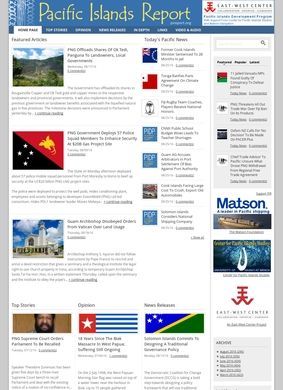
Someone trying to understand a leadership shake-up in the Marshall Islands, or a fisheries dispute touching Fiji, or how American Samoa is handling a public health question, usually hits the same wall: the Pacific is enormous, the issues are local, and most general news skips over it entirely. The Pacific Islands Report is the East-West Center's answer to that gap. It runs under the Pacific Islands Development Program, a federally funded research institution based in Honolulu that has been doing this work since 1980, and the coverage maps closely onto the kinds of questions that other outlets leave unanswered.
Geographic scope and content organization
The reach is the first thing that registers. Pacific Islands Report covers territories and nations across the region: American Samoa, Fiji, Guam, the Marshall Islands, Micronesia, Papua New Guinea, Samoa, the Solomon Islands, Tonga, Vanuatu, and others, with the wider Asia-Pacific frame around them. Content is sorted by region and by topic, which is the sensible approach for a part of the world where governance, environment, arts and culture, public health, economics, politics, and education behave differently from one island group to the next. A researcher chasing one country can stay narrow; someone tracking a theme across the whole Pacific can pull the cross-cutting view instead.
Leadership development and research programs
Three program areas anchor the work: Leadership Development and Governance, Community Engagement and Development, and Publications and Information. That last strand is what most outside readers will reach first, since it carries the news, analysis, and announcements tied to Pacific Island policy and development. The other two explain where the material comes from. Pacific Islands Report is not a clipping service repackaging wire copy. It comes from an institution that trains people, convenes them, and produces its own policy-relevant research, then publishes around that activity.
Training partnerships with Taiwan
Closer to serious research than casual reading, and that shapes how useful a visit turns out to be. The training and exchange side is concrete enough to evaluate on its own terms. The Pacific Islands Leadership Program operates under a memorandum of understanding with Taiwan's Ministry of Foreign Affairs, which is a specific bilateral arrangement. The program also backs doctoral work through the Hawaii Pacific Foundation Doctoral Research Award, placing Pacific Islands Report inside the academic supply chain, helping produce the next round of regional scholarship alongside commenting on the current one.
Arts and cultural programming
The cultural programming is a useful indicator of how the program defines its own mission. The annual Celebrate Micronesia Festival and the film screenings it hosts sit alongside governance and policy material, which says that arts and culture are treated as part of regional development rather than an afterthought. For a reader who arrived purely for policy analysis, that breadth can feel like a detour. For anyone trying to understand the Pacific as a lived region and not purely a data set, it rounds out the picture in a way a pure think-tank feed would not.
Four decades of continuous coverage
The historical depth is substantial. A program operating continuously since 1980 has watched decolonization, climate pressure, shifting aid relationships, and the slow build of regional institutions across the same set of islands. That continuity is genuinely hard to find elsewhere. When the analysis in Pacific Islands Report references how a governance question has evolved, it draws on decades of direct engagement, not a scan of recent headlines. Coverage of this length and consistency gives the archive a longer memory than other outlets working the Pacific beat.
Access and institutional structure
One practical note worth flagging: the original pidp.eastwestcenter.org/pireport/ address now redirects into the East-West Center's PIDP section. The Pacific Islands Report identity has effectively folded into the broader Pacific Islands Development Program presentation. A visitor expecting the old standalone news page should know the destination has moved, though the redirect lands in the right place. The content lineage is intact even if the front door changed.
Academic profile without consumer ratings
Pacific Islands Report does not operate as a commercial listing and has no conventional review profile on Yelp, Google Maps, or similar platforms. A broad search turns up no star ratings or aggregated user scores, which is expected for an academic program rather than a consumer-facing service. The East-West Center itself has an established public profile with Congressional funding, peer relationships with universities and governments across the Asia-Pacific, and decades of cited research output. Contact is handled through the East-West Center's main channels. No public-facing email for Pacific Islands Report appears independently of the institutional parent, and for a research program of this type that is simply how the contact structure works.
Best uses for policy researchers
What Pacific Islands Report is genuinely good for comes down to a few clear uses. It is a strong starting point for policy researchers, graduate students, journalists covering the region, and people from the islands themselves who want institutional analysis written with the Pacific as the primary subject, not the footnote. The topic organization makes it possible to go deep on environment in one nation or economics across several, and the connection to active training and research means the material is tied to current practice. Someone hunting for daily breaking-news coverage of every island will find the rhythm slower and more analytical, closer to a research institution's publishing cadence than a newsroom's.
Against the obvious alternative, the Pacific Community offers technical and scientific reporting across member states, and on raw operational data it often goes deeper into specific sectors. Where Pacific Islands Report holds its ground is the combination: policy and development substance paired with a U.S.-based academic vantage, a four-decade archive, leadership training that feeds people back into the region, and cultural programming that treats the Pacific as more than a development case file. That mix of scholarship, longevity, and genuine regional engagement is what makes Pacific Islands Report worth keeping in a working set of sources.