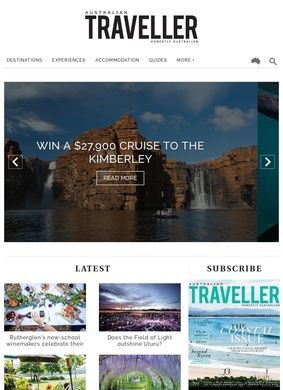
You have two weeks off, a rough idea that you want to drive the coast or chase a quiet beach somewhere, and absolutely no plan beyond that. Most travel sites at this point either bury you in sponsored hotel links or send you bouncing between forums. Australian Traveller takes a narrower job and does it with some confidence: it covers Australia, only Australia, and it tries to answer the question of where you should go and what you should book once you get there.
Browse by region or activity
The structure follows how people actually travel inside the country. You can browse by region, which is the sensible entry point if you already know you want Tasmania or the Top End but nothing finer than that. Or you can come at it sideways through activities and experiences, which suits the traveller who knows they want to dive, hike, or eat their way through a city but has not settled on a destination. This is where Australian Traveller pulls ahead of a generic planner. Sitting on top of both approaches are the Top 100 lists, the feature the brand is probably best known for, where editors rank places, stays, and experiences into something you can work through one by one.
Top 100 lists and editorial rankings
What gives the content its weight is that it is produced in-house by travel writers rather than scraped or syndicated, and that shows up in the hotel and restaurant reviews. There is a monthly column called Hotel Addict that reads like a running diary of properties someone has genuinely stayed in, which is the sort of thing you cannot replicate with an aggregator. Accommodation reviews, destination guides, travel news, and video sit alongside it, so Australian Traveller works both for trip planning and for the slower habit of reading about places you might never visit. I tend to trust a travel site more when its writers clearly went somewhere, and that texture is present here.
Original reviews from travel writers
The newer addition is an AI planning tool called Ask AT, which Australian Traveller has folded into the experience for people who would rather describe what they want and have an itinerary suggested back. Whether it becomes part of your routine depends on how much you enjoy the browsing itself, because the Top 100 lists already do a lot of the narrowing that such a tool promises. Treating Ask AT as a shortcut for the indecisive, with the editorial guides as the deeper layer underneath, seems like the honest way to read what is on offer.
Ask AT planning tool for quick itineraries
There is a commercial side to Australian Traveller, handled without much disguise. It publishes a print and digital magazine you can subscribe to from AUD 9.95 a year, which is cheap enough to feel like a goodwill gesture toward turning casual readers into regulars. It also sells access to curated travel lists and guides, runs annual Readers' Choice Awards that pull in audience votes and dangle holiday prizes, and offers a newsletter signup and competitions. None of that is hidden behind the editorial, and the awards in particular give the brand a recurring reason for its readers to come back and have a say, which is a smarter form of engagement than the usual loyalty gimmicks.
Magazine subscriptions and reader awards
On the question of who it is for, the answer is comfortably broad without being vague. Domestic travellers planning a long weekend or a state road trip are the obvious core of who Australian Traveller is built for, but the depth of regional coverage also serves international visitors who have decided on Australia and now need to figure out the difference between, say, the Whitsundays and the Great Ocean Road. The exclusively Australian focus is the thing I would point to as its real strength: a generalist global travel site can tell you Sydney is worth visiting, but it rarely knows which regional town is worth the detour.
Who should use Australian Traveller?
Credibility is where I would temper expectations slightly, though not because the content disappoints. Contact runs through a form at the site. There is no phone number or street address shown, and reaching a person means going through that form, which is normal for a media brand but worth knowing if you expected a publisher you could ring.
Limited contact options and no external ratings
Outside validation is another matter, and it deserves a plain answer. A search for independent reviews of the publisher turned up nothing usable: no Google rating, no Trustpilot presence, no third-party verdict on Australian Traveller itself. What does surface is reviews for Aussie Traveller, an unrelated caravan accessories maker at a different address, so be careful not to read those as a reflection of this publisher. The absence of outside ratings does not mean the work is poor, only that you are judging it on the content in front of you, with no crowd of voices to lean on.
Taken together, this is a focused, editorially driven guide to one country, with a clear commercial layer and a planning tool bolted on for the time-pressed. The writing carries the authority of people who travel for a living, the Top 100 format gives the browsing a spine, and the single-country scope is the whole point of using it over a global rival. The one gap is external validation: you are largely taking the editorial on its own merits, and there is no outside chorus to back it up. That is a real limitation, but the content is substantial enough that most readers will arrive at a verdict quickly by reading a few pieces and judging the writing for themselves.