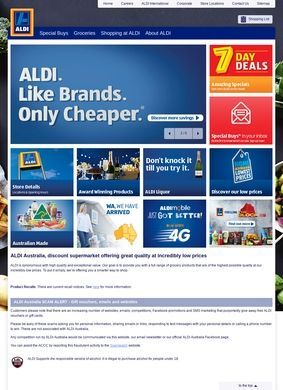
Running stores across most of Australia, ALDI Australia is the local arm of the German discount supermarket chain, and its website is where the weekly rhythm of the business plays out. The structure mirrors how the stores work: a steady grocery range that stays roughly the same, and a churn of one-off bargains that change twice a week. Anyone who has wandered the middle aisle of an ALDI store already knows the second part, and the site exists partly to tell you what is coming.
Special Buys program
That second part is the Special Buys program, and it gets prominent space online. The catalogue refreshes every Wednesday and Saturday with non-food items that have nothing to do with each other: power tools one week, ski gear or kitchen appliances the next, then apparel, homewares, electronics, sporting goods. It is a genuinely odd merchandising idea when you describe it plainly, and ALDI Australia leans into it by publishing the upcoming catalogue in advance so people can plan a trip around a specific item. The transient nature of the stock is the whole point. If you want the thing, you go that week or you miss it.
Grocery range and private labels
The grocery side is steadier and far more conventional. ALDI Australia lists fresh produce, meat, dairy, bakery items, frozen foods, pantry staples and drinks, most of it sold under the company's own private-label brands instead of the name brands you would find at a larger competitor. That private-label model is the engine behind the lower prices, and the site does not pretend otherwise. The range is narrower than a full-service supermarket on purpose, which is a trade-off shoppers either accept or they do not.
Store locator and online shopping
Practical tools sit alongside the catalogues. A store locator lets you search by suburb or postcode to find the nearest location, covering a footprint that spans New South Wales, Victoria, Queensland, South Australia, Western Australia and the Australian Capital Territory. There is an online shopping section covering selected groceries and Special Buys for delivery or click-and-collect, though the framing makes clear this is a slice of the in-store range, not the full catalogue. ALDI Australia also publishes recipes, which read as a soft way to push the private-label products into a shopping basket, and that is fine; plenty of supermarket sites do the same.
The corporate and about section covers the company's history and stated values, its sustainability commitments and supplier information. None of it is buried. The careers portal is more substantial than a token page, listing job vacancies across both retail stores and distribution centres, so someone looking for warehouse or shop-floor work can search current openings directly.
Safety recalls and feedback
There is also a customer feedback and product recall portal, and I found that worth singling out. Recall information is one of those things that is easy to scatter across press releases and hard for an ordinary shopper to locate when it counts. Having a clear route for it, sitting next to general feedback, is sensible housekeeping for a food retailer of this size. It shows ALDI Australia treats safety notices as part of normal operations and not something to handle quietly.
Mobile app features
The mobile app rounds out the digital offering. Available for both iOS and Android, the ALDI Australia app carries the catalogue, shopping lists and store location, which is a reasonable consolidation of the features most people would want on a phone while planning a shop. It does not try to be everything, and given how much of the experience is built around the rotating Special Buys, a phone-friendly way to browse the upcoming catalogue is arguably the most useful thing it can do.
Stepping back, the site is coherent in a way that reflects the business behind it. The discount model, the private-label range, the twice-weekly Special Buys, the limited but functional online shopping: each piece of the ALDI Australia website maps onto a real part of how the company operates, and there is little in the way of padding or grand claims. It reads like a tool built for shoppers who already understand the trade they are making, lower prices and a tighter range in exchange for skipping the big-brand variety.
Checking limitations of online ordering
There is a limitation, though it is one baked into the model itself. The online shopping section covers only selected products, so anyone hoping to do a complete weekly grocery run entirely through the site will find the coverage partial. ALDI Australia is still very much a stores-first business, and the website is honest about being a companion to the physical shops rather than a full replacement. The online side complements the in-store experience rather than trying to replicate it.
Customer reviews by location
On outside reputation, ALDI Australia draws a substantial volume of Google reviews across individual store locations, so public sentiment is easy to check by searching a specific store. The aggregate picture is consistent with what a large discount chain tends to accumulate: a mix of loyalty from regulars and frustration when stock runs short or queues run long. None of that changes what the website itself offers, and what it offers is clear and functional. Browsing upcoming Special Buys, checking a recall, finding the nearest store or hunting for a job, ALDI Australia covers the expected ground and a bit more without overstating what the brand is.