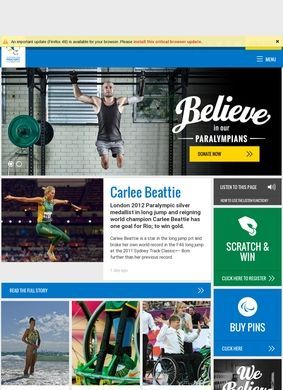
It is worth asking what the body that picks Australia's Paralympic teams actually puts on its website. Quite a lot, as it turns out. The Australian Paralympic Committee, which now operates publicly as Paralympics Australia, runs the site as the national home for Para sport in the country: it selects and manages the athletes who compete at the Paralympic Games, and the calendar the Australian Paralympic Committee works to stretches well ahead. Milano Cortina 2026, LA 2028 and Brisbane 2032 all sit on the horizon, with results and stories from Paris 2024, Tokyo 2020, Beijing 2022 and the 2000 Sydney Games already on record. That mix of forward planning and history gives the site a clear spine.
How classification determines fair competition
Beyond the headline job of running teams, the Australian Paralympic Committee goes into the machinery that makes Para sport function. Classification is one of the harder parts of the disability sport world to explain, and the site sets out how it works for athletes with physical, vision and intellectual impairments. This is not a topic many casual visitors arrive looking for, but anyone trying to understand how competition is kept fair will find the explanation in one place instead of scattered across a dozen federations.
Pathways for beginners and elite athletes
The answer shifts depending on which section you open, and that range is the most useful thing about it. For people thinking about getting into Para sport, The Start Line lays out a participation pathway. For athletes already competing, there is the Para Sport Equipment Enhancement Program, coaching support, and sports medicine and physiotherapy services, all of which speak to the practical cost and physical toll of competing at a high level. Equipment is a real barrier in Para sport, and a program aimed squarely at that problem is one of the more practically useful things the Australian Paralympic Committee offers.
Support for life after sport
Athletes are also treated as people with lives outside the arena. The Australian Paralympic Committee lists Beyond Sport Mentoring, a Building Employer Confidence program, the Pride in Sport initiative, and a Paralympic Speakers Program. These tackle the awkward truth that an athletic career is finite and that employment, identity and life after sport matter. A speakers program doubles as an income avenue for athletes and a way to push the Australian Paralympic Committee's message into rooms it would not otherwise reach.
Community outreach beyond elite sport
Then there is the community and education layer, which is broader than I expected from a team-selection body. The Australian Paralympic Committee runs an Education Program aimed at schools, with a full Schools section containing curriculum-linked material and school-based fundraising campaigns. There are also Indigenous PWD and Sport initiatives, Welcoming Australia work, and a Universal Design Guide. That last item points outward, toward how spaces and services treat disabled people generally, and it is what separates an organisation trying to shift attitudes from one that simply fields winning teams.
The education angle deserves a second look. Putting curriculum-linked content in front of teachers, and pairing it with fundraising that classrooms can actually run, is a sensible way to reach a generation early. It also keeps the Australian Paralympic Committee present in places far from any stadium, which over time is probably how public attitudes move more than any single Games broadcast does.
Funding channels for public and corporate support
Funding is handled openly, and the channels are varied enough to suit different givers. There are straight donations, a ParaLottery, AUS Squad membership, gifts in wills, and a Woolworths Double The Impact partnership that ties a major retailer to the cause. Spelling out so many routes, including the planned-giving option that most organisations bury, shows a body that depends on public support and is candid about asking for it. Corporate backing of that kind is what the Australian Paralympic Committee needs to operate at the scale of a national sporting institution.
Behind the registration numbers
One detail worth noting for anyone who cares about legitimacy: the site publishes its registration numbers, ACN 061 547 957 and ABN 41 810 234 213. That is the sort of plain administrative transparency that costs nothing to provide and quietly tells visitors they are dealing with the genuine national entity, not a lookalike fundraising operation. For the Australian Paralympic Committee, which solicits donations and gifts in wills, putting those identifiers in plain sight is the right instinct.
What holds the whole thing together is breadth without much padding. The Australian Paralympic Committee could have built a thin site that simply announced teams and posted results, and plenty of national bodies do exactly that. Instead the offering runs from elite selection through grassroots participation, classification mechanics, athlete welfare, schools outreach and several distinct fundraising programs. Each of those is a real function with its own page, not a label hung on an empty section.
Finding specific information among many programs
If there is a caution, it is that the sheer number of programs can make the site feel like a lot to take in on a first visit. Someone arriving to find one specific thing, say the classification rules for vision impairment or the steps to book a speaker, has to work past a wide menu to get there. That is a navigation point more than a content failing, since the underlying material is genuinely there once you reach it.
A search for public ratings or independent reviews of the Australian Paralympic Committee turns up mainly news coverage of athletes and Games results. This is the kind of organisation that people engage with through sport programs and direct participation, not through consumer review platforms, so the absence of scored ratings says nothing useful about the Australian Paralympic Committee one way or the other. For a visitor who wants to understand how Para sport is organised in Australia, who runs the teams, how athletes are classified and supported, and where the money comes from, the site answers those questions directly and in its own voice.
The Games it is pointing toward, from Milano Cortina through to a home Brisbane Games in 2032, give the content a clear reason to keep growing. The classification pages and the equipment program sit a click or two from the donation buttons, which is a fair picture of what this organisation actually does day to day.