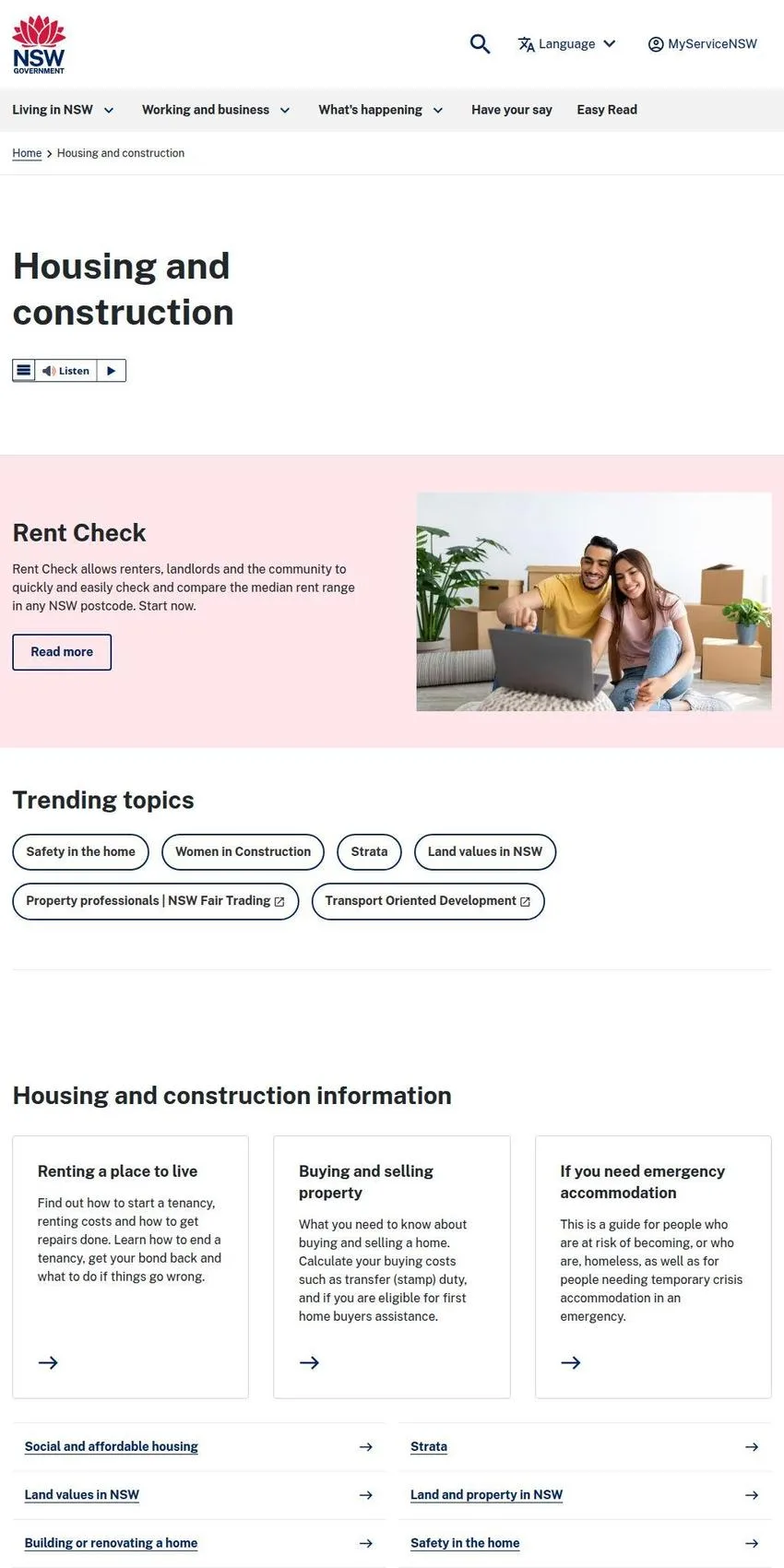
The housing and construction section of the New South Wales Government website gathers the state's rules for renting, buying, selling and building homes. NSW Fair Trading, the consumer protection agency within the Department of Customer Service, maintains the property pages and enforces most of the laws they describe. What was once published on a separate Fair Trading website now sits here under a single design, alongside planning announcements, grants and ministerial media releases.
The most used tool is Rent Check, which shows the median rent range for any NSW postcode so that renters, landlords and researchers can compare asking rents against actual bonds lodged.
Renting a place to live
The renting pages follow a tenancy from start to finish. They explain how to apply for a property, what a condition report must record, how to lodge a bond through Rental Bonds Online, and the minimum standards a rental property has to meet. During a tenancy, separate guides deal with getting repairs done, rent increases, and evictions and lockouts. A tenant who wants to put up picture hooks or make larger changes to a rental property has a page setting out which alterations need consent. At the end of a tenancy, the material turns to notice periods, cleaning and final condition reports, getting the bond back, and what being listed on a tenancy database means. The same area publishes residential tenancy forms, surveys and downloadable rental bond data.
Recent law changes are flagged prominently. Rent increases have been limited to once per year since 31 October 2024. Since 19 May 2025 landlords have needed a valid reason to end a lease and face limits on refusing pets. From 2 March 2026 tenants can choose to pay rent through Centrepay.
Support during hardship
A dedicated area covers emergency accommodation, low cost housing options, financial rental assistance, and the rules that let a tenant end a lease because of domestic violence. A separate guide is written for people who are homeless or at risk of becoming so, and for anyone needing temporary crisis accommodation in an emergency. Flood recovery pages explain what to do about damaged property and replacing lost documents after a disaster.
Buying and selling property
Buyer guides cover managing money for a purchase, deciding what type of property suits, and calculating costs with the Revenue NSW transfer duty calculator. The Home Buyer Assistance Finder checks eligibility for first home buyer schemes, including the option of saving a deposit through superannuation. Sellers get material on the sales process, agency agreements and the state's underquoting laws.
Because property agents, strata managers and conveyancers must hold a NSW licence, the section includes public registers where a buyer or seller can check a licence before signing anything. Further pages address investment property taxes, heritage properties, and residential land lease communities.
Strata and community living
More than a million people in NSW live under strata arrangements, and the strata pages form the largest single block of content. Reforms that started on 1 April 2026 changed the strata laws, with further changes later in the year, including a training requirement for strata committee members. Owners can consult a plain language guide to by-laws, levies, renovation approvals, pets, parking, noise and abandoned goods, or use the Strata Hub for annual reporting, which every scheme must complete.
For people serving on committees there are step by step instructions on running meetings, record keeping, appointing or changing strata and building managers, mandatory insurance, and the safety rules that apply to common property such as pools, windows and fire systems. A Strata Building Health Check helps schemes spot repair backlogs before they turn into legal and financial problems, and the Strata Building Bond and Inspections Scheme deals with defects in new apartment buildings.
Who does what in a scheme
Reference pages set out the difference between the owners corporation, the elected strata committee, and hired strata or building managers, along with the duties of chairperson, secretary and treasurer. Dispute pages explain the escalation path when owners, residents and managers disagree. A Strata and Property Services Commissioner oversees the sector, and community and neighbourhood schemes have parallel rules of their own.
Building, safety and contact points
The construction side of the section covers building or renovating a home, appointing a certifier, trade licences, loose fill asbestos insulation, and safety in the home. Land values and the role of the Valuer General have their own pages, as do retirement villages, from choosing a village through to leaving one. Recent publications listed on the landing page range from strata annual reporting fact sheets to Teacher Housing Authority reports, which gives a sense of how wide the section runs.
Fair Trading answers general enquiries on 13 32 20 during business hours, with a separate line for international callers and an Aboriginal enquiry service. The head office at 4 Parramatta Square is not open for walk in service; in person help runs through Service NSW centres across the state. Residential tenancy disputes that cannot be settled directly go to the NSW Civil and Administrative Tribunal, and the site explains how to prepare such an application. A Property Matters newsletter carries strata announcements and new resources for subscribers.





Business address
NSW Fair Trading
4 Parramatta Square, 12 Darcy Street,
Parramatta,
New South Wales
2150
Australia
Contact details
Phone: 13 32 20