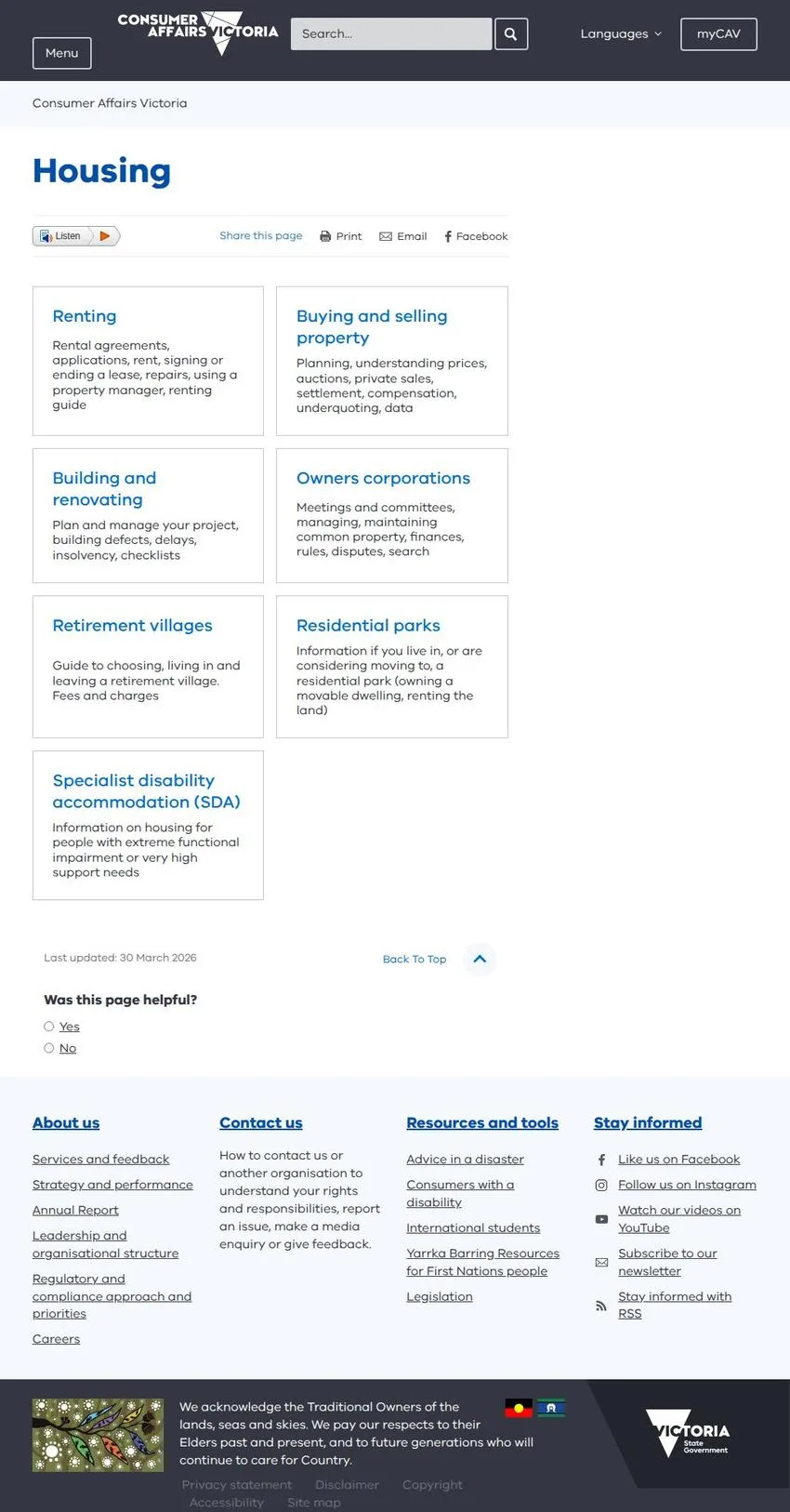
Consumer Affairs Victoria is the Victorian Government's consumer regulator, and its housing section holds the state's rules for renting, buying, selling, building and shared property ownership. The agency administers more than 30 legislative schemes, licenses estate agents and conveyancers, and funds assistance and advocacy services for consumers and renters experiencing vulnerability. Its stated task is to support Victorians in exercising their consumer rights and to make sure businesses and rental providers do the right thing.
The housing pages are organised into five areas: renting, buying and selling property, building and renovating, owners corporations, and retirement villages.
Renting under Victorian law
The renting area follows the life of a rental agreement, from applications and signing through rent payments, repairs, the use of property managers, and ending a lease. Victoria requires rental bonds to be lodged with the Residential Tenancies Bond Authority, which the agency administers, and bond lodgement and claims run through an online service. Significant changes to the rental laws begin on 25 November 2025, and a standing notice explains the new rules in advance.
An education campaign called Know the Funda-rentals condenses what every renter and rental provider needs to know: minimum standards, rent increases, repairs, pets, entry rights and notices to vacate. The separate Renters Guide walks through each stage of renting, from finding and applying for a property, through moving in and living there, to disputes and moving out. Both are aimed at people who have never dealt with tenancy law before.
Buying and selling property
The buying and selling pages concentrate on price transparency, and the underquoting rules are set out in unusual detail. An agent must not advertise a price below the seller's reserve or asking price, below a written offer the seller has already rejected as too low, or below the agent's own current estimated selling price. An advertised range may span at most 10 percent, and qualifying words or symbols such as "from" or "offers above" are prohibited. Agents must update price information for buyers whenever any of these figures changes during a campaign.
Every residential property an estate agent advertises for sale in Victoria must have a Statement of Information. It states a selling price or range, the three most comparable recent sales with address, date and price, and the median house or unit price for the suburb. Buyers can pick it up at an open for inspection, download it from the online listing, or request it from the agent, who has two business days to provide it. A property selling above its advertised price is not automatically evidence of underquoting, since competing bidders can push a sale beyond every estimate, but suspected cases can be reported to the regulator through an online form.
How agents set prices
Background pages explain where the numbers come from. When a seller first engages an agent, the sales authority document must contain the agent's estimated selling price, and that estimate has to be reasonable and based on research into comparable properties. The seller's own reserve or asking price can differ from the estimate, may be kept from the agent during the campaign, and at auction is usually settled only on the day. Buyers are entitled to ask an agent how any advertised figure was developed and whether it has changed.
Off the plan and riskier purchases
Companion pages cover planning a purchase, researching property types, buying off the plan, and the value of independent expert advice before signing a contract. A separate page warns about high risk property investment products marketed to retail buyers.
Owners corporations and other forms of housing
Apartment and townhouse owners deal with the owners corporation pages, which use the older term body corporate as a signpost for readers who know it. The material explains meetings and committees, the tiers into which schemes are divided by size, rules, maintenance of common property, and the finance, insurance and record keeping duties that committees carry. A public register lets anyone search for an owners corporation manager. Disputes have their own resolution path, ending at the Victorian Civil and Administrative Tribunal.
The building and renovating area helps owners plan and manage a project, with checklists and pages on building defects, delays and builder insolvency. Retirement village pages address contracts, fees and the process of leaving a village, a subject with long financial consequences for older Victorians.
The regulator behind the pages
Estate agents, conveyancers and owners corporation managers apply for and renew their licences through myCAV, the agency's online licensing system, and current application processing times are published openly. Workers licensed in another state can operate in Victoria under automatic mutual recognition.
Consumer Affairs Victoria translates its core guidance into more than 30 community languages, from Amharic to Vietnamese, and runs a general helpline on 1300 55 81 81 during business hours. The head office is at 121 Exhibition Street in Melbourne, with postal correspondence through a GPO box. Housing material sits beside the agency's other consumer content, covering shopping, car sales, product safety, scams and incorporated associations, so a renter or home buyer researching one problem can check related rights on the same site.






Business address
Consumer Affairs Victoria
121 Exhibition Street,
Melbourne,
Victoria
3000
Australia
Contact details
Phone: 1300 55 81 81