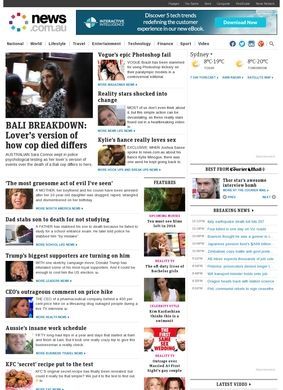
On any given weekday morning, News.com.au already has a dozen stories published before most people have finished breakfast. National politics, finance, sport, celebrity, travel, a live blog or two: the front page moves fast and covers a lot of ground. This is the digital flagship of News Corp Australia, and the pace is the point. The homepage is less a curated selection than a rolling feed from a company that publishes around the clock.
Multiple news verticals and sections
The breadth is worth understanding up front. News.com.au runs verticals for national and international news, business and finance, technology, entertainment, celebrity coverage, lifestyle, health, travel, sport, and weather. Each of those is an actual section with its own editors and subsections, not a navigation label. The property coverage connects through to realestate.com.au, the motoring section has its own beat, and opinion pieces get their own column space. Treating the site as a single destination undersells what it is: a collection of subject-specific publications sharing a platform.
State mastheads feed the national site
Two streams feed News.com.au. Some articles are produced directly for the site, but a large share is drawn from News Corp's state-based mastheads: The Australian, the Herald Sun, The Daily Telegraph, the Courier-Mail, and others. That pull-through is what gives the national feed its state-level texture. A Victorian story from the Herald Sun lands next to a Queensland one from the Courier-Mail, and News.com.au becomes the place that aggregates them for an audience that is not necessarily reading all four titles separately.
Regional stories surface nationally
The practical effect is real. State government decisions, regional court cases, local weather events: these get covered by the city masthead first, then surface on News.com.au for the broader readership. A purely national outlet would miss a lot of that granularity. The aggregation model, sometimes treated as a limitation, is the thing that makes the site unusually detailed about what is happening around the country.
Format variety across articles
Format range is also worth noting. There are written articles in every length from a quick two-paragraph update to long-form investigations. Video runs alongside text, photo galleries are common, and the live blog format gets switched on whenever something is breaking and changing by the hour. During federal election periods or major criminal trials the live coverage is continuous, with updates stacking through the day.
Free access with premium options
Most of what News.com.au publishes is free to read. That free access is a core part of why the site sits among the highest-traffic news destinations in the country. A portion of articles carries a premium label and sits behind a subscription paywall, but the majority of the day-to-day output is open. Advertising funds the free side, which is a straightforward arrangement and one that has been working for a long time. A digital subscription unlocks the premium content for readers who want it, and there are apps on iOS and Android for following the site through the day on a phone rather than a browser.
Depth pitched at different readers
Depth varies deliberately. Short fast pieces keep the breaking-news cycle moving, and longer analysis sits on top of that. Someone who wants to scan headlines and move on, and someone who wants to read into a story in detail, will both find something pitched at them. News.com.au has never tried to be one thing at one level, which is either a feature or an inconsistency depending on what a reader expects.
Sections function as separate products
One thing that takes a moment to appreciate: because the verticals under News.com.au are genuinely distinct, the experience depends on which section a reader settles into. Finance and Travel are pitched at different audiences. Someone who only wants sport can stay in Sport and ignore the celebrity coverage entirely; someone in for lifestyle content will rarely cross into politics. The sections behave more like separate products than like folders in a single archive. Readers who drift through the front page without finding a home section often underuse what the site offers.
Publishing pace and consistency
Volume and consistency are the two things News.com.au does reliably. The politics desk publishes through the day, sports results land quickly, and the front page has already cycled through several new leads by midday. That pace, combined with the reach the News Corp masthead network gives the site, puts News.com.au in a category of its own among Australian digital news publishers. No substantial public review record appears in searches, which is typical for a large media platform rather than a product people rate. The scale and longevity of the site in the Australian market are the evidence that matter, more than any aggregated score.
From breakfast to breaking news
News.com.au is where Australian news lives for a large portion of the population. The free access, the scope of the verticals, the aggregated state coverage, and the continuous publishing schedule combine to make it a reasonable first stop for anyone tracking what is happening in the country today, and what happened yesterday.