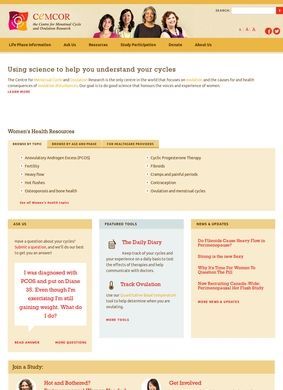
Where does someone go for science on ovulation when most health sites stop at periods and pregnancy? The Centre for Menstrual Cycle and Ovulation Research, run out of the University of British Columbia, fills that exact gap. The centre describes itself as the only centre in the world built solely around ovulation, what disturbs it, what causes those disturbances, and what they mean for the rest of a woman's health. That is an unusually narrow focus, and the depth that comes with the narrowness is the whole point.
The audience splits two ways, and the site is honest about both. One side is women across every life phase who want plain answers about their cycles, perimenopause, contraception, or a symptom that nobody has explained well. The other side is clinicians and researchers who need something more rigorous than a magazine column. The Centre for Menstrual Cycle and Ovulation Research tries to feed both groups from the same body of work, and for the most part the material is sorted clearly enough that a curious patient and a busy doctor can each find the level they came for.
Cycle tracking tools built on research
A lot of academic centres publish papers and leave it there. This one builds tools. The Daily Diary is a cycle-tracking instrument, and the Ovulation Tracker runs on the Quantitative Basal Temperature method, which ties the tracking back to a defined measurement approach instead of guesswork. These are not novelty widgets bolted onto a homepage; they grow out of the same research the centre is known for, so the data a person records is meant to mesh with how CeMCOR thinks about cycles in the first place.
Resource library organized by life phase
Around those tools sits a resource library that goes wide. It covers fertility, contraception, common menstrual concerns, and the treatments tied to each. The written articles are grouped by life phase, a sensible way to organise a topic where a twenty-year-old and a forty-eight-year-old have almost nothing in common in terms of what they need to read. A glossary helps with the terminology, which is useful here because hormone science drowns newcomers in jargon faster than almost any other corner of medicine.
Scientific foundation and peer review
The intellectual backbone is substantial: more than two hundred published scientific studies stand behind the centre's positions. That body of work is what separates an explainer from an authority. When the Centre for Menstrual Cycle and Ovulation Research makes a claim about perimenopause or bone health, there is a trail of peer-reviewed material under it, and the site does not hide that trail. For a reader who wants to check the basis of a recommendation, the path from a plain-language article to the underlying research is shorter than it usually is on health sites.
Connections between hormones and health
Topic coverage stretches past the obvious. Perimenopause gets serious attention, as do estrogen-related issues, bone health, thyroid concerns, and hormonal contraception. The thyroid and bone material is worth flagging, because those connections to the menstrual cycle are exactly the ones that general health writing tends to skip. Pulling them into the same place as the cycle content reflects how the body works, where one hormonal system rarely moves without nudging another.
Dr. Jerilynn Prior's research leadership
Much of the centre's identity traces back to Dr. Jerilynn Prior, its founding researcher, whose books are available through the site. That single-author throughline gives the Centre for Menstrual Cycle and Ovulation Research a consistent point of view, which cuts both ways. The upside is coherence: the articles, the books, and the research speak the same language and rarely contradict one another. The flip side is that a reader leaning hard on the centre's conclusions is leaning, in large part, on one scientist's lifetime of work, so it pays to read the cited studies alongside the summaries.
Community engagement and advisory structure
Two advisory bodies stand behind the operation, a Community Advisory Council and a Scientific Advisory Council. The split is telling. One council keeps the work tethered to the women it is meant to serve, and the other holds it to a research standard. Plenty of health sites claim oversight without naming who provides it; the Centre for Menstrual Cycle and Ovulation Research naming both councils is a concrete signal that the governance is real and not decorative.
Study participation, podcasts, newsletters
The centre also runs the kind of activity you would expect from a working research group. It posts study participation opportunities, so visitors can do more than read, they can take part. There are podcasts for people who absorb material by ear, news updates, and a newsletter for anyone who wants the centre's output to come to them. None of this is unusual on its own, but together it paints a place that is still producing, still archiving.
Forum questions and personal testimonials
A forum gives readers somewhere to talk, and the Ask Us Q&A section draws the most engagement. Hormone questions are deeply personal and often go unanswered in a rushed clinic visit, so a channel where they can be posed straight to the Centre for Menstrual Cycle and Ovulation Research addresses a real gap. Testimonials are present too. They are the softest evidence on the site and should be read as such, but next to two hundred studies and a named scientific council, a few personal accounts are hardly the load-bearing wall.
Independent reviews of the Centre for Menstrual Cycle and Ovulation Research are sparse online; a search turns up very little in the way of third-party ratings or public user scores. The site itself does not offer star ratings or aggregated feedback. That absence is worth noting, though the peer-reviewed publication record and the named advisory structure are a more meaningful check on quality than platform ratings would be in any case.
It is worth being clear-eyed about the limits. The Quantitative Basal Temperature method asks for daily discipline, and basal temperature tracking suits some people far better than others. The single-researcher gravity of the place means a reader chasing a full diversity of expert opinion will want to pair the Centre for Menstrual Cycle and Ovulation Research with other reading. And the focus on ovulation, while its defining strength, means anyone needing broad reproductive or general medicine will use this as one stop among several.
Set it against a mainstream resource like the Mayo Clinic's women's health pages, and the contrast becomes the recommendation. Mayo will give a reader broad, cautious, well-edited coverage of almost any condition, which is the right call when the question is general. But for someone trying to understand ovulation itself, its disturbances, and the cascade into bone, thyroid, and perimenopausal change, the Centre for Menstrual Cycle and Ovulation Research goes deeper into that one subject than a general clinic site ever attempts, and it shows its working while doing so. For the specific question of how a cycle functions and what to do when it does not, this is where the deeper answer lives.