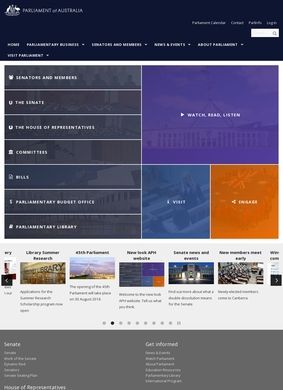
Australia's federal legislature publishes its own authoritative record at aph.gov.au, and the Parliament of Australia website is that record made accessible. It covers both the Senate and the House of Representatives, and it is built less as a promotional piece and more as a working archive of how laws are made, who makes them, and what was said along the way. The audience it expects is narrow and purposeful: citizens tracking a specific bill, journalists checking a quote, students writing an assignment, policy staff who need the primary text instead of a condensed version of it.
Following bills through parliament
The legislative tracking is the part most visitors will use. You can follow a bill from introduction through both chambers, see where it stalls or passes, and read the enacted Act once it clears. That is the core function of any legislature's website, and the Parliament of Australia treats it accordingly. Sitting alongside that is Hansard, the verbatim transcript of every public sitting, reaching back to 1901. Committee hearing transcripts are filed there too. For anyone who needs to know exactly what a member said, in what order, on what day, this is the unedited record. The depth of the back catalogue is genuinely useful in a way summaries never are, because a summary always involves a choice about what to leave out.
Hansard transcripts from 1901 onward
Parliamentary business spreads wider than the chamber floor. Chamber documents, committee reports, petitions, and Senate Orders all have their place, and the committee work itself is documented through inquiries, submissions, and the reports that come out the other end. This is where the slower, less televised part of legislating lives, and the Parliament of Australia does not hide it behind the headline votes. The Members and Senators section closes the loop between the abstract process and the people running it: profiles, voting records, and correspondence details for every elected representative. A voting record published next to a profile lets a reader hold a position to a name without taking anyone's word for it.
Committee work and member records
One resource sits a little apart from the day-to-day legislative machinery. The Parliamentary Handbook, hosted on its own subdomain, has functioned as the official reference of Australia's parliament since 1915. It gathers heads of state, parliamentary office holders, a chronology of parliaments, sitting calendars, and royal commissions into one place. That is a long institutional memory to maintain in a single location, and it answers the kind of factual question: who held which office in which parliament, a question otherwise scattered across decades of fragmented records. The Parliament of Australia gains a great deal of its reference authority here.
Parliamentary Handbook as institutional reference
The handbook is published through the Parliamentary Library, which also produces its own research papers and briefings. The library output occupies useful ground: it sits between the raw legislative record and the interpretation a reader might otherwise reach for in a newspaper or think-tank summary. Research produced for the parliament's own use, and then made publicly available, means the same briefing material that informs members is available to anyone who goes looking. Making those papers public is a meaningful choice, and the Parliament of Australia is richer for it.
Research papers from the Parliamentary Library
There is also an Issues and Insights strand offering analysis on current policy questions. That framing is broader and softer than the precise legislative tracking, and it reads more as commissioned commentary than primary record. It is a reasonable addition, though it is the section where a careful reader should keep the line between document and interpretation in mind.
Current policy analysis and election results
Beyond the records, the Parliament of Australia carries a 2025 Federal Election live results dashboard, the kind of timely feature that draws a large one-off audience and then settles back into the archive. Education resources round things out for students and visitors, pitching the same material at people who are not policy professionals and may never become them.
Department of Parliamentary Services operations
The Department of Parliamentary Services occupies a corner that feels operational more than civic. DPS handles facility management and support for Parliament House, and it also runs health and wellness services on site. Its presence on the Parliament of Australia website is a slight oddity: most visitors will never need to know who maintains the building or staffs its clinic. Its inclusion fits the logic of a single official portal that documents the whole institution, the building and its upkeep included, even if that material sits well outside what most people arrive looking for.
Primary source material for legislative questions
The Parliament of Australia does the thing an official legislative resource exists to do, which is to be the source rather than a retelling of it. The value is in the primary material: bills trackable in real time, transcripts going back more than a century, voting records attached to real names, and a handbook that has kept the institutional memory since before most of those records existed. When the question is what parliament did, said, or decided, this is where the answer originates and where secondary coverage eventually traces back to.
Accessibility challenges for new visitors
The gap worth noting is between the richness of the archive and how much it asks of a first-time visitor. The Parliament of Australia has assembled an authoritative body of material, but the breadth that makes it complete also makes it dense. The structure assumes you already know whether you want a bill, a Hansard entry, a committee submission, or a library paper before you arrive. Someone who knows the vocabulary of legislating will find what they need without much friction. Someone who does not may struggle to distinguish the live election dashboard, the historical handbook, and the facilities department at a glance. The Parliament of Australia has the substance; whether it successfully delivers that substance to citizens with no prior experience of legislative machinery is a separate question, and one the site only partially answers.