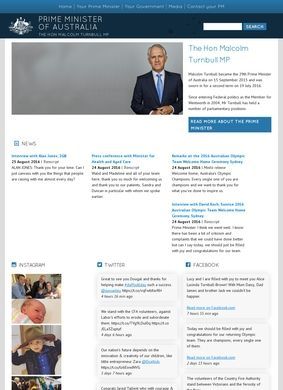
Arriving at the Prime Minister of Australia's Homepage without a particular agenda, the first impression is one of organisation rather than spectacle. The site is built around the office's actual outputs: speeches, policy summaries, transcripts, biographical information and a mechanism for the public to write directly to the office. That combination makes it something more deliberate than a campaign page parked at a government domain.
Publishing official statements directly
Start with the obvious purpose. The site exists to publish what the Prime Minister's office says and does, in the office's own words, with no intermediary deciding which sentence gets quoted. For Australian citizens and for the press, that distinction matters. When a transcript or a speech goes up on the Prime Minister of Australia's Homepage, it is the primary record, and everything downstream in the news cycle traces back to it.
Primary records for the news cycle
The Our Work section is where the Prime Minister of Australia's Homepage stops being ceremonial and gets specific. It groups the government's current priorities into plain themes a reader can follow without a political science degree. Cost-of-living assistance sits up front, which tracks with where public attention has been. Healthcare gets framed around Medicare and aged care reform. There is material on employment and economic opportunity, on support for first-home buyers trying to enter the housing market, and on national infrastructure spending.
Government priorities and programs
These read as ongoing programs with named mechanisms behind them, not slogans. The featured announcements include an expansion of paid parental leave to six months and a set of tax reform measures. Those are concrete enough to check against, to argue with, to hold the government to later. A policy page that commits to specifics is doing harder work than one that gestures at values, and this one commits.
Specific commitments on policy
On the Prime Minister of Australia's Homepage, the About the PM area covers the biography and the formal role, which is useful for anyone who wants to understand what the office actually does as opposed to what they assume it does. Your Ministry extends the same logic outward to the wider government: departments, the cabinet, who holds which brief. Taken together these sections answer a real question, namely who is responsible for what, and they answer it from the source.
Who is responsible for what
The Media section of the Prime Minister of Australia's Homepage is the part journalists and researchers will use most. Press releases, speeches and official transcripts collect in one place, available without paywalls or paraphrase. For anyone building an argument, writing a story, or checking what was said against what was reported, it functions as the document of first resort. The value is in the completeness and the directness, not in any commentary wrapped around it.
Press releases, speeches, transcripts
Transparency is handled with more care than expected. There is a Freedom of Information disclosure log, which lets the public see what has already been released under FOI requests instead of starting every inquiry from zero. The site also carries an accessibility statement, a privacy policy and a website disclaimer. None of those are glamorous, and most visitors will never click them, yet their presence says something about the standard the office is willing to be measured against. A government page that publishes its own disclosure log is inviting scrutiny rather than dodging it.
Freedom of information disclosure log
Social presence is wired in across Facebook, X, LinkedIn and Instagram, each linked from the site. This lets the office push the same official material into the channels where people already are, while keeping the website as the canonical home. Whatever circulates on those platforms can be traced back to the source document here, which is the right relationship between a fast feed and a slow record.
From official website to social channels
Navigation is the quiet strength of the Prime Minister of Australia's Homepage. The structure mirrors how someone would naturally search: who the Prime Minister is, what the government is doing, who runs which department, what was said. There is no clever reinvention of the menu, and that restraint is a feature. A citizen arriving with a single question can usually reach the relevant page in two or three clicks. The Prime Minister of Australia's Homepage does not bury its substance under design the way many official sites do.
How does navigation work here?
If there is a limitation worth naming, it is one built into the format itself. The Prime Minister of Australia's Homepage reflects the priorities and the language of the government that currently holds office, so it reads as the official position and nothing else. That is exactly what it should be. A reader looking for opposing analysis, costings disputes, or independent assessment of whether the paid parental leave expansion or the tax reform package will land as described has to go elsewhere. This site tells you what the government intends and claims. The judging of those claims is left to the reader, the press and the parliament.
What the government intends and claims
Used for what it is, the Prime Minister of Australia's Homepage is a well-organised primary source. The policy explanations are specific, the document archive is genuinely useful, the transparency apparatus is real, and the path from a visitor's question to an answer is short. Researchers studying current Australian governance, journalists reporting on it, or citizens trying to understand a particular initiative in the government's own framing will find the Prime Minister of Australia's Homepage a reliable starting point. Once the office has told you plainly what it is doing on cost of living, on Medicare, on housing and on tax, the published record is detailed enough to make a judgment from.