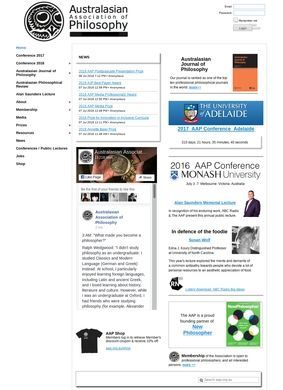
Running a journal since 1923 is not the kind of thing a marginal body manages. The Australasian Association of Philosophy has been doing exactly that with the Australasian Journal of Philosophy, and the century-long publication record is the clearest single fact on the site. The association covers academic philosophy across Australia, New Zealand, and Singapore, and its membership base is built primarily from researchers, lecturers, and postgraduate students, with a general membership path for people who follow the field without working inside it. Surfacing the Australasian Association of Philosophy through a business directory search is a reasonable starting point, but the site itself is where the substance actually lives, and it repays close reading.
Three journals with different editorial models
Publications are the core offering, and the Australasian Association of Philosophy runs three distinct titles rather than one. The flagship is the Australasian Journal of Philosophy. Alongside it sits the Australasian Philosophical Review, which uses open peer commentary: a lead article draws written responses from other philosophers, and then the author replies, so an argument gets tested publicly instead of disappearing after one anonymous round of refereeing. A third journal, Philosophical Exchange, is set to launch in 2026.
Three titles with different editorial models is a real spread for one association, and adding a new journal to the existing two is a meaningful commitment. The open commentary format in particular is worth noting for anyone trying to gauge the association's intellectual culture. It is a model that deliberately creates pressure on ideas, which is either appealing or uncomfortable depending on where you sit in the field.
Conference and student development programs
The annual conference is the other obvious fixture. The 2026 meeting runs in Aotearoa New Zealand from July 5 to July 9, with keynote speakers and themed streams that let participants group papers around shared questions instead of scattering across a generic programme. Separate winter schools run for postgraduate and undergraduate students. That second tier is the detail worth pausing on, because running a programme for undergraduates means putting time into students who may never publish in any of the three journals. It is slow, unglamorous work, and the Australasian Association of Philosophy does it anyway. The conference calendar is layered for different career stages, not organised around a single prestige event, and that layering reflects a genuine long view of the discipline.
Teaching support and professional infrastructure
There is curriculum development support aimed at philosophy teaching in both universities and schools, which extends the work past the seminar room. A jobs board lists academic posts. Internship opportunities are flagged separately. A mailing list handles current awareness, and an associations directory points toward related bodies. The Australasian Association of Philosophy holds registered charity status, which positions it as a not-for-profit organisation whose stated purpose is the health of the discipline rather than any financial return. For a body of this kind, that status is the expected and appropriate footing.
Prizes reflecting the discipline's values
The prizes map the field's values usefully. The Annette Baier Prize honours work connected to a major figure in the association's history. The Postgraduate Presentation Prize rewards the craft of presenting arguments in person, a distinct skill from writing them up on paper. A Media Prize recognises philosophy that reaches a public audience outside the academy. The Innovation in Inclusive Curricula Prize backs people rethinking how the subject is taught to broader and more varied groups of students. Read together, those four awards say that the Australasian Association of Philosophy cares about scholarship, public engagement, teaching practice, and the pipeline of new practitioners. It has committed its name and money to each of those categories, where they are visible and accountable, not left as vague institutional aspirations.
Membership options for different affiliations
Membership is handled online and includes a life membership option for those who want to settle the question permanently. The general membership path is the door for someone with no institutional affiliation, though most of the site's substance is pitched at people already working inside academic philosophy. The journals assume a reader who can follow specialist argument. The winter schools and prizes are for people at or near university. That is not a design flaw in the Australasian Association of Philosophy; a peak professional body is supposed to serve its profession first, and the general membership option is there precisely for the engaged outsider who wants to stay connected without claiming a role they do not have.
Outside the Australasian Association of Philosophy's own communications, public-facing third-party reviews of the organisation are sparse. A search across the main review platforms turns up no rated listings under this name. That is not unusual for an academic association; the relevant reputation is carried in the discipline itself, in citation records, in how the Australasian Journal of Philosophy is regarded by philosophers who publish in or referee for it. The Australasian Association of Philosophy has been operating long enough that its standing is not primarily a function of consumer review aggregators, and the absence of a Google rating says nothing useful about the quality of what it does.
From a century of publishing to current expansion
What gives the Australasian Association of Philosophy weight is how the pieces line up against each other. A 1923 journal, a second title built for open argument, a third launching soon, an annual conference with structured streams, two tiers of winter school, four prizes covering different parts of the field, curriculum work reaching into secondary schools, plus the quieter infrastructure of a jobs board, internship listings, a mailing list, and an associations directory: that is the full apparatus of a discipline's professional life, spanning three countries. Few subject associations carry all of it at once.
The breadth is the thing worth flagging for anyone weighing whether to engage. The publications alone could justify the Australasian Association of Philosophy's existence; the teaching and student programmes are arguably where it does its most durable work, because they shape who enters the field and how the subject is presented before anyone reaches a research seminar. The 2026 launch of Philosophical Exchange alongside the New Zealand conference in the same year points toward an organisation adding to its programme, and for a body with a hundred-year publishing record, continued expansion is a stronger indicator than mere preservation. The range holds together, and nothing in the picture looks like padding around a single strong programme.