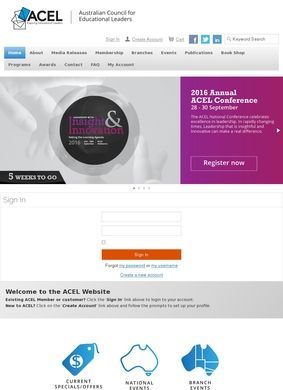
Almost every serious education body in Australia points its members somewhere, and for the people who run schools that somewhere is often the Australian Council for Educational Leaders. It is the national professional association for the leadership tier of the sector: principals, deputies, heads of department, system administrators, and the aspiring leaders coming up behind them. That single focus is what sets the tone for the whole operation. The membership is not teachers in general, it is the people responsible for teachers, and the programs are shaped accordingly.
Professional development and accreditation
The core of what the organisation does sits in professional development. Courses, workshops, and structured leadership training run through the year, aimed at the specific problems a principal or a system leader faces rather than classroom pedagogy. Alongside the training sits accreditation, a way for leaders to have their development formally recognised, useful in a career path where advancement often hinges on demonstrated capability. For someone stepping from a teaching role into a deputy principal chair, that ladder of recognised programs is the practical draw.
Leadership training programs
Conferences and events form the second pillar. The Australian Council for Educational Leaders runs gatherings that bring school and system leaders together, and the value there is partly the sessions and partly the room itself. Leadership can be an isolating job, and the chance to compare notes with people carrying the same weight is a genuine reason to show up. State-based chapters extend this across the country, so a leader in one state is not dependent on a single national event happening once a year in one city. The regional structure keeps the association close to the people it serves.
Conferences and regional chapters
Publications answer part of that question. The association puts out The Australian Educational Leader, a journal written for and often by people in the field, which gives members a steady flow of thinking on how schools are led rather than how they are taught. A journal like this does quiet work: it keeps a busy principal in touch with research and practice without requiring them to leave the building. Read over time, it becomes a record of how the profession's thinking shifts.
The Australian Educational Leader journal
The other part of the answer is the network. Membership plugs a leader into a national community of peers, mentors, and the events and chapters already described. For an early-career leader that connection can shape a whole trajectory, opening doors to mentoring and to the kind of conversation that never happens inside a single school. For a veteran principal it is a way to give back and stay current at the same time. The association has held this role in Australian education for a long time, and its programs reflect an organisation that knows its audience well.
Building networks across careers
It is worth being plain about the shape of the offering. This is a membership body, not a service you buy once and walk away from. The value compounds for people who use it: attend the events, read the journal, work through an accreditation, tap the network. A leader who joins and does none of those things will get little out of it, the same as any professional association. The programs are built for participation, and they reward it.
Membership structure and participation
Who the Australian Council for Educational Leaders serves also tells you who it does not. This is not a resource for parents comparing schools, nor for classroom teachers looking for lesson ideas. It sits one level up, in the space where school and system decisions get made, and it stays there. That narrowness is a strength. The training, the journal, and the events all speak the same language, and a member is never left wondering whether the content was written with their job in mind.
The breadth across a leader's career is one of the more useful things here. Someone can enter the orbit of the Australian Council for Educational Leaders as an aspiring leader taking a first development course, stay through the deputy and principal years using accreditation and conferences, and remain into system-level roles or mentoring. Few professional bodies manage to hold a member across that whole arc, and it means the relationship deepens over time instead of ending at the first promotion.
Scope and reach of the organisation
Set against comparable national associations in other professions, the mix looks familiar and sound: development, credentialing, a flagship publication, events, and regional presence. The Australian Council for Educational Leaders assembles these into a package aimed squarely at educational leadership, and there is no obvious gap in what a leader in this field would expect from a peak body. The regional chapters in particular do more than they might appear to, because they turn a national name into something a leader can reach without crossing the country.
Comparing with other peak bodies
A search for independent reviews of the Australian Council for Educational Leaders comes up mostly empty. It is not the sort of outfit that turns up in a business directory listing with a star rating next to its name, and there is no meaningful public review trail to weigh against what the programs themselves offer. That absence is ordinary for a membership body built around a professional tier, not the general public, and it says little either way about the quality of what members actually get.
For the leaders it is built for, the case is straightforward. The programs match the job, the journal keeps thinking current, the events break the isolation, and the accreditation gives development a formal edge. The Australian Council for Educational Leaders has earned its standing as the national home for this group, and the range of what it offers backs that up. What a member gets out of it in the end comes down to use, the same as with any professional association worth joining.