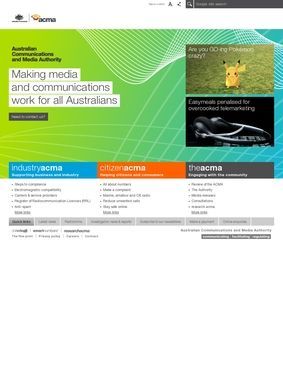
Acma.gov.au is the working site of the Australian Communications and Media Authority, the federal statutory regulator for broadcasting, radiocommunications, telecommunications, and online content across Australia. The remit is broad. It runs from the radio spectrum that carries mobile signals to the rules governing what a commercial television licence can and cannot do, and the site is built for two quite different audiences: ordinary consumers with a complaint or a question, and the industry participants who hold the licences and have to stay compliant with them.
What sits underneath is regulatory infrastructure, not marketing. The spectrum management function alone covers apparatus licences, frequency allocation, and the periodic spectrum auctions that decide who gets to use which slice of the airwaves. That is dry material, but it is the sort of reference a radiocommunications engineer or a licensing consultant returns to repeatedly, and having it published by the body that issues the licences removes any question of authority.
The Australian Communications and Media Authority carries statutory teeth behind almost everything it puts on the page, and that changes how you read it: these are not opinions about how the sector should behave but the actual rules it is measured against.
What the regulator handles
The clearest way to understand the Australian Communications and Media Authority is to look at the four pillars it regulates and how the site splits its attention between them. Telecommunications is probably the pillar most people brush up against. This is home to the Do Not Call Register, the numbering plans that govern how phone numbers are allocated, carrier and carriage service provider registration, and the consumer complaint routes for people who feel a telco has treated them badly.
Broadcasting is the second pillar, and it comes with its own dense layer of licensing detail: commercial television and radio licences, the community broadcasting sector, and the anti-siphoning rules that decide which sporting events must stay available on free-to-air. Then there is spectrum, already mentioned, and finally the newer online content and safety work tied to the Online Safety Act and the industry codes aimed at harmful material on the internet.
The online safety remit is the youngest of the four, and it shows. Where the broadcasting and spectrum sections have decades of accumulated rules and precedent, the internet content work is still building out its industry codes, and the Australian Communications and Media Authority publishes that material alongside the older functions without pretending it is equally settled. A reader who wants to understand how Australia is approaching harmful online content will find the current state of play here, codes and consultations included.
Spectrum and licensing tools
The part I find most genuinely useful is the set of register and licence search tools. A public database where you can look up who holds a given licence, or check numbering allocations, turns the Australian Communications and Media Authority from a rule-publisher into something you can query.
For anyone in the industry, that searchability is the difference between guessing and knowing. Licensees, spectrum holders, and the consultants who work around them all lean on these registers, and they are the kind of function that only the issuing authority can maintain with any credibility.
Consumer safeguards and complaints
On the consumer side, the site handles a real complaints function. Spam and unsolicited communications fall under the Spam Act, which the Authority enforces, and the same office pursues robocall matters and the Telecommunications Consumer Protections Code. If you have received relentless telemarketing or think a message broke the rules, this is where the enforcement power sits, and the Australian Communications and Media Authority explains the boundaries of what it can and cannot act on.
That distinction is easy to miss but saves people time. Plenty of consumer grievances about telcos belong instead to the Telecommunications Industry Ombudsman, and a well-run regulator site has to route people correctly instead of absorbing every complaint. The Australian Communications and Media Authority draws those lines, and the routing spares a fair amount of wasted effort on both sides.
The enforcement work also has a public-facing record. When the Australian Communications and Media Authority acts against a company for spam or breaches of a consumer code, the outcomes are documented, and that visibility is part of what gives the rules bite. A regulator that publishes its enforcement is a regulator you can hold to its own standards.
Who reads it and why
The audience for this material is genuinely mixed, and the content reflects that split without pretending everyone wants the same thing. Industry participants come for the consultation papers, the draft industry codes, and the guidance that tells a regulated entity how to stay on the right side of a rule before it becomes an enforcement problem. Those documents are technical and often lengthy, which is appropriate; a broadcaster's compliance officer is not looking for a summary.
Consumers arrive with narrower, more immediate questions. Can I stop these calls. Is this message legal. Who do I complain to. The Do Not Call Register is the obvious front door here, and it works as both a practical tool and a statement of what the Australian Communications and Media Authority is empowered to do.
Research and market reporting
Beyond regulation, the Australian Communications and Media Authority publishes communications market reports and statistics on how Australians use the internet, mobile services, and broadcast media. This is the quiet asset on the site. A journalist writing about mobile coverage, a policy analyst modelling data usage, or a student researching media consumption will find primary numbers here that are hard to source anywhere else with the same standing.
The reporting is a byproduct of the regulator's oversight role, which is exactly what makes it trustworthy: the figures come from an organisation that collects them as part of doing its job, not to sell a narrative. Few other Australian bodies sit closer to the raw data on communications usage than the Australian Communications and Media Authority.
The reports also feed back into policy. Consultation processes on the site frequently reference the same market data, so a reader who wants to understand why a particular rule is being proposed can trace it to the evidence behind it. That loop between measurement and regulation is visible if you spend any time in the research section.
One practical caution worth stating plainly: the site is large and the language is regulatory, so a first-time consumer visitor can land some distance from the answer they need. The volume of material that makes it valuable to industry is the same volume that can slow down a member of the public. That is the nature of a body that has to publish for lawyers and for callers annoyed by robocalls in the same breath.
The four regulatory pillars, the register search tools, the enforcement functions, and the market reports each occupy their own corner of acma.gov.au, and knowing which corner you want before you arrive makes the whole thing far more navigable.