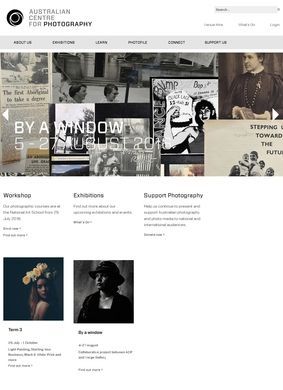
Is the Australian Centre for Photography still running as an independent gallery? No. The organisation that photographer David Moore founded in Sydney has been absorbed into a larger state museum, and the web address that once belonged to it no longer resolves to anything the institution controls. Type that URL expecting an exhibitions calendar and you land on a dead or repurposed page.
That is the blunt headline. Much of what the Australian Centre for Photography built is still worth caring about. It just lives somewhere else now.
A gallery built on lens-based media
For most of its life the Australian Centre for Photography was an independent nonprofit gallery and education institution, and for a long stretch it was described as the country's leading home for photography and lens-based media. That is a real claim with a real record behind it, not a marketing line someone bolted on.
The Australian Centre for Photography paired exhibitions with teaching. It gave wall space to serious photographic work and ran courses alongside it, which is how a small nonprofit becomes a fixture that working photographers pass through instead of a room that opens twice a year.
The phrase "lens-based media" is worth pausing on, because it signals a wider remit than framed prints. It stretches to video, digital work and photographic practice that does not fit the old gallery categories, and committing to that range early is part of why the institution stayed relevant to practising artists rather than settling into a museum of vintage prints. A place that only celebrated the past would not have mattered to the people making the next thing.
David Moore's founding vision
The place traces back to David Moore, himself a photographer, who set it up in Sydney as a dedicated home for the medium at a point when photography was still fighting for room on gallery walls. Founding it was a statement that the form deserved an institution of its own.
Whatever happened later, that origin gives the Australian Centre for Photography a lineage most galleries cannot claim. A working photographer starting a gallery for photographers tends to build something with different priorities than an administrator would, and the exhibition history bears that out.
Retrospectives and first-look exhibitions
The exhibition record is the strongest evidence of what the place meant. It mounted major retrospectives of Max Dupain, Olive Cotton and Merv Bishop, three names that anchor the history of Australian photography. It also gave early exhibitions to artists including Bill Henson and Tracey Moffatt, both of whom went on to international careers.
Putting established masters and emerging talents under one roof is a specific kind of curatorial ambition, and the list reads like a short course in the medium's Australian canon. This is the part of the Australian Centre for Photography's history that outlasts the closure, and it is the reason the name still comes up in conversations about the medium here.
Hibernation and the Powerhouse handover
The ending was financial. The Australian Centre for Photography announced what it called a hibernation during the COVID period, after funding fell away and the numbers stopped working. Plenty of organisations never come back from that word.
This one was rescued, in a fashion. The Powerhouse Museum, the Museum of Applied Arts and Sciences, a New South Wales state institution, acquired the Australian Centre for Photography, taking on the photography archive and an endowment of roughly 1.6 million dollars. It now continues the mission under the banner of Powerhouse Photography: commissions, acquisitions, research fellowships, internships and publications. The archive and the money survived. The independent name did not.
That list is worth reading closely, because it shows the mission was kept rather than shelved. Commissions and acquisitions mean new work still enters a public collection under this lineage. Research fellowships and internships mean the teaching instinct carried over. Publications keep the scholarship going.
For anyone who valued what the Australian Centre for Photography did, the practical news is that the functions continue inside a much larger and better-funded state museum, even if the front door and the letterhead have changed. Whether that trade is a loss or a rescue depends on how much the independence itself mattered to you.
The site today and where the work went
Here the review runs into a wall, and honesty demands saying so. The live site could not be reached at all. One attempt failed on a TLS certificate mismatch, with the host's certificate pointing at a generic registrar placeholder instead of the organisation; a second method came back forbidden. In plain terms, the domain looks defunct or handed off, which is exactly what you would expect once the institution stopped operating on its own.
A certificate that resolves to a registrar's parking infrastructure is usually a sign the address has lapsed and been picked up by the hosting company, not a sign of an active site with a configuration slip.
Because the site would not load, its contact details, opening hours and any current information cannot be assessed. There is nothing there to judge, and pretending otherwise would be dishonest.
Outside traces are faint. A Tripadvisor attraction page for the Australian Centre for Photography exists, but no aggregate score or review count showed up in the listing, so it gives no measurable reputation signal one way or the other. A Wikipedia article records the history in more detail than any surviving official page does, and an arts directory still carries an old Darlinghurst address in Sydney, which now points at a location the organisation has left. No Trustpilot, Google or Yelp rating turned up anywhere in the search, so there is no crowd verdict to lean on either.
None of that is surprising for an institution that closed its independent doors. Consumer review platforms track places you can walk into and buy a ticket for; a defunct gallery folded into a state museum falls off those systems fast. The record that survives is archival and encyclopaedic, which is the appropriate place for it, and it tells a consistent story about what the organisation was.
So the verdict is split, and it should be. As a working website to visit, the Australian Centre for Photography is effectively gone: the URL is dead, contact cannot be verified, and there is no live programme behind it. As a piece of Australian cultural history, the Australian Centre for Photography still matters, and the collection it built now sits inside the Powerhouse. Powerhouse Photography is where that legacy now lives, and this entry works best read as a headstone with a forwarding address.