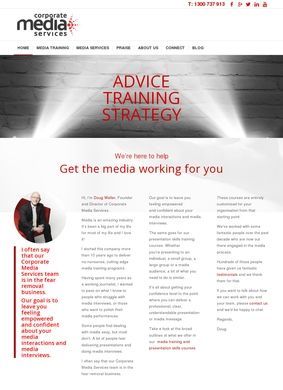
A senior executive gets a call from a journalist about an unfolding problem, and the clock is already running. That moment, when someone untrained in handling reporters has to speak on the record under pressure, is exactly what Corporate Media Services prepares people for. The Australian firm has been running media and communications training since 1998, and its core work is teaching the people who end up in front of cameras and microphones how to do it without making the situation worse.
Training programs offered
The training side covers a fairly complete spread. Corporate Media Services offers executive media training and dedicated spokesperson training, public speaking and presentation skills, and a separate program built specifically around crisis media communications. That crisis focus is the part that reads as genuinely useful, because it is one thing to give a polished interview when the news is good and another to hold your line when the questions are hostile. The firm runs webinars too, so the format is not limited to a single room and a single day.
Consulting and strategy services
On the consulting end, the offering moves past coaching into media strategy and ongoing media consulting. That distinction is worth thinking through for buyers deciding what they actually need. Some organisations want a one-off skills session before a product launch or an annual report; others want someone helping shape how they talk to the press over a longer stretch. Corporate Media Services appears set up to handle both, and the programs are described as customised to each client instead of being run off a fixed syllabus.
Who gets trained
The client list named on the site is broader than the usual corporate-only crowd. Executives, managers and senior staff are the obvious audience, but Corporate Media Services also points to first responders and subject-matter experts. That mix makes sense once you think about who gets pulled in front of a microphone unexpectedly. A fire officer or a technical specialist can suddenly become the face of a story without ever having asked for the role, and they tend to need a different kind of preparation than a CEO doing a planned sit-down.
Instructor backgrounds and credentials
The trainers are described as award-winning senior journalists with backgrounds in reporting, editing and presenting, both across Australia and overseas. For this kind of work, that pedigree is the right one. People who have spent careers asking the difficult questions and deciding what makes the cut know precisely where an interviewee tends to slip, and a former editor can explain why a quote gets used or buried in a way a generic presentation coach cannot. The credibility of media training rests almost entirely on whether the instructor has lived inside the newsroom, and Corporate Media Services leans on that directly.
Reaching clients across Australia
Reach is national. Corporate Media Services delivers face-to-face and online, listing every Australian capital, Melbourne, Sydney, Brisbane, Canberra, Perth, Adelaide, Hobart and Darwin, alongside work with international clients. For an organisation with offices scattered across states, or for one that simply prefers in-person coaching, that coverage removes a practical obstacle. The online option fills the gaps for anyone outside those cities or short on time.
Beyond the paid programs, there is a blog with media tips and a resources section holding articles, videos and media links. Free material like this lets a prospective buyer sample how the people behind the training think about handling the press, which is useful before anyone picks up the phone. It is a reasonable sign of confidence to put some of that expertise out in the open. Whether the depth is genuinely useful or superficial is something a visitor can judge in a few minutes.
Contact details are plain to find, which matters here more than it might for a shop selling a fixed product. Training of this sort is bought through a conversation, so the buyer wants to reach a person quickly. The site lists a national phone number, and the director, Doug Weller, publishes a direct mobile alongside a personal email. Putting the named principal's own line on the page is a small thing that points to accountability; the person responsible for the business is reachable, not buried behind a generic enquiry form.
The gap in the picture is outside validation. A search for independent reviews of Corporate Media Services turned up nothing usable, with results pointing to unrelated companies sharing the name in the United States. That is not evidence of anything bad, since plenty of specialist B2B training firms operate largely through referral and repeat work and never accumulate a stack of public ratings. It does mean a prospective client cannot lean on a body of third-party feedback the way they might when choosing a consumer service. The longevity fills some of that absence: a firm trading in this niche since 1998 has clearly kept clients coming back, because media training is a market where a weak operator does not last decades.
The strengths are concrete. A clear and focused service range, instructors with the exact background the work demands, genuine national and online delivery, customised programs, and a director who makes himself directly contactable. The weaker spot is simply that an outside buyer has to take the quality on the firm's own account, supported by its track record, instead of cross-checking against published reviews. For most organisations choosing media training, the deciding factor is a conversation with the trainer and a sense of whether the approach fits the people who will actually be coached. On the published evidence, Corporate Media Services has the credentials and the tenure to make that conversation worth having.