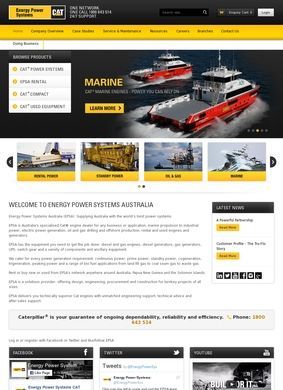
Cat diesel generators are the anchor here, sold in both prime and standby configurations, and that single fact tells you most of what you need to know about who Energy Power Systems is built for. Trading as EPSA, this is the authorised Australian supplier of Caterpillar power systems, covering Australia, Papua New Guinea, and the Solomon Islands. The catalogue runs well past generators into industrial engines, marine power systems, oil and gas equipment, and lithium-ion Battery Energy Storage Systems sold as portable units. None of this is consumer-facing kit. It is the sort of equipment a mine site, a data centre, or a defence contract specifies, and the company makes no pretence otherwise.
Authorised dealer status for three manufacturers
What gives the listing weight is the dealer status. Energy Power Systems holds authorised warranty dealer standing for Caterpillar, Deutz, and MWM, which is a harder thing to claim than a generic reseller badge. A buyer evaluating a six-figure standby system cares whether the supplier can honour a manufacturer warranty and source genuine parts, and that authorisation answers the question directly. It also sets a floor under expectations: an outfit carrying three separate manufacturer authorisations has been audited to standards a casual trader never faces, and Energy Power Systems puts that front and centre. The used equipment line leans on the same credibility: ex-rental fleet items resold after certification by Cat-trained engineers, which is a sensible way to move depreciated stock without dumping unknown machines on a customer who depends on uptime.
Rental division covers generators and site equipment
The rental division is more interesting than a bolt-on revenue stream usually is. It covers generator sets, compressed air equipment, and temperature control systems, available on short- or long-term hire with national reach. That combination is worth noting because the customers who need a 500kVA genset for a shutdown often need site cooling or compressed air in the same window, and sourcing all three from one supplier removes a coordination headache. Long-term hire also opens a door for operators reluctant to carry the capital cost of standby plant they hope never to switch on, and Energy Power Systems pitches the hire fleet at exactly that hesitation.
Certified used equipment from ex-rental fleet
Certified used stock sits logically beside the rental arm, since ex-rental units are the natural feedstock. A machine that has been maintained on a service contract, then inspected and signed off before resale, carries a different risk profile than something bought at auction with no history. Whether the pricing reflects that assurance is not something the site spells out, and a serious buyer would want the inspection paperwork in hand before placing an order.
Service agreements and remote monitoring
Service is where the company tries to keep customers past the initial sale. Energy Power Systems offers Customer Value Agreements, extended service coverage, parts supply, remote monitoring, and a separate gas parts and service line. Remote monitoring is the line item worth pausing on, because for standby plant the whole point is knowing the unit will start when grid power fails, and a monitored asset removes the guesswork of manual test runs. The CVA structure suggests Energy Power Systems wants maintenance locked into a planned schedule, not left to ad hoc callouts.
Industries served across mining to food processing
The roster of industries served is long, and for once the length reads as descriptive rather than padded. Mining, agriculture, construction, data centres, marine, government and defence, health and education, manufacturing, oil and gas, renewable energy, utilities, waste management, facilities management, and food processing all appear. These are the sectors that actually buy industrial power, and the spread reflects a supplier with branch coverage broad enough to serve remote mine camps and metropolitan data centres alike. Energy Power Systems operates multiple branches across the three-country territory, which is the kind of physical presence that counts when a generator needs a technician on site within hours, not days. An entry in a business directory only tells you so much; the branch network is what confirms this is a logistics operation, not a sales office with a wide product list.
Papua New Guinea and Solomon Islands operations
Reach into Papua New Guinea and the Solomon Islands is a genuine differentiator. Power infrastructure in those markets is unreliable, the logistics harder, and a Caterpillar dealer with established branches there is solving a real problem for resource projects and government work. It also explains the heavy emphasis on standby and prime power: in places where grid reliability cannot be assumed, on-site generation is the baseline, not a contingency.
On reputation, the picture is lopsided and honesty demands saying so. The reviews that surface are about Energy Power Systems as an employer, not as a supplier. Glassdoor carries 17 employee reviews at 3.7 out of 5, with 81 percent saying they would recommend the company; SEEK shows 19 employee ratings at 3.8 and a separate set of 19 reviews at 4.3. A workforce that mostly recommends its employer is a fair proxy for an organisation that is not in turmoil, and for a technical supplier such as Energy Power Systems the competence and retention of engineers does feed back into service quality. But it is an indirect reading.
Where is the customer feedback?
No customer-facing platform turned up: no Google reviews, no Trustpilot, no ProductReview.com.au entry for this entity. That is not damning in a B2B field where deals close through tenders and account managers rather than online ratings, yet it leaves an outside observer without the one thing that would confirm the service promises hold up in the field.
Contact follows the same B2B logic. A toll-free national number sits on the site and a contact form is available, which is the route most procurement enquiries take anyway. Branch locations are listed, though specific street addresses and direct email contacts were not surfaced from the homepage, so reaching a particular depot likely means going through the central line first. For a company whose buyers negotiate contracts instead of walking in off the street, that is workable, if a touch less open than a full directory of branch details would be. Energy Power Systems clearly expects the first move to be a phone call or a form.
The substance is not in doubt. Energy Power Systems sells real equipment from named manufacturers, backs it with authorised warranty standing, and runs the service, rental, and certified-used arms that a serious power supplier needs. The catalogue is deep, the dealer credentials check out, and the regional footprint is the rare kind that competitors cannot easily replicate. What none of it resolves is how Energy Power Systems performs once the generator is installed and the grid actually drops. Employee ratings in the middling high-threes and no customer voice anywhere online mean the published evidence runs out at the spec sheet. That is not unusual for B2B suppliers of this scale, but a prospective buyer should go in knowing the independent verification simply is not there yet.