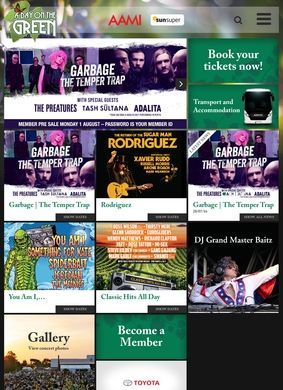
Running for more than two decades on a single idea takes either luck or genuine product-market fit. A Day On The Green started in 2001 with two shows and has since put on over 500 events drawing past four million people. Run by MG Live under the Mushroom Group, the series sticks to vineyard and winery settings instead of arenas or city parks, which gives the brand a very particular shape. These are not gritty club nights. The pitch is grass, wine country, and an outdoor stage in the late afternoon sun, and that pitch has been consistent since day one.
A touring series across multiple regions
One thing that takes a moment to register about A Day On The Green is the geography. This is a touring series, not a fixed venue. Events move across Hunter Valley and Orange in New South Wales, Geelong in Victoria, Mount Cotton in Queensland, the Barossa Valley and Adelaide Hills in South Australia, Swan Valley and Perth in Western Australia, and Tasmania, with dates in New Zealand on the schedule as well. The site has to function as a touring schedule, and it reads best that way: pick a region, see which artists are coming, check the venue details for that specific stop. It is a different browsing experience from a single-venue promoter, and once you understand the model, the layout makes sense.
How does the ticketing process work?
Event listings are the backbone, organised around lineups and vineyards. Each show pairs a headline act, usually a mix of international names and Australian artists, with a named property. That pairing is the actual product. Tickets are sold only through Ticketmaster, with no in-house checkout, which is a clean arrangement but also means the buying experience is entirely outsourced. If something goes wrong with a ticket, you deal with Ticketmaster, not with A Day On The Green directly. That is worth keeping in mind before the purchase, though for straightforward sales it causes no friction at all.
Membership benefits for repeat attendees
There is an online store for merchandise and a membership program that turns out to be more useful than a standard mailing list. Members get presale access, early announcements before public on-sale, and offers held back for the fan club. For a series where popular shows sell out, that presale window is a real advantage, not a token perk. Anyone attending more than once a year has a concrete reason to join. An FAQ and Help section rounds out the site, covering accessibility, ticketing, and membership questions, which are exactly the three areas an outdoor multi-state event needs to address clearly. The FAQ is genuinely useful and goes well beyond boilerplate.
Social media presence and audience reach
The social footprint is large and active: more than 161,000 followers on Facebook, plus presences on Instagram, Twitter, TikTok, YouTube, and Spotify. For a concert promoter, that following functions as both a marketing channel and a rough proxy for audience size, and 161,000 is a number that accumulates through two decades of repeat attendees. The Spotify presence fits naturally for a music brand, more so than it would for most event promoters.
Limited third-party reviews and ratings
The editorial coverage does not match the scale of the operation. The Guardian reviewed a specific A Day On The Green concert, and PubClub.com ran an event review, so A Day On The Green has been written up by outside outlets. That counts for something. No aggregate star rating appeared on Google, Trustpilot, or Tripadvisor with a verified score attached to the parent brand. For a company that has hosted four million attendees the absence is unusual, though it partly reflects how event series work: people review individual shows, individual venues, and the ticketing platform, so the organiser ends up without one tidy consolidated number. The audience clearly exists; there is just no single place where its collective opinion is recorded.
Contact options and support channels
Contact follows a similar pattern. There is no phone number or email on the homepage. Everything routes through the Help and FAQ section, and ticketing questions go to Ticketmaster. The social channels are listed and are clearly the preferred way A Day On The Green communicates with its audience. For an operation this size, the absence of at least a general enquiries line is a genuine, if minor, friction point. If a question falls outside the FAQ and is not a Ticketmaster matter, the path forward is less clear than it should be.
Setting expectations for attendees
What the site does well is set expectations honestly about what these days actually are. The framing is consistent throughout: outdoor, seated or lawn, wine-country venues, a curated handful of acts per show. A Day On The Green does not oversell. Returning attendees will know roughly what they are buying before they reach the Ticketmaster checkout. The membership program is the standout feature for that repeat audience, and the multi-state spread means A Day On The Green is genuinely national, not a Melbourne or Sydney concern wearing a national label.
Accountability gaps in customer support
The doubt that remains sits on the gap between scale and accountability. A series this large, leaning entirely on Ticketmaster for transactions and an FAQ for support, gives an attendee very little direct line to the organisation itself when something goes sideways: a cancelled show, an accessibility need the FAQ does not anticipate, a refund dispute that falls between the promoter and the ticket seller. The track record over two decades argues that those situations get resolved, but the site does not make clear how. A Day On The Green has clearly built a loyal audience over a long time. The gap is in how it handles that audience when things do not go to plan, and the published evidence leaves that question open rather than settled.