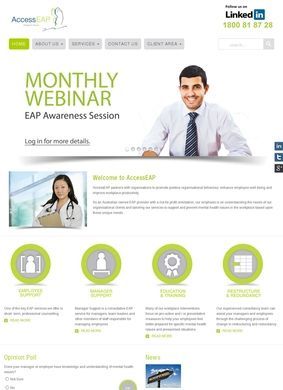
A 24/7 Critical Incident Support line is the detail that tells you what kind of operation Access EAP is. When a workplace goes through something traumatic, a death, an accident, a violent event, they put a clinician on the phone or in the room within the hour. That single service shapes how the rest of the offering reads, because everything else, the counselling, the onsite visits, the manager coaching, orbits the same idea of being reachable when an organisation genuinely needs help.
Crisis support available 24/7
The core product is a confidential Employee Assistance Program. Employees can book sessions to work through career pressure, financial stress, or relationships that have started to bleed into how they function at work. Counselling like this is fairly standard across the EAP sector, so with any provider what separates them is less whether they offer it and more how much sits behind it. For Access EAP the backing is a not-for-profit founded in 1989, Australian-owned, working across Australia, New Zealand, and South-East Asia. More than three decades in one narrow field is the sort of fact that does quiet work on its own.
Confidential counselling for employees
Onsite Support extends the same logic, sending clinicians out to meet people in person, either one-to-one or in a group. Some workforces, blue-collar industries in particular, are slow to use a counselling line they have only read about, and being physically present changes the odds that anyone opens up. Access EAP has built sector-specific programs for exactly those environments. Blue-collar industries, education, government, and healthcare each get a tailored approach instead of one generic program stretched across very different workplaces.
Onsite clinicians for workplace sectors
Then there is the layer aimed at the people running things. Leadership and Manager Support gives decision-makers somewhere to take the awkward questions: how to handle a struggling team member, how to read warning signs, when to escalate. Psychosocial Risk Management covers the regulatory side of the same concern, helping employers identify workplace hazards and stay compliant with obligations that have grown sharper in recent years. That pairing is telling. Access EAP understands an EAP has to serve the legal and structural environment the employer is responsible for, as much as the individual in distress.
Leadership coaching and risk management
The website is built to route people quickly. A booking portal lets an employee arrange counselling without a phone call, and live chat is there for anyone who would rather type than talk. A mobile app puts round-the-clock access to counselling and wellbeing resources in a pocket, which counts for something given that the hardest moments rarely arrive during office hours. None of this replaces the human service, but it lowers the barrier to reaching it, and for a population that often hesitates before asking for help, a lower barrier can be the difference between a call made and a call avoided.
Digital booking and mobile access
The login structure says something about how Access EAP is wired internally. Separate portals exist for employers, ambassadors, and associates, alongside the employee-facing booking flow. That setup shows the organisation runs through a network of contracted clinicians and workplace champions rather than a single central office. For an employer weighing providers, the spread of associates can mean broader geographic reach and shorter wait times. It also puts the consistency of care squarely on the provider's vetting and coordination. The site does not explain how that network is managed day to day, which is a fair question to raise during a procurement review.
Network of contracted clinicians
Contact details are easy to find. A freephone number, 1800 818 728, sits openly on the site alongside a physical address at Level 8, 75 Castlereagh Street in central Sydney, and a clinical response email. For a service where someone might be in genuine crisis, having a real street address and a freephone number visible without hunting is part of the trust the whole arrangement rests on. Access EAP gets that right.
On the consumer platforms most procurement teams check first, Google, Trustpilot, and similar, there are no client-facing ratings to point to. That absence is unsurprising for a business-to-business EAP: the people using the counselling are bound by confidentiality and are not going to leave a public star rating about something so private. Still, it means an employer cannot lean on a wall of testimonials when making the case internally. The judgement falls back on the service structure and the provider's track record.
Glassdoor ratings and employment feedback
The one substantial set of reviews comes from Glassdoor, where Access EAP carries 35 employee reviews at 2.0 out of 5 stars. That is worth reading carefully, because it measures what it is like to work there, not what it is like to be a client. Internal morale and the quality of care delivered to an employer's workforce are different things. Plenty of organisations score poorly as employers while still doing solid work for the people they serve externally. Even so, a 2.0 is low enough that a rigorous procurement process would reasonably ask how clinician satisfaction and retention touch service consistency, given how much the model depends on the associate network. Indeed also lists the company with a careers profile, which adds presence without adding a verdict.
Access EAP comes out of this review with a clear profile. The clinical offering is broad, sensibly split by sector, and backed by a long not-for-profit history and a 24/7 crisis capability that many cheaper programs cannot match. The digital tools are practical, the contact route is specific, and the structure looks built for scale across three regions. The soft spot is limited external evidence: no public client ratings, and the only sizeable feedback on record being an employer score that speaks to the internal workplace rather than the care delivered. The offering is strong enough to shortlist on its published merits, and the outstanding question about staff satisfaction is concrete enough to put directly to Access EAP during any evaluation process.