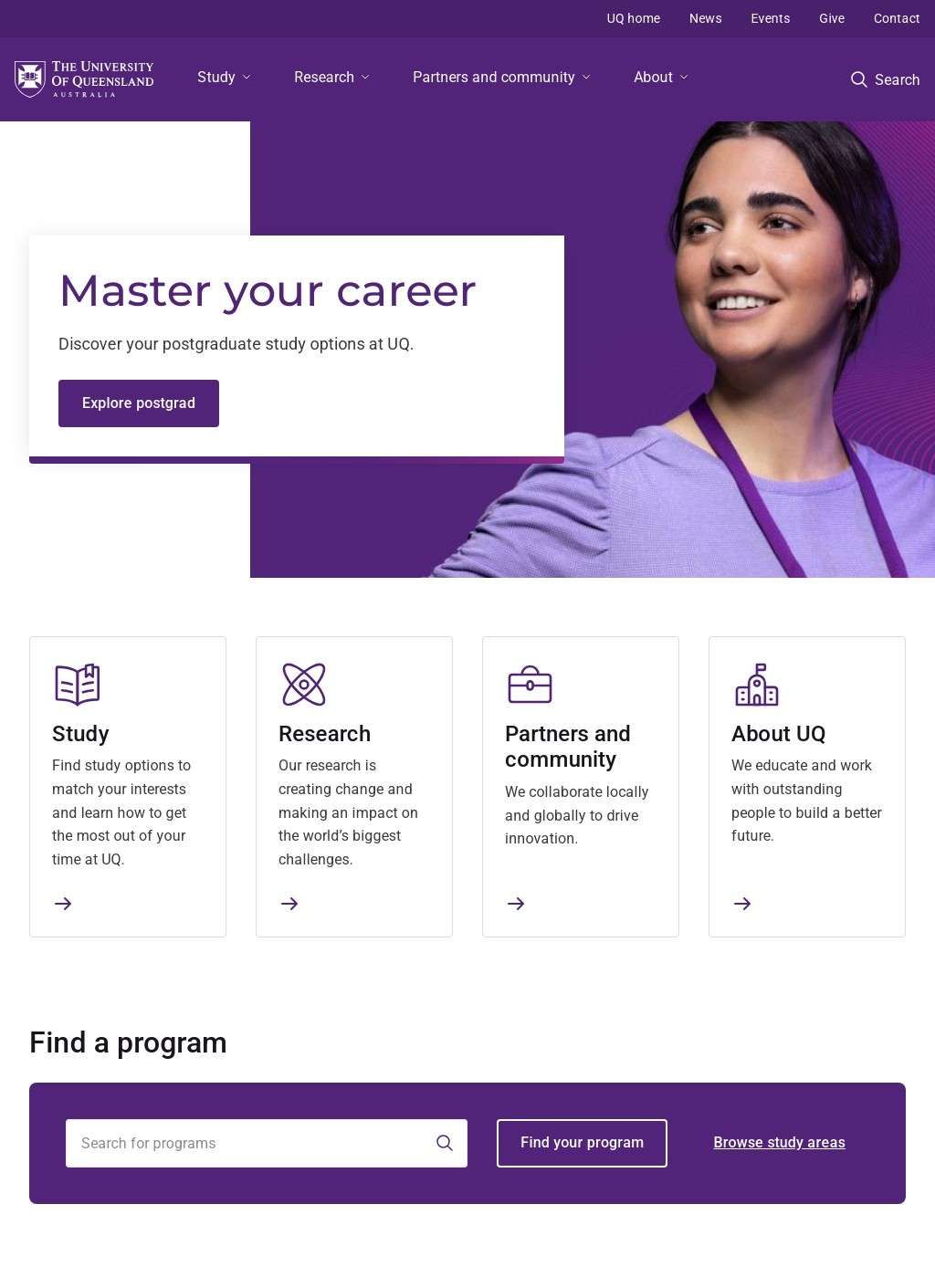
A university that ranks 40th in the world and first in its own state for graduate employability is not a place that needs to work hard for attention, and the University of Queensland site reads accordingly. It puts the substance up front: degrees, research, and the machinery that supports both, laid out for people trying to decide whether to study, research, or partner here. The QS World University Rankings 2027 placement sits in plain view, as does the graduate employability claim, and those two numbers frame most of what follows.
Degree programs and admission pathways
Start with the teaching side, because that is where most visitors arrive. The site covers undergraduate and postgraduate programs spread across faculties, schools, centres and institutes, which is the usual sprawl of a large public research university, and it does the harder job of routing different people to the right entry point. High school leavers get one pathway, non-school leavers another, and international students a third, each with its own admissions guidance. That separation matters because the questions those groups ask barely overlap. Alongside the degree programs sit short courses and professional development, so the offering is not limited to people chasing a full qualification. Scholarships and financial support get their own treatment at the University of Queensland, which is the kind of practical information a prospective student actually needs before committing years and money.
Research infrastructure at the Graduate School
Research is where the University of Queensland stops looking like a teaching institution with a research wing and starts looking like the reverse. The Graduate School handles PhD, MPhil and professional doctorate candidates, and the site describes research capabilities across a long list of specializations, which is what you would expect from an institution operating at this scale. What lifts it above a directory of departments is the supporting apparatus: shared facilities and infrastructure that individual researchers can draw on, ethics support for work that needs clearance, and structured routes into industry partnership.
Industry partnership opportunities
That last piece is worth dwelling on. A lot of universities talk about working with industry and then bury the mechanism. Here it reads as an actual offering, partnership opportunities presented next to the research capabilities they connect to, which is the arrangement a company scouting for a collaborator would want to find without three phone calls. For a prospective doctoral candidate, the combination of a dedicated Graduate School and named shared infrastructure says something concrete about what the years ahead would involve.
How do the rankings shape the site?
The two ranking figures earn their placement here more than anywhere else on the site. A world position near the top forty and the strongest graduate employability in Queensland are exactly the kind of measures that matter to the people research recruitment targets, and putting them in front of the research material instead of hiding them on an about page is a sensible choice. A doctoral applicant comparing institutions tends to reach for exactly these figures early, and the site meets that instinct halfway.
Campus life and student accommodation
Campus life gets real coverage too, not the token paragraph some institutions settle for. The University of Queensland runs multiple campuses, and the site accounts for what daily life across them involves: library services, study support for people who need help getting through the coursework, sport and recreation facilities, arts and cultural venues, and student accommodation options. Accommodation in particular is a make-or-break question for anyone relocating, so its presence as a distinct offering and not a buried footnote is the right call. Taken together these turn an abstract enrolment decision into something a person can picture.
Indigenous student support and engagement
One area stands out for being treated as core rather than supplementary. The University of Queensland maintains dedicated support for Aboriginal and Torres Strait Islander students and runs Indigenous engagement initiatives, including NAIDOC Week programming. Plenty of institutions gesture at this and leave it at a statement of values. Presenting specific programming and a dedicated support structure is a different thing: the commitment has staff and a calendar behind it, not a lone paragraph of good intentions.
Staying connected after graduation
The site also serves people whose relationship with the institution extends past graduation or beyond enrolment. Exchange and study-abroad programs handle students moving in both directions. Alumni networks keep former students connected to the University of Queensland, and the giving and donor programs give that connection somewhere to go for those inclined to support the place. Volunteering opportunities and career and employment services round it out, the latter connecting logically to that employability ranking. It is a wide audience to serve on one site: prospective and current students, doctoral and research candidates, Indigenous students, exchange participants, industry partners, researchers, alumni, donors, and the surrounding community. The University of Queensland does not try to collapse them into a single generic visitor, and the material is segmented enough that most of them can find their own corner without wading through everyone else's.
If there is a structural challenge in a site like this, it is the sheer breadth. An institution offering degrees across every faculty, doctoral supervision, short courses, sport facilities, donor programs and international exchange has to organise an enormous amount of material without leaving any one audience stranded. The pathway-based routing for admissions suggests the University of Queensland understands this, splitting the front door into separate entrances for separate needs instead of pointing everyone at the same page. Whether every one of the many audiences it names gets that same clarity deeper in is harder to judge from the offerings alone, though the admissions structure at least sets a decent precedent.
What the site does well is refuse to coast on its reputation. The rankings are there, stated plainly, but they sit beside genuine detail about programs, research infrastructure, financial support and campus services instead of standing in for that detail. A visitor learns what the University of Queensland offers instead of simply hearing that it is well regarded, and for an institution this size that restraint is worth noting. The scholarships information, the ethics support, the accommodation options, the Indigenous programming: these are the specifics that tell a reader whether the place fits their situation, and they are present in enough depth to matter.
Choosing the right entry point
The practical question is which of these doors applies. A degree, a doctorate, a research partnership or a year abroad each has its own entry point on the site, and the University of Queensland lays out enough about each one to let a visitor judge the fit on its merits instead of on the ranking alone. Between first-year admissions, doctoral supervision, industry collaboration and donor giving, there is enough range on show that most people arrive with something concrete to evaluate rather than a marketing pitch to take on faith.