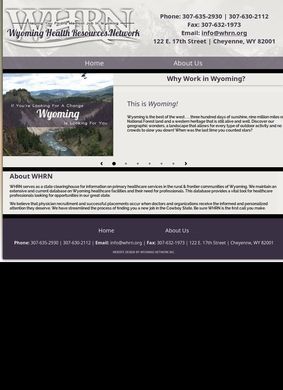
A clinic in a Wyoming town of nine hundred people loses its only physician to retirement, and the nearest replacement is an hour of highway in either direction. The administrator has no recruiting budget, no pipeline of candidates, and no time to cold-call residents who have never once considered practicing three hours from a city. That gap is the exact problem Wyoming Health Resources Network was built to close. WHRN is a nonprofit recruitment agency that matches healthcare professionals with jobs in the state's rural and frontier communities, and it does the matching free for everyone involved.
Free is the word that changes the whole calculation. A private physician recruiter can charge tens of thousands of dollars per placement, money a nine-hundred-person town simply does not have. Because WHRN is a 501(c)(3) funded largely by the Wyoming Office of Rural Health, that cost disappears for the clinic and for the clinician alike.
It has been doing this since 1995, which is a long run for a small nonprofit.
Wyoming's frontier counties, the ones with only a handful of residents per square mile, are among the hardest places in American medicine to keep staffed, and distance compounds every vacancy. A recruiter who understands that terrain is worth more than one who treats a rural post like any other listing. WHRN's whole reason to exist is that local specificity, and it is why a statewide, mission-driven agency can make placements a national job board would never manage.
Free help on both sides of a hire
The service is built around two audiences that need each other and routinely cannot find each other. On one side are physicians, nurse practitioners and other clinical staff who might be open to rural work. On the other are the clinics and facilities with empty posts and thin resources to fill them. WHRN sits in the middle, and the website is organized along that divide, with separate paths for job seekers and for employers.
Neither side pays for the matching, which is the detail that makes the whole arrangement work. A private staffing firm has to charge somebody, and in a market this small that cost would fall on either an already-stretched clinic or a clinician already taking a pay cut to work rurally. Removing the fee from both sides is less a marketing point than the precondition for the agency existing at all.
For job seekers and physicians
The Job Seekers and Current Job Openings sections are the starting point for a clinician. WHRN works across physicians, nurse practitioners and other clinical roles, and it describes its approach as matching candidates to openings that fit their own stated criteria, not steering everyone toward whatever happens to be vacant. For a nurse practitioner who wants rural practice but has no idea which Wyoming towns are hiring, that filtering is the real service. The Physician Needs section speaks more pointedly to doctors weighing a move, mapping where the shortages sit.
A job seeker also gets something easy to overlook: someone on the Wyoming end who already knows the facilities and can say what a posting is truly like, which counts for a lot when the choice is whether to uproot for a town the applicant has never set foot in. The process is meant to be low-friction: a candidate states what they want, and the matching happens on the agency's side.
For someone still in residency or juggling licensure across state lines, having that legwork handled by people who already know the Wyoming market removes a stage most job hunts dump straight onto the applicant.
For clinics and facilities
Employer Solutions is the mirror image, aimed at the clinics, hospitals and health centers doing the hiring. WHRN gives them no-cost recruitment support, which for a small rural facility without a human-resources department is a genuine subsidy rather than a courtesy. The agency keeps long-term relationships with healthcare organizations across the state, so it can operate as a standing pipeline instead of a one-off job posting that expires and is forgotten.
A hospital that fills a hard vacancy through WHRN has an obvious reason to come back the next time someone leaves. That repeat dynamic is probably how a small nonprofit has held on for nearly three decades: it becomes part of how its client facilities staff themselves.
The databases and the visa route
Two things lift WHRN above a generic job board, and both flow from its place inside Wyoming's rural-health infrastructure. Neither is something an individual clinic or a lone job seeker could easily arrange alone.
A listing in an ordinary business directory would show a name, a phone number and a service category, none of which explains why a rural hospital would call this particular agency instead of any other recruiter. What actually explains it sits underneath that surface, in the two arrangements described below.
WWAMI, WICHE and J-1 placements
WHRN provides access to the WWAMI and Wyoming WICHE professional databases, the regional medical-education and workforce programs that feed clinicians into the mountain West. A single rural clinic has no practical way to tap those pools on its own, and the agency is the point of access. It also handles J-1 visa placements, and it makes a specific, useful observation: Wyoming frequently has visa slots still open when higher-demand states have exhausted theirs.
For an international medical graduate who needs a J-1 waiver position in an underserved area to stay and practice, an available slot is the entire game, and an agency already fluent in the Wyoming waiver process strips out a great deal of the paperwork and the uncertainty. This is the corner of WHRN's offering that would be hardest for anyone to reproduce without it, and it is the strongest single reason a physician outside the state might pick up the phone.
The databases matter for a quieter reason too. They let the agency reach candidates before those clinicians ever list themselves publicly, which is how a thinly staffed clinic ends up in front of a physician it could never have found through open advertising alone.
What backs it, and what nobody outside can check
Judging an operation like this by consumer star ratings would miss the point, because that is not how a state-funded placement nonprofit builds trust. WHRN's credibility rests instead on where its money comes from. Funding through the Wyoming Office of Rural Health ties it to a public rural-health mission and to a degree of accountability that a private lead-generation site would never carry. The About section sets out the organization's purpose and history, and its people are not hidden behind a generic inbox.
Reaching the agency is easy, which counts in its favor. The Executive Director is named on the site, and a direct phone number, an email address, and a full contact page are all there. For a clinician deciding whether to trust someone with a career move, or an administrator handing over a hiring need, a named person and a working phone line make a real difference, since there is somebody specific to answer for the result.
That openness cuts both ways. A clinician trusting the agency with a relocation and a facility trusting it with a critical hire both need to know a real organization stands behind the promise, and the named leadership plus the public funding line give them that footing before a single call is made.
The weaker spot is independent verification. A search for reviews of WHRN returns almost nothing usable about this particular organization. Its own pages fill the results, and the WHRN acronym belongs to several unrelated bodies as well, a VA women's health research network, an Australian rural-health research group, and even a gene-nomenclature database, so an ordinary search dredges up material about outfits with no connection to Wyoming recruitment. No third-party ratings from placed clinicians or from client clinics surfaced at all.
None of that is damning on its own. A free, quiet, state-backed nonprofit is exactly the sort of organization people use and never think to review, and the missing Yelp entries say little about the quality of any given placement. It does, though, leave a prospective user leaning almost entirely on the funding pedigree and on the agency's own account of what it delivers.
That is the doubt worth carrying into any first phone call. WHRN makes a clean, plausible, well-funded case for itself, and its mission is one few people would dispute. What no visitor can confirm from the outside is whether the placements hold.
Whether the physician who takes the frontier post is still there in three years, whether a clinic that recruited through the agency came away satisfied enough to do it again, whether those long-term relationships produce filled positions or only repeated searches: on all of it, the single available source is the organization itself, and a job or a hire is a large thing to stake on one voice.