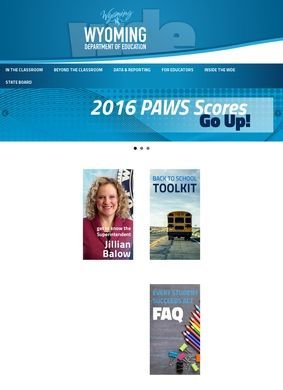
Hathaway Scholarship administration and the Wyoming Education Savings Account sit near the front of what this site handles, and that pairing says a lot about its range: one is a long-running merit and need aid program tied to ACT and WorkKeys results, the other a newer account-based mechanism for families choosing schooling outside the traditional public path. Both run through the Wyoming department of Education, the state's K-12 agency, and the site reads as the working hub for them, not a glossy front page.
Programs organized by audience
Most of the material is built around the day-to-day needs of distinct groups: parents, teachers, district administrators, students, and the taxpayers footing the bill. The Wyoming department of Education does not try to soften that breadth. Career and technical education sits next to assessment data, which sits next to nutrition programs, because all of it genuinely falls under one roof. I went in expecting the usual scattered state-agency layout and found the program areas at least grouped by who needs them, which helps. Navigation is built around audiences rather than internal departments, and the difference is noticeable.
Linking testing to scholarships
This section of the Wyoming department of Education touches a student's path out of high school directly. Career and technical education programming, ACT and WorkKeys testing coordination, and dual enrollment facilitation all live here. The connection to Hathaway is the practical thread: the scholarship leans on those same test scores and course records, and the department administers the program instead of merely describing it.
For a parent or a junior trying to map out what counts toward aid and what a CTE track actually leads to, having the testing logistics and the scholarship rules under the same authority cuts down on the usual runaround between offices. The detail is administrative, not promotional, which is the right register for this kind of work.
Dual enrollment gets its own footing too, so a student earning college credit while still in high school can trace the rules back to the state level instead of relying on a single counselor's reading of them. In a state with long distances between districts and uneven access to advisers, that clarity has practical value that a local resource often cannot provide.
Statewide data and reporting
The reporting side is where the Wyoming department of Education proves most useful for people who are not parents or teachers. Statewide assessment results, school and district accountability reports, content and academic standards, and accreditation oversight are all published here. Enrollment statistics, graduation rates, and per-pupil expenditure figures round it out, along with the federal reporting tools and public accountability dashboards that feed them.
Tracking district funding sources
That is a serious amount of data for anyone comparing districts, researching a move, or simply trying to understand where the money goes across Wyoming's 48 school districts. The Wyoming department of Education also handles the federal funding streams, Title I and IDEA among them, that flow to those districts, so the spending data and the program data come from the same source instead of being stitched together from outside estimates.
A school board candidate, a journalist, or a taxpayer with a pointed question can pull the numbers directly. The dashboards do the heavy lifting that would otherwise require a records request, and the standards documents spell out what students are expected to learn at each grade. It is dry reading, but the kind that does not fall apart when you go looking for the underlying source, which is more than can be said for third-party summaries of state education policy.
Beyond the data, the Wyoming department of Education posts media releases and strategic plan documents, plus a full staff and school-district directory. That directory is the quiet workhorse here: it lets someone find the right district contact without guessing, and a researcher can confirm who oversees what without submitting a records request. For anyone who has spent time with a generic business directory trying to locate a state official, the contrast is obvious.
Resources for parents and families
Parent-facing resources occupy their own substantial block. The Wyoming Education Savings Account program and broader school choice options sit alongside special education family supports, the National School Lunch and nutrition programs, and homeschooling guidance. A family weighing whether to homeschool, claim an ESA, or stay in their assigned public school can read the official rules for each in one place. The Wyoming department of Education treats these as parallel choices, each documented, instead of steering toward one.
School safety initiatives
Safety and wellness gets real attention, not a token page. The THRIVE mental health initiative, the federally funded Project AWARE grant program, and school threat assessment frameworks are all administered through the Wyoming department of Education. These are the kinds of programs that often hide inside a single district; pulling them to the state level means a counselor in a small town has the same framework to work from as one in a larger district.
Certification tools for educators
Teachers and administrators get a dedicated set of tools from the Wyoming department of Education: professional development programming, statewide educator conferences, teaching certification and licensure, and instructional resource libraries. Certification alone is a recurring headache for anyone entering or moving within the profession, so having the licensure process run through the state agency, with the conference and development calendar attached, keeps the bureaucratic side in one lane.
The resource libraries lean toward classroom use, the kind of material a teacher actually opens during planning. Paired with the certification path, the Wyoming department of Education covers both the credential and the craft, which is more than some state agencies bother to connect. An administrator running a district has the accreditation rules, the funding reporting, and the staff directory within reach of the same login.
Across all of it, the site behaves like an operational tool for a working K-12 system. The Hathaway pages, the ESA rules, the accountability dashboards, and the licensure process each answer to the legislature and to families, and the site structure reflects that accountability rather than obscuring it. The Wyoming department of Education spreads itself across a wide brief, from a kindergartner's lunch program to a graduating senior's scholarship file, and the site keeps those threads separate enough to follow. The numbers and the rules originate here, and the published record is thorough enough to verify that without having to take it on faith.