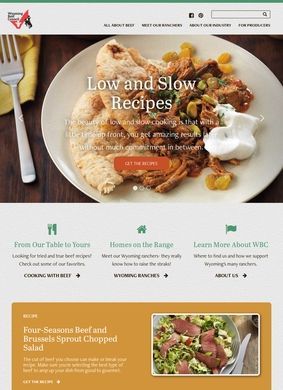
Producer checkoff dollars fund the Wyoming Beef Council, and the site that carries the organization's name is built around what those dollars produce rather than around the organization itself. That framing shapes everything: instead of a mission statement landing page, visitors get a kitchen reference with seasonal recipes, cut charts, trimming guides, and short instructional videos. The cooking content is organized around when people cook, a tailgating collection alongside the seasonal sets, which is a small but telling editorial choice. Most recipe sites index by dish type or ingredient and leave it there. Anchoring the collections to cooking occasions means the site is more likely to be useful at the moment someone actually needs it, instead of sitting as a reference someone bookmarks and forgets.
Cut charts and trimming guides
The cut charts and trimming guides do real work. They answer the quiet question of what a given cut is and how to handle it, the sort of thing a shopper standing at a meat case rarely has on hand. Most people leave a butcher counter with a vague sense they paid the right amount and no idea what to do next. Pairing those charts with short instructional videos makes sense, because knife work is genuinely hard to learn from a paragraph.
Beef basics and beef university
A chart tells a shopper where a cut sits on the animal and roughly how to cook it, and a short clip fills the gap a still image leaves open, the angle of the blade, the direction of the grain, the moment to stop trimming. Nutrition gets its own section too, extending into early-years dietary guidance, which is a more specific commitment than the usual single-page treatment. The Wyoming Beef Council organizes that material under two labels: "Beef Basics" for entry-level explanation and "Beef University" for the deeper content. The naming is a touch cute, but the structure underneath it is straightforward. Start simple, go further if you want the detail. A curious visitor can move from a basic cut chart into the nutritional science without leaving the site, and that range is wider than the surface recipe-destination impression suggests.
Profiling ranch families statewide
The "Wyoming Stories" section is the most local thing on the site. It profiles ranch families and operations whose checkoff contributions pay for everything else on the Wyoming Beef Council's pages, giving the organization a face beyond a logo. For a consumer visiting for a recipe, it is context. For the council, it is accountability: here is who funds this, here is who they are. Recipes and cut charts are useful wherever they come from, but the producer profiles tie the site to the state in a way the cooking content alone cannot.
Trade tools for industry buyers
A large block of the site points at a second audience entirely. Publications, wholesale price updates, foodservice inspiration, and retail insights are not aimed at a home cook deciding what to make for dinner. They speak to buyers, distributors, and people working the supply chain who need current numbers and trade-level material.
Checkoff transparency measures
The Wyoming Beef Council keeps this content visible rather than buried, and that makes the dual mission easy to read at a glance. Transparency about the checkoff itself is handled the same way: the site explains how the mandated assessment dollars are used, references the national Beef Checkoff coordination structure, and posts board vacancy opportunities so the producers funding the operation can step into governing it. That combination, accounting for the money alongside an invitation to participate in decisions, gives the Wyoming Beef Council real credibility with the rancher audience it cannot afford to alienate. An organization collecting a mandatory assessment had better show its work, and this one does.
Why is there no rating trail?
No aggregated public ratings turned up for the Wyoming Beef Council, which is about what you would expect from a commodity promotion board with a mandatory funding base. It does not compete for reviews the way a commercial service does, and the absence of a rating trail is not a credibility gap here.
Balancing two different audiences
The published material holds up on its own terms: the cooking resources are genuinely usable, the early-years dietary guidance goes further than the category usually bothers to, and the checkoff accounting is transparent enough to follow. The Wyoming Beef Council manages the split between consumer reference and industry resource better than the site's plain appearance implies, and the Wyoming Beef Council producer content, taken on its own, reads as an honest account of who pays for what and why. Worth returning to once you know what is actually in there, because the first pass at the homepage undersells it.