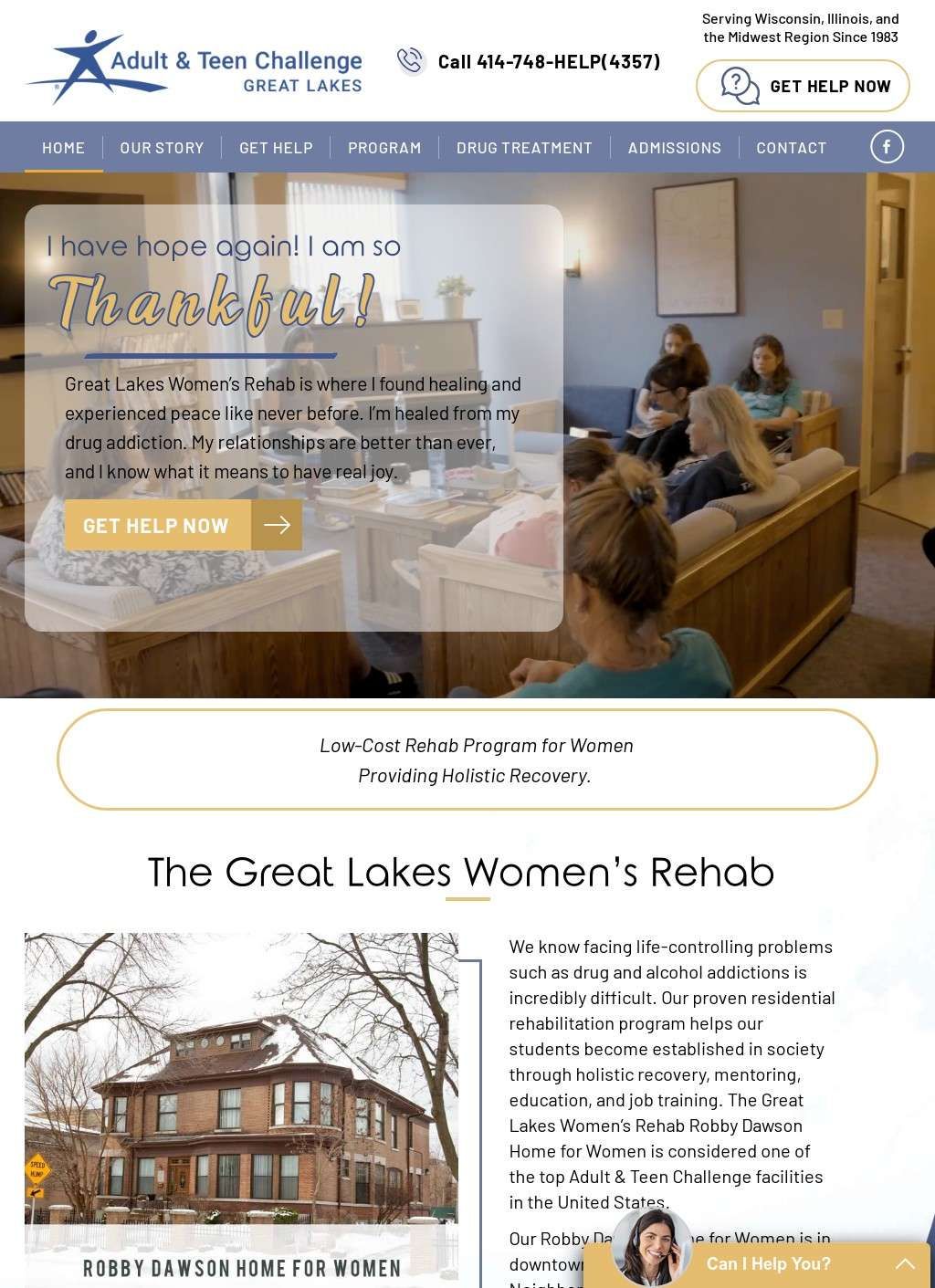
Sitting at 727 North 31st Street in Milwaukee, the Robby Dawson Home for Women runs a program that lasts a full twelve months, and that length alone tells you most of what you need to know. Weekend detox and 30-day stays send people back out before the hard part starts. Great Lakes Adult & Teen Challenge built the women's side of its work around a year of residential treatment for adult women dealing with substance abuse and the patterns that tend to come with it. That commitment to duration separates Great Lakes Adult & Teen Challenge from a lot of what gets advertised under "rehab" and shapes everything else the program does.
Twelve-month residential treatment for women
The approach is openly Christ-centered. Daily devotionals, spiritual guidance, and a faith-based curriculum form the spine of the program, and the site does not soften or hide that. The candor here is worthwhile, because a woman considering a year of residential care deserves to know upfront whether a religious framework fits her or not. Some readers will find that orientation exactly right; others will know immediately it is not for them. Either way, Great Lakes Adult & Teen Challenge states it plainly on its main page, and that honesty is worth crediting.
Faith-based curriculum and spiritual guidance
Beyond the spiritual core, Great Lakes Adult & Teen Challenge offers a practical set of services: individual and group counseling, life skills and vocational training, relapse prevention education, mentorship, and what the site describes as community-based accountability. The vocational and life-skills piece is the more grounded part of the offering. Recovery that ends at the door of the facility tends not to hold, and training someone toward employable skills and daily structure gives a person somewhere to stand once the program ends. Mentorship and ongoing accountability fill a similar role, extending support past the counseling hours and into the slower work of rebuilding a routine. None of it is exotic, and that is more or less the point: these are proven components assembled into a long enough stretch of time to let them take hold.
Counseling, training, mentorship services
Women served come mainly from Wisconsin, Illinois, and the wider Midwest, which fits a Milwaukee-based residence drawing from its own region. The focus is narrow on purpose: adult women, long-term care, substance abuse and what the organization calls life-controlling issues. Great Lakes Adult & Teen Challenge also runs a separate men's program under the same parent organization, so the two populations are handled distinctly. A woman entering the Robby Dawson Home is not sharing space with a coed caseload, which removes a complication many mixed facilities carry.
Vocational skills for life after treatment
Cost is the other piece that will matter to many families. Great Lakes Adult & Teen Challenge runs as a nonprofit funded by donations and presents itself as a low-cost alternative to conventional treatment, an unusual position in a field where the price of care often climbs into territory that closes the door before treatment even begins. For anyone who has priced out private addiction care, the gap between that and a donor-funded program can be enormous. No exact figure is published, but the funding model is the relevant fact and the site is direct about it.
Women from Wisconsin, Illinois, Midwest region
Longevity is part of the picture too. Great Lakes Adult & Teen Challenge has been operating since 1983, a long stretch for any treatment program, religious or secular. Decades of continuous operation do not guarantee outcomes for any individual, but they do mean this is an established operation with a long record behind it, not a program that opened last year and has yet to prove anything. For a field where programs open and close with some frequency, that track record is a reasonable thing to weigh.
Nonprofit funding model keeps costs low
On the practical question of reaching them, the site does well. The phone number, 414-748-HELP, is exactly the sort of memorable line a person in crisis can hold onto, and an intake email and the physical street address both sit in plain view. A person can find where the place is without working through menus or filling out a form first. For a program whose first contact is often a frightened family member or a woman at a low point, that visibility is more than a convenience; it is part of doing the job properly.
Operating since 1983 with established record
Independent assessments of the program land in moderate territory. Recovered.org assigns it a Trustscore of about 3.69, drawn from a blend of user reviews and accreditations, which lands in respectable-but-not-glowing territory. A Yelp listing exists under the Great Lakes Adult & Teen Challenge name, though the review tally was not available. The facility also turns up on Addiction Resource, Rehabs.com, Drugabuse.com, and Reachrecovere.com as a recognized provider, which is meaningful: those directories tend to vet what they list, and appearing across several of them puts Great Lakes Adult & Teen Challenge among known regional providers instead of unverified names.
Easy contact through phone, email, address
Graduate testimonials appear on the affiliated greatlakesmensrehab.com and greatlakesatc.com sites. Testimonials published by an organization about itself carry the obvious limits, and a careful reader should treat them as encouraging without mistaking them for independent proof. They are worth reading for the texture of individual stories, but the third-party listings and the Recovered.org score are the steadier evidence of how Great Lakes Adult & Teen Challenge is regarded from outside its own pages.
From third-party directories and moderate ratings
Put together, the case for Great Lakes Adult & Teen Challenge is fairly coherent. A year of structured residential care, a clearly stated faith foundation, practical training alongside the spiritual work, a donor-funded model, and a history running back to 1983: these are what Great Lakes Adult & Teen Challenge has going for it. The accreditations and the moderate Trustscore back that up without overselling it. The one thing a prospective resident should sit with is the religious framing, which is central and non-negotiable, and the absence of published pricing or hard outcome data. A family doing its homework will want to call and ask directly about completion rates and what the year looks like day to day, since the published material stops short of those specifics. The phone number is easy to find, and that makes asking straightforward.