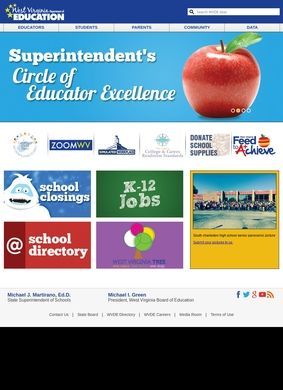
The West Virginia Department of Education keeps a public School Directory and Closings feed, the page a parent pulls up at six in the morning when the roads ice over. It is a small, practical utility sitting on a very large official site, and it points straight at who the whole thing is built for: students, families, educators, districts, and administrators across the state. A tool that mundane and that useful tells you more about the site's purpose than any mission statement would.
This is the official state government home of public education in West Virginia, and the navigation is arranged the way a government org chart is. Everything sorts by function into a handful of broad areas, and each area opens into long lists of programs, policies, and offices. A first visit can feel like reading a table of contents, but the depth underneath holds together, and most of what a school employee or a parent would come looking for has a named, findable home somewhere in the structure.
Academics, from content standards to the virtual school
The Academics area is the core of the site. It holds Content Standards and Policies, Assessment, and the grade-band pages for early, elementary, middle, and secondary education, alongside Special Education, Adult Education, and International Education. There is a School Choice section, a Virtual School, published School Calendars, and CareerTechWV for the state's career and technical pathways, plus Awards and Recognition and the Common Ground Partnership. It is a wide spread that tries to cover every age and every route through the system in one place.
Most of these pages are not things a casual visitor reads for pleasure. They are working reference material: the standards a teacher plans lessons against, the assessment windows a principal schedules around, the calendar a district formally adopts. Depth matters more here than polish, and on that measure the West Virginia Department of Education stocks the shelves fairly deep. The material is aimed at people who need to be precise, and it treats them as such.
The Virtual School and CareerTechWV are the two pieces I would steer a specific family toward, because they answer concrete questions: how a student takes a course the local building does not offer, and where the vocational tracks actually lead after graduation. A School Choice section in the same area gives families a starting point for the enrollment options open to them, which is exactly the kind of question that sends a parent to a state site in the first place.
Student support and wellness
Running parallel to academics is a Student Support and Wellness area that reaches well outside the classroom. Child Nutrition, School Safety, and mental, behavioral, and physical health programs live here, together with the 21st Century Community Learning Centers, Communities In Schools, and Engaging Families WV. There are ESEA programs, a Super STARS Council, and a dedicated line for students experiencing homelessness.
Grouped this way, the section shows the West Virginia Department of Education acting as far more than a curriculum office. A child who is hungry, unhoused, or unsafe does not learn well, and giving those concerns their own labeled programs signals that the agency treats them as part of the core job. It is one of the more genuinely useful corners of the site for a family in a tight spot, and it is where a school counselor or a social worker would likely start.
The machinery behind the classroom
A state education agency is also an employer, a data operation, and a bureaucracy, and the West Virginia Department of Education does not hide any of that.
Educator and Staff Development is the recruiting and training engine. Become a Teacher and Certification manage the pipeline into the profession, while Professional Teaching Standards, Educator Preparation Policies, the Professional Learning Framework, E-Learning for Educators, Conferences, and the Technical Assistance Centers cover keeping people current once they are in the classroom.
There is even a section on artificial intelligence in education, a topical addition many state agencies have been slower to put in writing, and its presence suggests the West Virginia Department of Education is trying to get ahead of a question every district is now fielding from teachers and parents alike.
The Divisions and Offices area is the org chart made clickable. It holds an Employee Directory and a Division Directory, the State Superintendent of Schools, and the West Virginia Board of Education, along with the WV Schools for the Deaf and the Blind and the WV Schools of Diversion and Transition, institutions the West Virginia Department of Education operates directly rather than through a county district.
About Us then collects the back-office functions: Finance, Purchasing, Legal Services, Communications, School Facilities, School Transportation, Infrastructure and Network Operations, the Strategic Plan, and the WV Tiered System of Support. It is the unglamorous half of running a school system, laid out for anyone who needs to find it.
Data and school improvement
The Data and School Improvement area is where the West Virginia Department of Education shows its accountability side. Accountability itself, Systems of Support and Improvement, Leadership Support, and Educator Evaluation sit next to Education Data, Special Education public reporting, and the governance pieces: Data Privacy and Security, Inter-Agency Data Agreements, and WVEIS, the West Virginia Education Information System that ties district records together across the state.
For a superintendent, a school board member, or a researcher, this is the corner worth bookmarking. Public reporting and education data are what let an outsider check how a district is actually performing, and the West Virginia Department of Education puts those in a clearly named place instead of scattering them across press releases. Data Privacy and Security getting its own listing, next to the reporting it governs, is an honest touch given how much student information a system like this holds and how much scrutiny that data now draws.
Everyday tasks stay close to the surface, too. The top-level utility links keep Events, News, Careers, the School Directory and Closings, and an Employee Portal for staff one click from the front page, so the routine reasons a person visits the West Virginia Department of Education do not require digging through the deeper policy trees. It is a sensible piece of design on a site that could easily have buried them.
It is a big site because it is a big job, and the structure mostly justifies its scale. A West Virginia school figure chased through a district page or some third-party aggregator is usually sitting on the West Virginia Department of Education site already, filed under whichever office owns it.