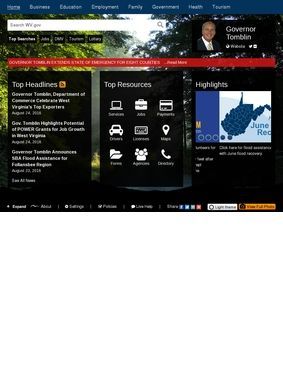
Where does a West Virginian go to renew a driver's license, register to vote, or buy a hunting license without bouncing between a dozen unrelated agency websites? WV.gov is built to be that single front door. It pulls the state's online business under four headings (Business, Education, Government, and Tourism) and pushes the most common self-service tasks up where people can reach them quickly. The driver's license renewal, vehicle registration renewal, voter registration, and hunting and fishing license purchases all sit within a click or two of the homepage, which is the right call for a portal that most people open with one specific errand in mind.
A single entry point for state services
That practical bent is the strongest thing about the site. A lot of government portals treat the homepage as a press-release wall and bury the tasks people came for. WV.gov leads with the errands instead. For someone who just needs to sort out a tab renewal before a road trip, that ordering saves real frustration.
Who uses WV.gov
The short answer is almost everyone who deals with the state in any capacity. Residents handling personal paperwork are the obvious audience, but WV.gov also points job seekers toward a search portal powered by JobCase, and it hands entrepreneurs a business formation resource center for anyone working through the steps of starting a company in West Virginia. That spread means a college student looking for work and a small-business owner filing formation paperwork can both start from WV.gov, even though their paths diverge almost immediately.
Internal and external audiences
Beyond individuals, the portal also speaks to state employees and agencies themselves, which is a quieter but important role. A government site has to function as internal infrastructure as much as a public face, and the agency-facing material here suggests WV.gov is trying to do both jobs from one address. Drivers, voters, hunters, and anglers each get their own clear entry point, so the site does not assume every visitor is there for the same reason.
Clear categories and constitutional offices
One thing I appreciate is that the categories on WV.gov are concrete tasks and audiences instead of vague departmental jargon. Business, Education, Government, Tourism: a newcomer to the state can read those four words and immediately guess which one holds what they need. That kind of plain labeling is underrated on official sites, where the organizing logic often mirrors the bureaucracy instead of the citizen.
The homepage also surfaces direct links to eight major constitutional offices and branches: the Governor's Office, the Secretary of State, the Attorney General, the State Treasurer, the State Auditor, the Legislature, the Judiciary, and Veterans Assistance. Putting all three branches of government plus the elected statewide officers on one screen gives WV.gov a genuine civic-reference value. If you are trying to figure out which office handles a particular concern, that lineup orients you fast.
Complete agency directory
Past the headline tasks, WV.gov keeps a fuller directory underneath. An alphabetical agency directory covers all state departments and boards, which matters because the eight marquee offices are only the visible tip. Most real government interactions involve some board, commission, or department that never makes a homepage. An A-to-Z listing is the unglamorous feature that turns a portal from a brochure into a usable reference, and it is good to see WV.gov include it instead of leaving it out for the sake of a cleaner front page.
News feed, tourism partnerships, support
WV.gov also runs a state news feed branded "daily304" that collects government announcements and opportunities. For a portal, a news stream is a sensible way to keep the page from going stale and to flag deadlines, programs, or openings that residents would otherwise miss. Whether it stays genuinely current is the kind of thing only repeat visits would tell you, but the inclusion is reasonable.
Tourism handled through wvtourism.com
Tourism is handled a little differently. Instead of building out a full travel section inside the portal, WV.gov leans on a partnership with wvtourism.com for that material. That is a defensible division of labor, since a dedicated tourism site can do photography and trip planning better than a general portal ever would. The trade-off is that a visitor chasing tourism content gets handed off to another property, which is fine as long as the seam between the two is smooth.
Help center with live chat
For people who get stuck, WV.gov runs a help center offering live chat support alongside FAQs. Live chat is more than most state portals bother with, and pairing it with a standard FAQ set means quick questions and stranger ones both have a route. On a site whose whole purpose is to move people through transactions, having a human-assisted fallback is a meaningful detail rather than a cosmetic one.
Taken as a whole, WV.gov reads like a portal that knows its job is routing more than dwelling. It collects the transactions people repeat (renewals, registrations, licenses), the offices they occasionally need to find, the agencies they rarely think about until they must, and a news layer to keep things moving. The architecture is task-first and audience-first, and that is the correct instinct for this kind of resource. The aggregation across business, education, government, and tourism means a single bookmark can replace a folder of scattered agency links.
What limits exist in portal design?
There are limits worth naming. A portal is only as good as the destinations it sends you to, and aggregation can mask uneven quality once you click through to an individual agency or to the JobCase-powered job search. The driver's license and registration renewals depend on the systems behind them working smoothly, and a clean front page cannot guarantee a clean checkout three pages deep. The tourism handoff to a separate site, while sensible, also means WV.gov cannot fully own that part of the experience. None of this is a flaw in the portal's design so much as the inherent ceiling of any hub that stitches together other people's services.
Downstream experience depends on linked systems
My verdict is positive but measured. As a one-stop entry point for state services, WV.gov does the important things right: it foregrounds the common tasks, keeps a complete agency directory rather than only the flashy offices, offers live help, and labels its sections in language a regular person understands. It is built around what residents, job seekers, business owners, drivers, voters, and hunters and anglers actually come to do, and the constitutional-offices lineup gives it real reference weight on top of the transactional stuff. The honest caveat is that the experience downstream of the homepage will vary with the individual systems it links to, and the tourism content lives elsewhere.
For anyone needing to interact with West Virginia state government, though, this is the sensible place to start, and a noticeably more usable one than the agency-by-agency hunt it replaces. WV.gov earns a confident recommendation as the front door, with the routine reminder that the rooms behind it are run by different hands.